
Marco Sousa: Atlântico Expresso, August 14, 2017
Translated into English by Katharine F. Baker
A retired professor who taught at the University of the Azores, Urbano Bettencourt devotes particular attention to islander literature, on which he has given presentations at conferences in Cape Verde, Madeira, the Canary Islands and the Azores. He has also collaborated on magazines devoted to this specialty, at home and abroad. This week we get to know a bit about the life of this educator and writer, who also served in the Portuguese military in the African colonial war.
Manuel Urbano Bettencourt Machado, age 67 (now he is 75), was born in Piedade in the Concelho of Lajes on the island of Pico in 1949.
In the realm of short stories and poetry, he has published eleven books: Raiz de mágoa (Setúbal, 1972); Ilhas, with J. H. Santos Barros (Lisbon, 1976); Marinheiro com residência fixa (Lisbon, 1980); Naufrágios Inscrições (Ponta Delgada, 1987); Algumas das Cidades (Angra do Heroísmo, 1995); Lugares sombras e afectos, illus. Seixas Peixoto (Figueira da Foz, 2005); Santo Amaro Sobre o Mar, illus. Alberto Péssimo (Arganil, 2005); Antero, illus. Alberto Péssimo (Arganil, 2006); Que paisagem Apagarás (Ponta Delgada, 2010); África: frente e verso (Ponta Delgada, 2012); Outros nomes, outras guerras (Lajes do Pico, 2013).
In discussing works he has published dealing with the colonial war, our interviewee states that “the war and its influences are already present in my short 1972 book, published when I was about to depart for Guinea-Bissau’s marshes. After that, they appear throughout my books in a general way, in some cases directly and at length, in others more obliquely and briefly. I would say the war influenced my writing, not always with deliberate purpose or intent, but as the result of an inner impulse incapable of being controlled rationally. War, for those who have gone through it, is the type of wound that Herbert Pagani said is held secret and intimate, but keeps on bleeding.
“In África: frente e verso, I assembled all the texts on the war that I had published so far. But in my next book I included a new poem about the war, about the anguished memory that bubbles up at the most unexpected moments and in a place as unlikely as Porto.”
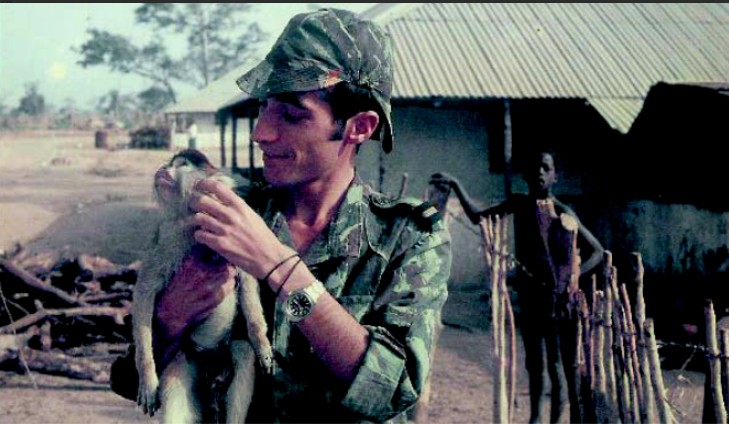
Since few people know that Urbano Bettencourt served in Guinea-Bissau, we urged him to tell a little about his experiences and what areas he was in.
“I traveled through the interior of the Oio region between Encheia and Bissorã – the first seven months in the company formed at Évora, the remaining seventeen months in a company of Guinea-Bissau soldiers with whom I learned a lot in the best and worst moments. But, compared to other young men my age who did their military duty literally in foxholes along the border zone, I think I was very lucky. But I don’t much like talking about it outside the confines of writing, where it’s possible to control things, organize them and give them a distance that allows me some inner resolution.”
For the record, it should be noted that Guinea-Bissau’s war of independence began on January 23, 1963, with the start of guerrilla actions in the sector of Tite. By then, Portuguese forces had already been fighting in Angola for almost two years, with relative success.
Changing the subject, when asked to explain how he defines the dividing line that separates fiction from fact, Urbano replied, “I don’t know if it’s possible to establish a zone of separation between the two categories. If all writing is autobiographical, then it’s also certain that it shuffles, shifts and transfigures the data of personal experience, so here not everything that seems actually is, either. There are many factors external to experience itself that trigger a text by association of ideas, similarity of situations, even the suggestion of another text. Perhaps my most autobiographical African text is the narrative titled Noite [Night], which is at the same time the one in which fiction processes intervened the most.”
Upon his return to the Azores, Urbano encountered a new environment. “My hardships were fundamentally those of anyone who needs to work in order to survive in a new and unstable situation like that of August 1974. I spent two months on Pico, then in October I went to Lisbon. I’d spent two years intellectually deteriorating, and had survived thanks in large part to the books and newspapers that my friend José Henrique Santos Barros would send me, but I needed to revive myself somewhere. I went to Lisbon and Setúbal: I worked and studied, I began teaching, and after ten years I returned to the Azores, specifically to São Miguel.”
After graduating in Philosophy from the Seminary in Angra do Heroísmo, Urbano Bettencourt earned a degree in Romance Philology (“a major now extinct in Portugal”) at the University of Lisbon. “Later I finished my doctorate at the University of the Azores, while serving as an instructor there. Earlier I also taught school on the south shore of the Tagus River on the mainland, and in Ponta Delgada and Lagoa, São Miguel. But what I found hardest was growing aware of my increasing inner disenchantment and having to make an effort to overcome it day-to-day. The education system today is programmed to grind teachers down, to transform them into bureaucrats in service of educational trends imposed by successive tenants of the Education Ministry.”
In closing, we couldn’t let the opportunity pass to ask Urbano Bettencourt what he does in his spare time, when he can’t go to Pico. His answer was interesting. “Happily, there’s a great big world beyond Pico and the Azores. I like music and books, I have my family life, I like writing, and I enjoy movies, although now I’m reduced to home viewing because theaters in Ponta Delgada have become wastelands, at least for those of us who want to see serious films. Now I’ve gone to Pico more often, but on São Miguel there are other things to explore. And Porto has become one of my favorite places, from which you can access many other locales.”
Originally published 14 Aug 2017 as “Urbano Bettencourt: O professor e o escritor. ‘A guerra’ colonial ‘contaminou a minha escrita’” in Atlântico Expresso. Reproduced at:
The translator gratefully acknowledges the assistance of Emanuel Melo in reviewing this manuscript.
Katharine F. Baker is a translator with extensive experience in translating Azorean literature from Portuguese to English.
 Filamentos (artes e letras)