
There are filaments that do not break when stretched across oceans; they learn instead how to conduct light. They carry memories such salt carries luminosity, the way wind carries a voice long after the speaker has vanished from sight. Filamentos exists in that luminous tension. It is not merely a platform of arts and letters, but a living network of transmission—where poems become bridges, paintings become tides, and essays trace invisible routes between islands and continents. As Vitorino Nemésio reminded us with disarming clarity, an island is a way of inhabiting the world. Filamentos takes that idea seriously, extending it across water, time, and language.
From the Azores and Madeira outward—across the United States, Canada, Bermuda, and the wider Lusophone world—Filamentos has become a space where creation does not migrate; it circulates. It returns altered, carrying with it the echo of departure and the intelligence of return. The islands, so often imagined as margins, reveal themselves here as sources—places where the world is not reduced, but concentrated. In this sense, Filamentos embodies Álamo Oliveira’s recurring insight that the island is not an endpoint, but a condition of passage. Writing from the edge becomes a way of seeing more clearly—not less.
Since its quiet beginning in July 2023, Filamentos has grown not by acceleration, but by listening. What began with 146 posts expanded to 472 in 2024 and reached 923 publications in 2025, accompanied by an extraordinary expansion of language itself—from 116,907 words to nearly 793,000 words in just over two years. These figures do not mark accumulation, but commitment. Each poem, essay, review, and visual meditation adds a strand to an ever-thickening weave. Together, they form a living archive of the present—one that refuses to reduce the islands to memory alone and instead insists on their ongoing creative force.
The strength of Filamentos lies in its plural architecture. Its recurring segments—In the Silence of Hydrangeas, Whispers of the Atlantic, The Azorean West, Salt Lines: Cartographies of Return, Roots and Wings, The Tenth Island, The Incandescent Muse, The House of Many Shores, The Second Voice of the Sea—are not editorial categories but currents of belonging. Each traces a different route: exile and return, inheritance and rupture, translation and survival, landscape and voice. Visual art converses with poetry; literary criticism stands beside children’s literature; new novels appear alongside meditations on theatre, painting, and memory. This crossing of genres mirrors the islands themselves, places where land and sea are never separate, where identity is always formed at the boundary.
Crucially, Filamentos is bilingual by design. Some works arrive in Portuguese, others in English, and many live between the two through translation and dialogue. This is not a compromise but a philosophy. Language here is not a border; it is a vessel. Natália Correia’s insistence that the world remains unfinished without the word resonates deeply in this project. Translation becomes, therefore, an ethical act: not merely the transfer of meaning, but the continuation of presence across generations and geographies.
For second-, third-, fourth-, and fifth-generation readers—especially in regions where emigration from the Azores and Madeira has long ceased—this bilingualism opens a path beyond folklore. It allows them to encounter the islands not as nostalgic symbols, but as living intellectual territories: places of debate, dissent, and imagination. In this sense, Filamentos aligns with Vamberto Freitas’s critical warning that culture risks impoverishment when it is reduced to decorative identity or symbolic heritage. Here, literature and art are treated not as adornment, but as forms of thinking—tools for engaging the present with rigor and responsibility.
The reach of Filamentos confirms this living exchange. Read across the United States, Portugal, Canada, Brazil, Ireland, Scandinavia, Western Europe, Australia, and beyond—across cities such as Tulare, Fall River, Providence, Lisbon, Ponta Delgada, Angra do Heroísmo, Horta, Funchal, Toronto, Dublin, Fresno, Newark, Boston, Los Angeles, San Francisco, San Jose, Seattle, Vancouver, and Honolulu, among others—the platform forms an archipelago of attention. What emerges is not dispersion as loss, but dispersion as resonance: a dispersed territory animated by shared curiosity and ethical attention.
That dispersion, as Emanuel Félix has suggested in his reflections on island writing and diaspora consciousness, is not a sign of fragmentation but of relational geography—a way of belonging that exists simultaneously in many places, sustained by shared pulse rather than fixed borders. Filamentos gives that dispersed territory form and voice, allowing distance to become a condition of connection rather than erasure. That distance itself becomes a form of knowledge. As João Carlos Abreu has suggested in his poetry and essays, the sea does not simply separate island from diaspora; it teaches awareness—of space, of longing, of the effort required to remain connected. Filamentos transforms that learned distance into dialogue, allowing separation to become a condition for reflection rather than silence.
As a pedagogical instrument, Filamentos has found a home in classrooms and communities alike. Through the Portuguese Beyond Borders Institute (PBBI) at California State University, Fresno, it functions as a living syllabus—used in language, literature, and cultural studies courses to teach the Azores and Madeira as contemporary, evolving cultures. Students encounter not a closed canon but a breathing one—where established voices stand beside emerging writers finding their first public cadence. The past does not overshadow the present here; it illuminates it.
Perhaps most urgently, Filamentos dismantles a persistent myth: that the islands are culturally marginal, poor, or silent. By abundance—and by excellence—it reveals the opposite. The Azores, in particular, are often cited as having one of the highest concentrations of published writers per capita in the Lusophone world. Making this visible matters deeply for the diaspora. It reshapes how island heritage is understood in mainstream America and Canada, replacing caricature with complexity, silence with voice, absence with creation.
This work has been made possible through trust and solidarity. We extend our deepest gratitude to the Luso-American Development Foundation (FLAD) for its essential support in creating and sustaining Filamentos, and to the Luso-American Education Foundation for supporting Filamentos and other cultural initiatives of PBBI. Their commitment affirms a central conviction of this project: that culture is never a luxury, but a responsibility.
In the end, Filamentos is neither archive nor destination, but passage. It is the place where words become tides, where art learns how to cross, where belonging is practiced rather than proclaimed. The Azorean experience in America—so often misunderstood as loss or dilution—reveals instead a deeper continuity. Identity, as Onésimo Almeida has taught us, survives not by remaining intact, but by learning how to speak again in another place. That lesson echoes through every poem, essay, and image gathered here. Across the long distances of the Atlantic, Filamentos affirms that culture does not vanish when it moves; it transforms, and in doing so, endures. These filaments—of language, memory, and imagination—stretch from island to continent, from elder to youth, from silence to voice. And as long as they are tended, the diaspora will not drift. It will remain—thinking itself forward, inhabiting the world anew.
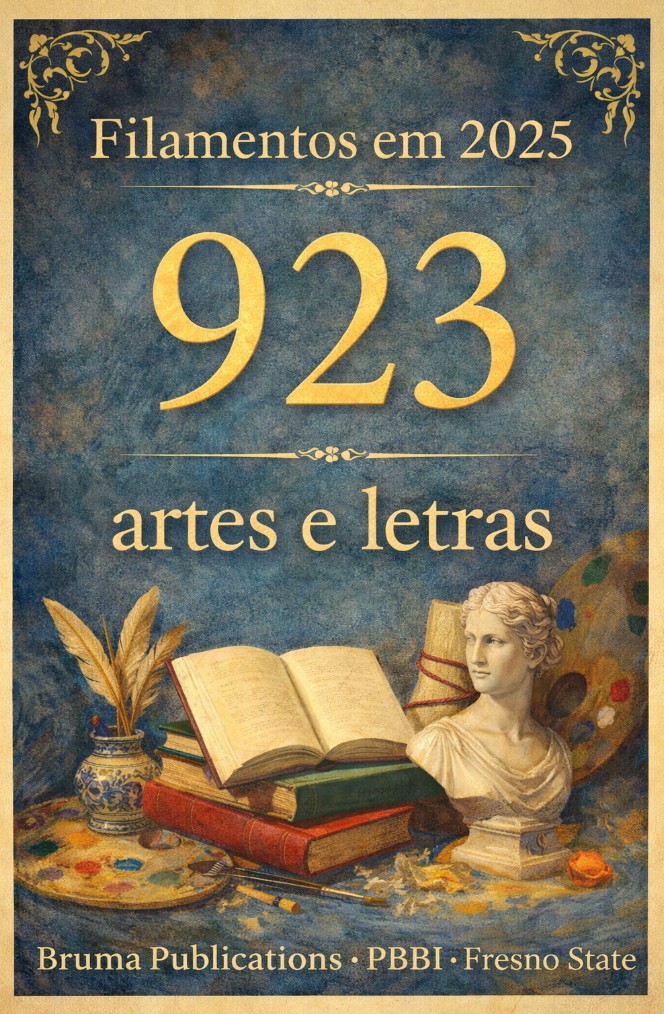
 Filamentos (artes e letras)