
Where islands dream, and stories cross oceans.
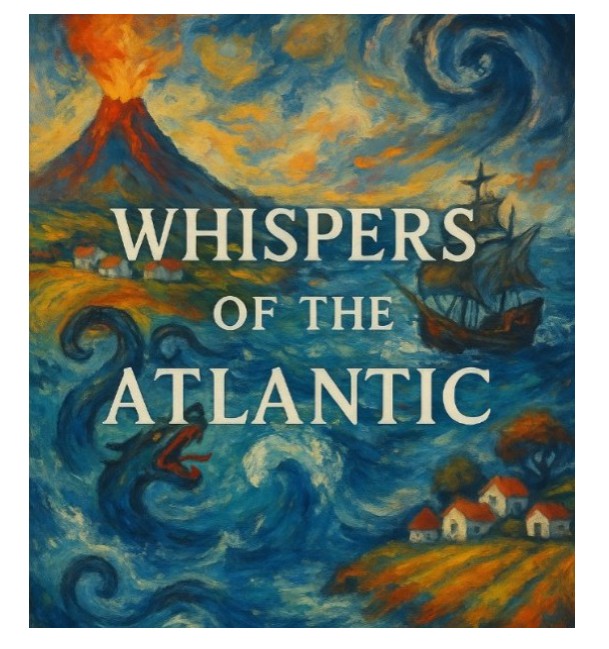
From the volcanic heart of the Atlantic, tales have risen through centuries—stories whispered around hearths, sung in work songs, carried on the wind across nine islands. Whispers of the Atlantic: Legends from the Azores gathers these timeless narratives and brings them into English, offering readers a journey through the enchanted archipelago where myth and memory intertwine. Giants, saints, sailors, and dreamers live side by side with the sea, the volcano, and the hydrangea. These are not only legends of the past; they are living echoes of a people who have always dwelled between fire and water, exile and belonging, homeland and diaspora.
The Legend of “Go with the Devil”
Long ago, there lived a woman of very modest means in the village of Guadalupe. One of her daughters was due to be married in just a few days. Preparations were underway: bread was being baked, sweets were made, meats were roasted, and everything was readied for a traditional wedding held at home, as was customary in those days.
With all these tasks, the poor woman had already spent more money than her limited means allowed. When an important ingredient for the wedding was found to be missing, the daughter went to her mother to ask for more money to buy it. Exhausted by so many expenses, half annoyed and half furious, the mother turned to her daughter and said, “Go with the Devil, girl—you’re taking everything I have!”
It was a moment of frustration, and no one paid much attention to those words. However, when the girl did not return from buying the ingredient, people began to find it strange. They set out to look for her but could not find her nearby or along the paths she should have taken.
All the neighbors of Guadalupe were alerted and began searching everywhere: from house to house, at the harbor, at the fountains, at the groom’s home—where he also joined in the search—at the mills, barns, and every place imaginable.
When the search within the village proved unsuccessful, they expanded it to the pastures and the mountains. Near a place called Caldeirinha, they found what appeared to be the first clues. With hope of finding the girl, they quickly descended the dangerous path that leads to the rounded opening descending into the depths of the caldera—and, according to the people of Graciosa, who knows where else beyond…
On the way down, they found the girl’s rubber boots resting on a rock, which dispelled all doubts. If she was not there, she had to be nearby. If she was not in plain sight, then she could only be inside the Caldeirinha. They returned to the village to fetch ropes strong enough to bear a person’s weight, and tying them around his waist, the groom descended in search of his beloved.
Everyone was anxious, as many believed the caldera to be one of the entrances to Hell. Full of fear, the groom slowly descended through the narrow opening of the caldera—a dark and terrifying hole. At the bottom, he found the girl. She was trembling with fear, her expression vacant and dazed. He tied her to the ropes they had brought, and both were pulled up by the people who had remained outside the caldera.
They had found her—alive and unharmed—and the wedding could go on. When they asked the girl what had happened and how she had ended up there, she simply did not know. It was then that the mother remembered the blasphemy she had uttered when she sent her daughter to the Devil—who, people believe, is always in search of souls to take to Hell. He wasted no time and had taken her at once, hiding her in the depths of the Caldeirinha.
The Legend of Vai-te com o Diabo (“Go with the Devil”) is an oral tradition from the island of Graciosa, in the Azores. It reflects the fears and beliefs of a superstitious people, still deeply connected to mysticism and the occult.
Bibliography
FURTADO-BRUM, Ângela. Açores, Lendas e Outras Histórias (2a. ed).. Ponta Delgada: Ribeiro & Caravana Editores, 1999. ISBN 972-97803-3-1 p. 169.
 Filamentos (artes e letras)