
God is an impure particle of dark matter
wandering in the impudent energy
that floods the galaxies of poetry (p. 11).
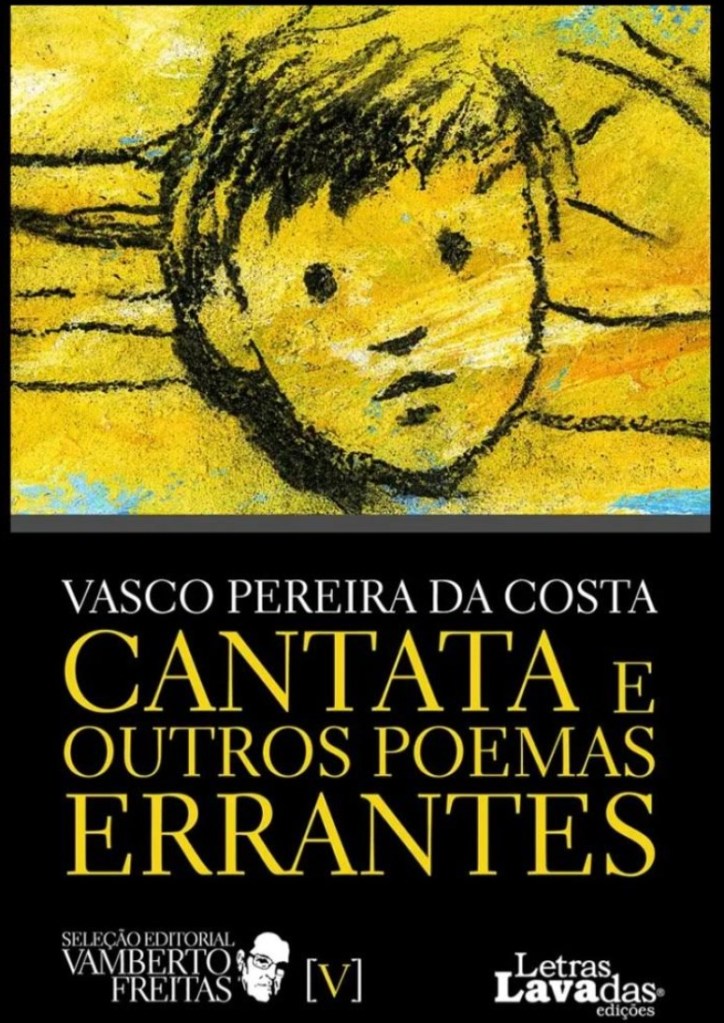
A poet of acute sensitivity and estimable sensory resources, a subtle pursuer of realities both visible and invisible, Vasco Pereira da Costa continues climbing upward and onward. Cantata e Outros Poemas Errantes [Cantata and Other Poems of Wandering] (Letras Lavadas Edições, 2025) is his most recent book, in which the grain of the poet’s voice (as Roland Barthes described the “body in the voice”) is heard in the vocal, sonorous, smooth, cantabile element of the words — Vasco is heir to an oral tradition — that is, in the musicality of his open vowels, always accurate tonics, and careful prosody:
The ships of my corsair hands
sail the hot coves of your hips (p. 60).
Rich in evocative depth, this is a book of impressions, itineraries, vibrations, memories that jump around, and shared affections. Away from his island, the poet returns to it through the retroactive effects of memory. He carries the lost and mythologized island, making it his home, the primordial, imagistic, and affective space — that is, the indelible memory of people, places and things that have taken root in his imagination. For example, some authentic figures from Terceira, his native island: Zé da Lata, Leonço, Jaquim das Horas, Marieta, Ti’ Doninha, Melra Preta and Francisco Borges.
Throughout this work’s hundred pages, the poetic subject captures emotions, sensations and states of mind — but without falling into the trap of a certain contemplative impressionism of the island’s landscape, since this ispoesy that starting from the island wanders through various geographic spaces (from Angra do Heroísmo to Alexandria, Egypt; Serra de Santa Bárbara to the Gorgons’ Plain of Cistene), ever in search of universal horizons.
For that very reason, this is a book that conducts dialogues with different literary universes (from Camões to Álvaro de Campos, José Régio to Blaise Pascal, Vitorino Nemésio to Vinícius de Moraes, António Pedro Pita to Nuno Costa Santos); musical universes (Gershwin, Miles Davis, Paderewski); philosophical universes (Engels, Spinoza, Nietzsche, Marcuse); and pictorial universes (Botticelli, Bosch, Hokusai).
Deconstructing myths and deities (in this regard, poem 17 on pages 45-48 is an anthological example), the poet combats the hypocritical simplification of life, seeking to decipher the enigma of days. To that end, and because he is concerned with humanity’s destiny on the world stage, he denounces illusory truths and renounces the masks of an alienating daily life. And he makes the poem a place of confrontation, translated into the inquiry of reality.
Cantata e Outros Poemas Errantes propels us toward a modernity grafted onto the rootstock of tradition. We come face to face with poesy linked to the ancestral community roots of poetic expression within the horizon of European culture, that is, a mythological and Hellenic poetry of the civilization to the south, of light, emotion and reason.
In tightly woven, meticulously crafted poems, Vasco Pereira da Costa speaks always and forever of the living integrity of reality, of its infinite and concrete essence that haunts, inhabits, fascinates, moves and renews him. It should be noted that, whether in fiction or poetry, he always assumed a passionate commitment to writing, honing the exact and essential words, seeking in them the rhythms and pulses, the silences and sonorities. This alone would perhaps be enough to prove, if necessary, that we are in the presence of one of the most significant voices in the realm of the best Portuguese poetry.
Originally published in Portuguese as “A memória do vivido e do sentido em Cantata e Outros Poemas Errantes, de Vasco Pereira da Costa” at:
 Filamentos (artes e letras)