
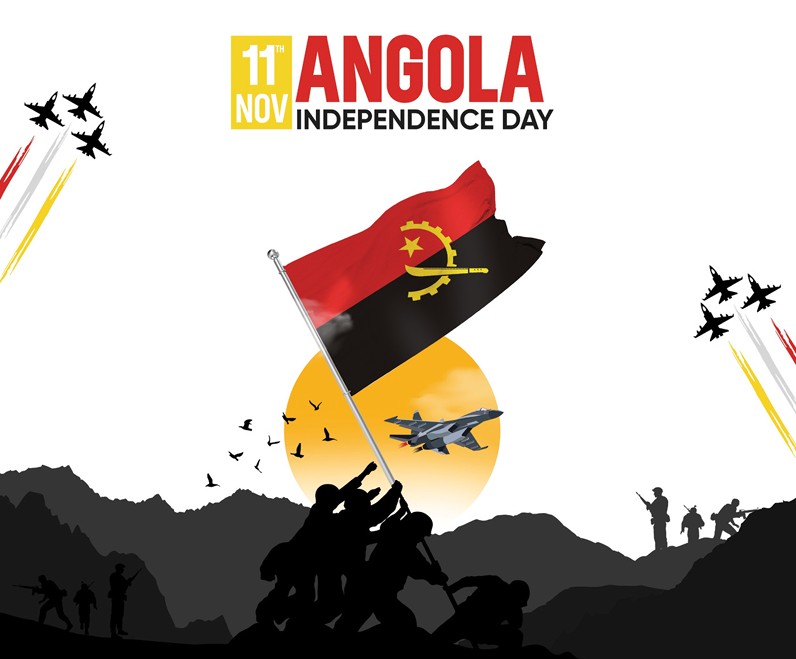
On the eleventh day of November, nineteen seventy-five, Angola awoke to itself. After nearly five centuries under Portuguese rule, a red-and-black flag rose above the ruins of the empire. The colonial army departed; the new nation, uncertain but luminous, stood trembling between euphoria and fear. In the words of Agostinho Neto, physician, poet, and first president of the Republic: “Com a firme vitória da tua alegria / e da tua consciência…” — Agostinho Neto, “Sagrada” – “With the firm victory of your joy and your awareness.” Those lines became prophecy — a vision of dignity reborn after centuries of silence.
The Portuguese presence in Angola spanned nearly five centuries, beginning in 1482, when Diogo Cão’s caravels first anchored at the mouth of the Congo River. It was an encounter that would shape both people in complex and irreversible ways. From that first contact grew a long, ambiguous relationship — marked by exploitation and resistance, by violence and exchange, by domination but also by the slow birth of a shared cultural and linguistic universe. Colonialism left deep scars: forced labor, the Atlantic slave trade, racial hierarchies, and the suppression of local sovereignties. Yet, alongside those injustices, something else was born — a network of ports and towns that connected Angola to the world, the introduction of new technologies and agricultural methods, the rise of mission schools and literacy that, however unequal in intent, gave many Angolans their first tools of modern education.
The Portuguese language, once an instrument of control, became paradoxically the seed of unity. It allowed communication across dozens of ethnic groups and regions; it became the medium through which future rebels and poets would articulate freedom. As the writer José Luandino Vieira would later show, the “language of the colonizer” could be broken open, transformed into something unmistakably Angolan — vibrant, creolized, and alive.
Cultural encounters enriched both sides: architecture bearing traces of baroque Lisbon and Kongo motifs; culinary and musical fusions that flowed across the Atlantic, influencing samba and fado alike. The Portuguese presence, for all its contradictions, left a living heritage that Angolans did not inherit passively but refashioned with creativity and defiance.
Thus, when independence came in 1975, Angola was not merely breaking from Portugal — it was reclaiming and redefining everything that the encounter had produced: the roads and churches, the books and the words, the very grammar of coexistence. The empire sought to impose a single civilization; instead, it created two intertwined destinies.
As historian David Birmingham observed, “the Portuguese in Africa did not simply build an empire of domination — they built a bridge across the Atlantic of human entanglement, tragic and enduring.”
In that paradox — of chains that became bridges — lies the origin of modern Angola’s strength and its most difficult inheritance.
Independence did not bring peace. The liberation struggle, begun in 1961 under the banners of the MPLA, FNLA, and UNITA, quickly transformed into a civil war over ideology, ethnicity, and foreign interests.
Angola, scarcely born, became a chessboard for the Cold War.
Cuba and the Soviet Union stood with the MPLA; South Africa and the United States armed UNITA and the FNLA, who also had assistance from European nations. Diamonds, oil, and ideology fed the flames.
The poet and novelist Pepetela would later write: “Mayombe é o retrato do homem e da floresta. A guerra é o espelho do que somos.” – “Mayombe is the portrait of man and the forest. The war is the mirror of what we are.”
Through the jungle and the city, the dream of freedom survived — battered, but unbroken. For nearly three decades, the Angolan people lived between the sound of helicopters and the whisper of poems. Writers became witnesses: José Luandino Vieira, imprisoned in Tarrafal, turned the creole speech of the musseques into literature; Amélia da Lomba and Isabel Ferreira raised the voices of women who refused invisibility; João Melo explored memory and exile as the nation’s moral landscapes.
When the guns finally fell silent in 2002, after the death of UNITA’s Jonas Savimbi, Angola stood scarred but standing. The peace accords opened the way to reconstruction — roads rebuilt, Luanda’s skyline rising, oil flowing from Cabinda’s fields. The nation became one of Africa’s fastest-growing economies, its GDP swelling as Chinese and Western investors sought Angola’s riches.
Yet wealth did not erase inequality. According to recent UN reports, nearly half of Angolans still live below the poverty line. The contrast between skyscrapers and musseques — between abundance and deprivation — remains a haunting refrain. As Ondjaki wrote in Os Transparentes:“Luanda é uma cidade feita de vozes e silêncios, de cheiros e fantasmas.” – “Luanda is a city made of voices and silences, of smells and ghosts.” And in those silences, the nation still listens to itself.
Angolan literature is not an ornament of independence; it is its conscience.
Through fiction and poetry, writers have built an invisible archive of the nation’s soul. José Eduardo Agualusa, in O Vendedor de Passados, warns that “the past is a country that issues false passports.”
Wanda Ramos, writing from Lisbon, confessed the dual guilt of the colonizer’s daughter and the immigrant’s witness.
Amélia da Lomba, in A Filha do Vento, sings of a woman “entre a guerra e o ventre,” between the womb and the war, carrying the weight of rebirth.
Cremilda de Lima and Gabriela Antunes teach children to imagine peace through storybooks, while Chó do Guri transforms the city’s rhythms into poetic resistance.
Every generation redefines angolanidade — that untranslatable term uniting geography, rhythm, and belonging. From Luandino’s musseque idiom to Ondjaki’s magical realism, Angola’s literature remains an act of reparation — a rewriting of what history erased. “O importante é a semente.” — Pepetela “What matters is the seed.”
Fifty years on, Angola stands at a threshold.
The post-war generation, unburdened by colonial memory, faces new battles: unemployment, corruption, inequality, and climate stress. The young poet may no longer carry a rifle but must wield language against apathy. As José Eduardo Agualusa observed, “We cannot live forever on the poetry of the past; we must build the prose of justice.”
Democracy, too, remains an unfinished verse — one that requires revision through participation, transparency, and accountability. Economic diversification beyond oil, educational reform, and environmental resilience are no longer dreams but necessities. Yet even amid difficulty, there is hope — esperança sagrada, sacred hope, as Neto called it. The fact that Angolans still sing, write, debate, and dream is itself a triumph.
Angola’s fiftieth anniversary is not only an African milestone; it is a Lusophone one. The language that was once divided now has the power to connect. Across the Atlantic, in Brazil, Portugal, Cabo Verde, Mozambique, São Tomé e Príncipe, Timor-Leste, and the Portuguese-speaking communities of North America, a shared cultural geography persists — diverse, polyphonic, creative.
Too often, the Portuguese diaspora in the United States and Canada limits its identity to folklore and nostalgia, forgetting that Lusophony is a living civilization — one that includes the voices of Africa, Asia, and South America. To teach the Portuguese language today is to teach not merely grammar but worldview; not only Fado and Camões, but also Neto and Noémia de Sousa, Mia Couto and Ondjaki, José Craveirinha and Agualusa.
To be Lusophone in the twenty-first century is to belong to a fellowship of seas and tongues — um arquipélago de humanidade. “As palavras são o meu país.” — Ondjaki – “Words are my country.”
As Angola celebrates fifty years of independence, its story calls to all Portuguese-speaking nations: to work together for a world more just, more creative, more humane.
The challenge is not technical but ethical — to turn linguistic kinship into political and social solidarity. To share expertise, to support education, to defend democracy, and to value culture as a form of development.
And to the diaspora, especially in North America, this anniversary offers a gentle indictment: to move beyond nostalgia and toward knowledge; beyond heritage toward engagement; beyond celebration toward conscience.
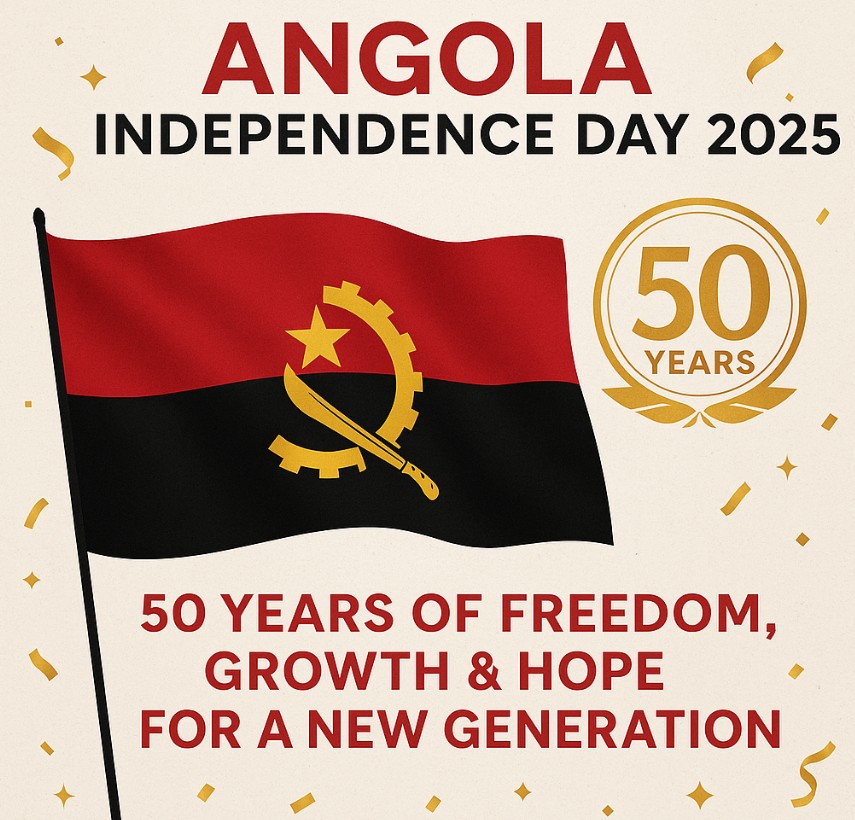
Fifty years ago, Angola taught us that freedom is not given — it is built, word by word, act by act, generation by generation.
Fifty years later, the lesson endures: the future of the Lusophone world depends not on power but on empathy, not on borders but on bridges.
“Não basta que seja pura e justa a nossa causa — é preciso que a pureza e a justiça existam dentro de nós.” — Agostinho Neto “It is not enough that our cause is pure and just—purity and justice must exist within us.”
In the long dusk of history, Angola rises like a phoenix of red earth and sea-salt wind. Its poets remain its architects, its youth its unbroken promise.
And perhaps, in the soft cadence of the Portuguese language — that ancient instrument once wielded as a chain and now reborn as song — we may yet hear the beginning of a new century. In this century, Lisbon, Luanda, Maputo, Brasília, Dili, Praia, and the diaspora speak not in hierarchy but in harmony.
Fifty years on, the work of independence continues: To make freedom visible. To make justice audible. To make hope real.
Diniz Borges
https://www.angola50anos.gov.ao/pt/Videoclipe

 Filamentos (artes e letras)