

Words travel like tides, carrying the cadence of distant lands across oceans and into new tongues. Translation, at its best, is not only the crossing of languages but the crossing of worlds, where the voices of poets and novelists from faraway islands and villages find a home in another reader’s breath. This year’s Northern California Translation Awards once again affirmed how literature dissolves borders, weaving together continents through the delicate craft of translators.
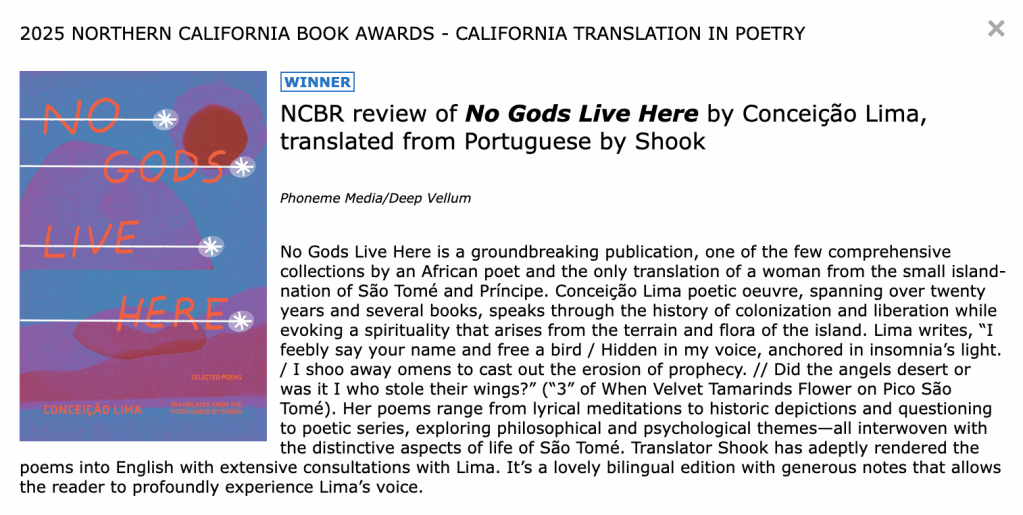
In the poetry category, the winning title was No Gods Live Here by Conceição Lima, a remarkable writer from São Tomé e Príncipe. Translated from Portuguese by Shook and published by Phoneme Media/Deep Vellum, the collection shines with the clarity and force of Lusophone African verse. Lima, who once wrote, “I am the daughter of this land / I carry in my body the weight of its silences,” embodies a tradition that binds memory, exile, and ancestry into poetry that speaks across oceans. Last year, Azorean writer Álamo Oliveira’s collection Through the Walls of Solitude, in English translation, stood among the three distinguished finalists—evidence of how the Portuguese-speaking world is claiming a larger stage in translation. Oliveira, who declared in one of his poems, “solitude is not silence, it is the echo of all voices we have lost,” captured the lingering resonance of insular life that continues to move readers far beyond the Azores.
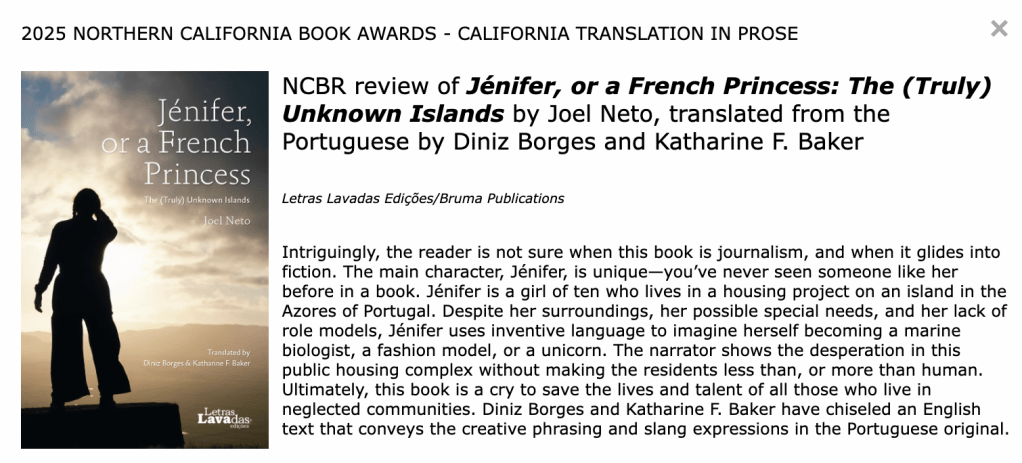
In prose, the award went to Chronicles of a Village by Nguyễn Thanh Hiên, translated from Vietnamese by Quyên Nguyễn-Hoàng and published by Yale University Press. Among the finalists stood Jénifer, or a French Princess: The (Truly) Unknown Islands by Azorean author Joel Neto, translated from Portuguese by Diniz Borges and Katharine F. Baker, and co-published by Letras Lavadas and Bruma Publications. Neto, who has described the Azores as “a place where the horizon is not the end but the beginning of everything we imagine,” offers a fiction rooted in insularity yet radiating with universality.
Bruma Publications, based in California, has expressed its pride in having two finalists in consecutive years—Álamo Oliveira’s poetry in 2024 and Joel Neto’s fiction in 2025. For Bruma, these acknowledgments are more than accolades; they are bridges between the Azores and North America, proof that translation nurtures both memory and imagination.
For Azorean literature, these honors signify a growing recognition of its distinctive cultural heritage. The Portuguese-American presence in California they are a testament to a community that carries islands within its heart. In the glow of these awards, one feels that literature is not simply a mirror of place but a lantern—lighting shores, crossing oceans, and reminding us that the smallest islands can carry the largest voices across the world. As Conceição Lima’s verse reminds us, “the sea is a book without end,” Álamo Oliveira’s poetry insists on listening to the echoes of memory, and Joel Neto’s fiction dreams new horizons—together affirming that Lusophone literature, in translation, is both rooted and infinite.
Here is a description of the review attached to the book Jénifer, or a French Princess: The (Truly) Unknown Islands– a finalist for the fiction award in translation.
Here is the description of the book, winner in the poetry category, No Gods Live Here.
 Filamentos (artes e letras)