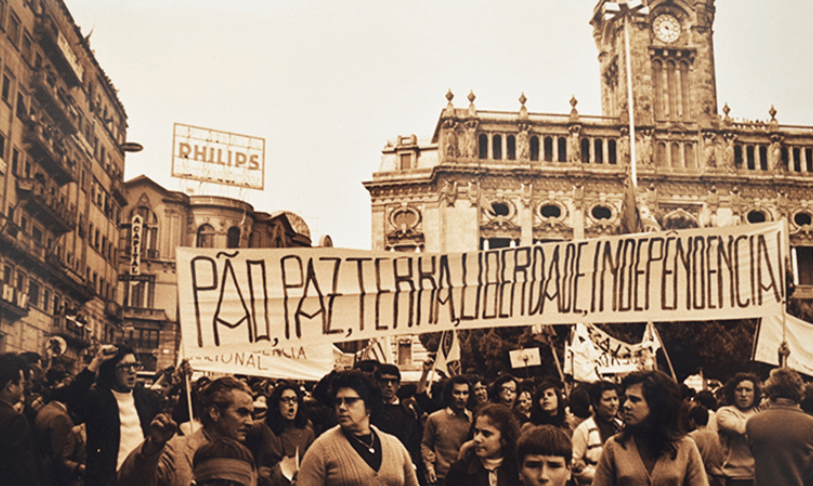
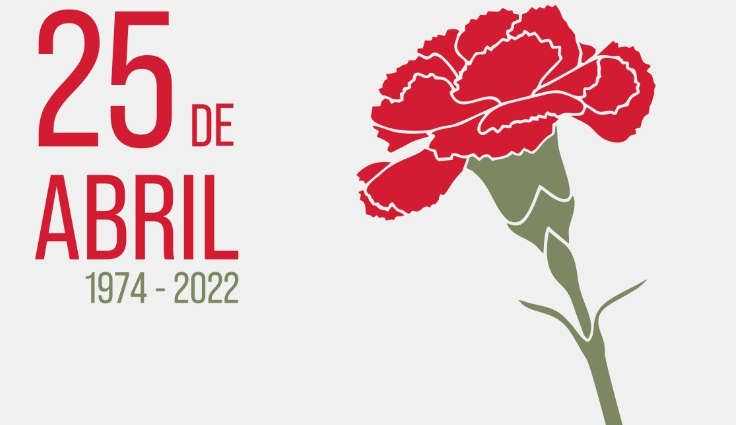
2022 – April 25th – The Carnation Revolution
April is a time of hope and inspiration for finding the best solutions in the current development phase under challenging times of globalization.
We are celebrating April on its 48th anniversary, and we can say that even in terms of time, April 25th is more significant and much more substantial than May 28th.
Portugal of April, of Freedom, Democracy, and Peace.
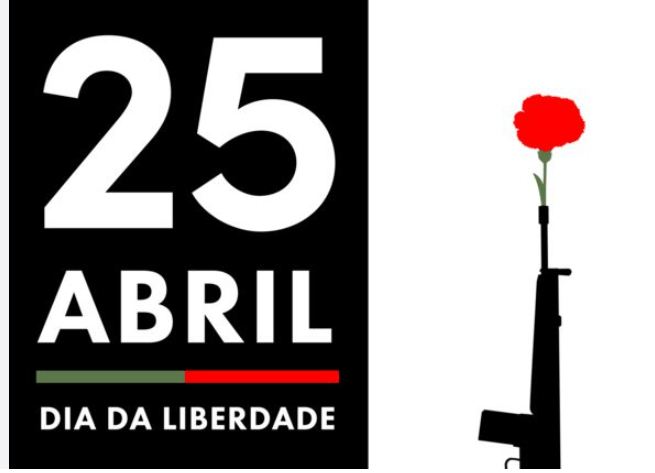
Portugal, of all and for all Portuguese, is universal. Today, it is a prestigious and respected country, the exact opposite of what it was under the fascist and corporate dictatorship of Salazar and Caetano.
April 25th restored our historical relationship with other peoples and cultures, a relationship of openness to the world and others, an essential dimension of our affirmation and independence, overcoming the vision and relations of the colonial empire, often imposed by force of arms.
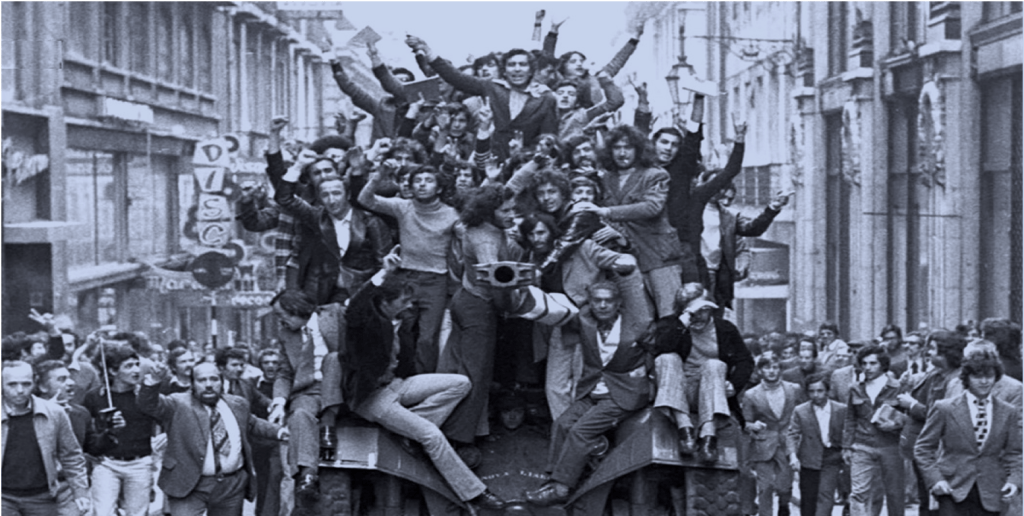
Today, we can fulfill our universalist vocation of openness to the world and others, of building bridges and mutually advantageous connections; with April 25th, we knew how to give priority to the wishes of the Portuguese and African peoples for freedom and independence, we knew how to put an end to the 13-year long colonial war and lay the foundations for a mutually advantageous relationship of cooperation and solidarity.
Portugal pioneered this profound change in the relationship with colonized peoples, rejecting processes of domination or subjection by other means, as has happened in different cases.
One of the singularities of April 25th was the profound, widespread adherence to the programmatic lines established by the MFA and the spontaneous popular adherence to a broad movement of direct participation in the conquest and construction of their future in freedom and democracy.

Our Democratic Municipal Power, enshrined in the Portuguese Republic’s Constitution, resulted from this grassroots dynamism in building a participatory democracy.
Another strength of our democracy comes from the very way in which the captains’ movement and the MFA organized themselves and took decisions, using genuinely democratic processes applied within an intrinsically hierarchical structure such as the Armed Forces; this under dictatorship, underground, and with a war on their backs (or perhaps because of it).
The processes and new relationships developed by the young soldiers allowed for an extraordinary leap and boost in strengthening the hierarchy, solidarity, and loyalty between comrades, preventing Spínola from erasing the MFA using the traditional military hierarchy and repeating May 28th when he tried to ignore the MFA’s program or postpone the constituent elections.
No circumstance can be invoked as an excuse for not encouraging or even abandoning the permanent exercise of democratic practices. The exercise and extension of democracy at all levels is essential for its defense and success. We have to be able to distinguish between democratic processes and populist processes or processes of manipulating public opinion and exploiting emotion.
The populist hierarchy or the hierarchy of installed power is actually the inverse of the democratic one. For populists, loyalty to the boss comes first, then to friends and interests, and only lastly to the people – this is the hierarchy of fascist corporatism. This is not the hierarchy of April, where the first loyalty is to the people, the Portuguese Republic’s Constitution and the legitimately constituted sovereign bodies.
Democracy is defended and promoted by providing everyone with decent living and working conditions, guaranteeing them justice and the necessary means to organize themselves in compliance with the Constitution of the Republic.
The best way to defend and promote democracy is not to allow it to be confined under any pretext whatsoever, nor to allow it to be reduced to a minimum, just an electoral expression; it is to encourage citizens to find appropriate ways to participate in national civic life, not to allow themselves to be confined by a party or ideological corsets; to enable them to put their capacity and creative energy at the service of the community and society, to encourage young people to participate in civic life at the service of the community before they start their active professional lives, to create a National Civic Service.
On the other hand, Democracy cannot be confused with the dictatorship of the majority. Having a majority does not mean being right; it means having the legitimacy to govern for all, with a view to the general welfare.
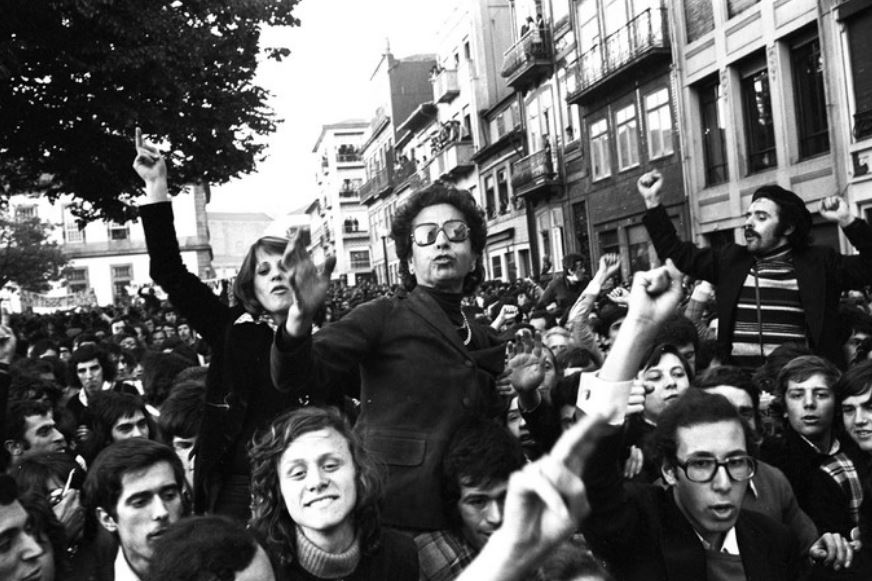
The principles that resulted from April 25th and are enshrined in our Constitution are still valid and inspiring in today’s globalized world. April 25th ended a long war and an armed conflict by negotiating PEACE, which established relations of mutual interest, cooperation, and solidarity with other peoples, refusing relations of subservience or inferiority.
The celebration of April today cannot fail to underline, in addition to the values of Freedom and Democracy, the value of PEACE, without which everything is called into question.
Today, we are witnessing a worsening of conflicts around the world, the defense and promotion of hybrid warfare; in Europe, the conflict has shifted to a form of armed confrontation that could turn into a continuously escalating war.
Today, in the 21st century, nothing can justify the use of arms as a means of politics, the invasion of one country by another, the massive violation of its borders, and the death of thousands of innocent people. Such an act deserves our profound rejection; the victims deserve our full support, and we must not confuse the aggressed with the aggressor. Still, we must also realize that demonizing peoples or making constant appeals to arms and the continuation of war is not the best way to help the victims, to limit the horrors and consequences of war, or to seek ways of negotiation that lead to PEACE.
We, the Portuguese and the soldiers of April know from experience that it is not by intensifying the war, it is not by using the simplistic Manichaeism of good guys and bad guys, by demonizing others, that we can create the conditions for negotiating and reducing the war and its horrors.
Due to its prestige reacquired with April 25th, its history, and diplomatic know-how, Portugal can and must actively seek political ways within the organizations to which it belongs, especially the UN, to move towards negotiation and PEACE.
All peoples and countries have the right to security and prosperity. We know that they don’t have an equal chance of achieving this. We understand that the most powerful take advantage of the areas where they have supremacy or hegemony, even to the detriment of other peoples; not hesitating to aggravate situations, provoking hybrid wars, and resorting to the use of the maximum violence of weapons, we refuse such a way of doing politics.
Cooperation and solidarity with the victims of war and aggression, YES.
Calls for and encouragement of xenophobic nationalism, NO!
Don’t confuse patriotism with nationalism.
It’s one thing to love your homeland and respect others and their homelands, but it’s quite another to have an irredentist nationalism that excludes and despises other countries and peoples.
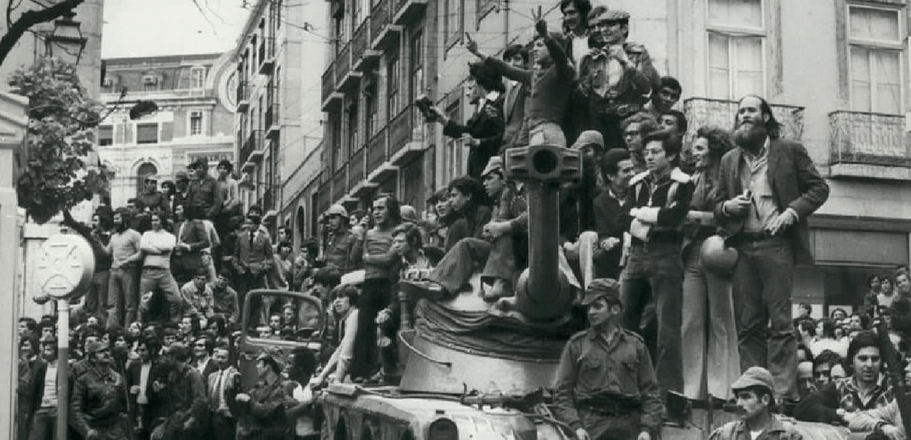
April 25th gave us the legitimacy to see the difference between patriots and nationalists. We have experience in building bridges and negotiating between conflicting parties.
In addition to alleviating the consequences, it is necessary to understand the causes to find political ways to establish lasting peace.
Every effort must be made with the parties to ensure that diplomacy is at work and that the guns fall silent.
Today’s world is much more complex than last century, with many political, strategic, economic, natural resources, financial, military, communications, environmental, cultural, and social variables. We must know how to explore new paths for the progress of humanity. We cannot fall back into the scenario of antagonistic blocs or powers nor the stigmatization of those different from us.
April 25th is an inspiration. Its values are more relevant than ever.
We in the military do not lack the courage to defend and fight for peace; we know well what war means, what some of its causes are, its costs and consequences;
Do not confuse this with defending or understanding an act of aggression.
Long live April 25th
Long live Portugal
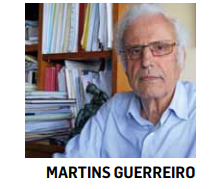
Martins Guerreiro
(One of the Officers of the Revolution, who is now a retired Admiral from the Portuguese Navy)
A reminder: This year, Portugal is commemorating the 50th anniversary of the Carnation Revolution. At the Portuguese Beyond Borders Institute from Fresno State, we will dedicate a series of events to this remarkable. Historical date. We will have several conferences and presentations, in person and online, starting on February 8th, with writer Luís Filipe Sarmento, followed by a guest every three weeks until the end of our Spring Semester of 2024. We will continue commemorating the 25th of April during our Fall Semester, with many more events from the end of August until the end of November. Our Fifth Anniversary Celebration, from now on during the Portuguese Immigrant Week in California, will feature the 25 de Abril, as will the Symposium: Filaments of the Atlantic Heritage, scheduled for May 2, 3, and 4. Join us online and in person as we celebrate the Carnation Revolution. Also, starting tomorrow, January 5th, and every Friday until the second week of May, we will feature a segment here on Filamentos on the Revolution and how it changed Portugal. It will be available here in Filamentos, throughout our various social media outlets, and at Fresno State for our students, faculty, and staff.
 Filamentos (artes e letras)
Falta a independência dos Azores e da Madeira.!
LikeLike