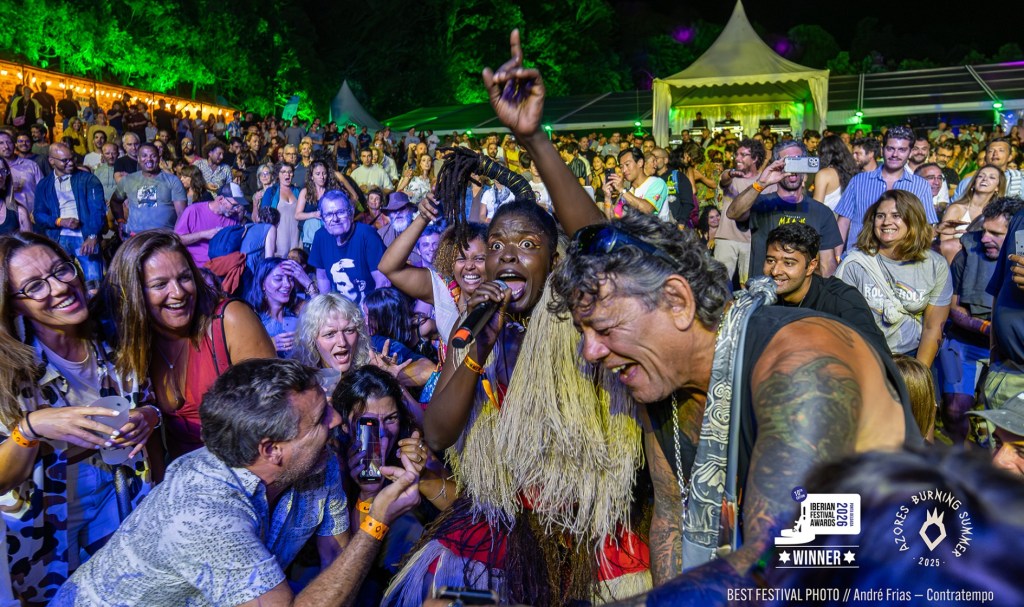
There are places where music arrives as spectacle—and others where it feels like a continuation of the land itself. At Praia dos Moinhos, in Porto Formoso, the Azores Burning Summer Festival belongs unmistakably to the latter.
Set for August 28 and 29, 2026, the festival returns with a program that reads not only as a lineup, but as a map of the Lusophone world—stretching from Cape Verde to Angola, from Brazil to Portugal, and echoing across the diasporas that bind them.
More than a decade into its trajectory, Azores Burning Summer has evolved into one of the most distinctive cultural gatherings in the Atlantic: an eco-festival where music, landscape, and sustainability are not parallel elements, but deeply intertwined.
A Lusophone Soundscape, Reimagined
This year’s edition brings together a compelling mix of established voices and contemporary innovators.
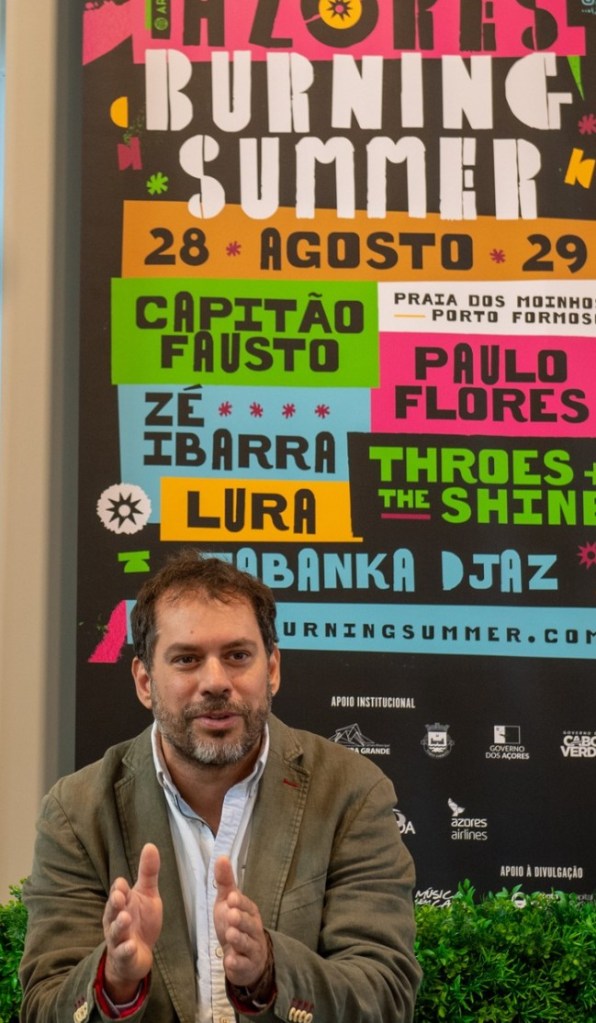
On August 28, the stage will welcome Lura, whose voice has carried the soul of Cape Verdean music to global audiences, blending tradition with a cosmopolitan sensibility. She is joined by Paulo Flores, a towering figure in Angolan music, whose work has long defined the evolution of semba and the political resonance of song. Completing the evening is Tabanka Djaz, a historic group whose sound remains inseparable from the cultural identity of Guinea-Bissau.
The following night, August 29, shifts the tone toward a new generation of Lusophone expression. Capitão Fausto, one of Portugal’s most influential bands, continues to reshape the contours of contemporary pop and rock. Brazil enters the conversation through Zé Ibarra, whose work bridges heritage and experimentation, while Throes + The Shine—an electrifying Luso-Angolan project—close the circle with a fusion of kuduro, rock, and electronic energy that resists categorization.
Together, the lineup reflects a central ethos of the festival: dialogue. Between past and present. Between continents. Between identities that are, in the Lusophone world, always in motion.
An Island Festival with a Global Pulse
What distinguishes Azores Burning Summer is not only who performs, but where—and how.
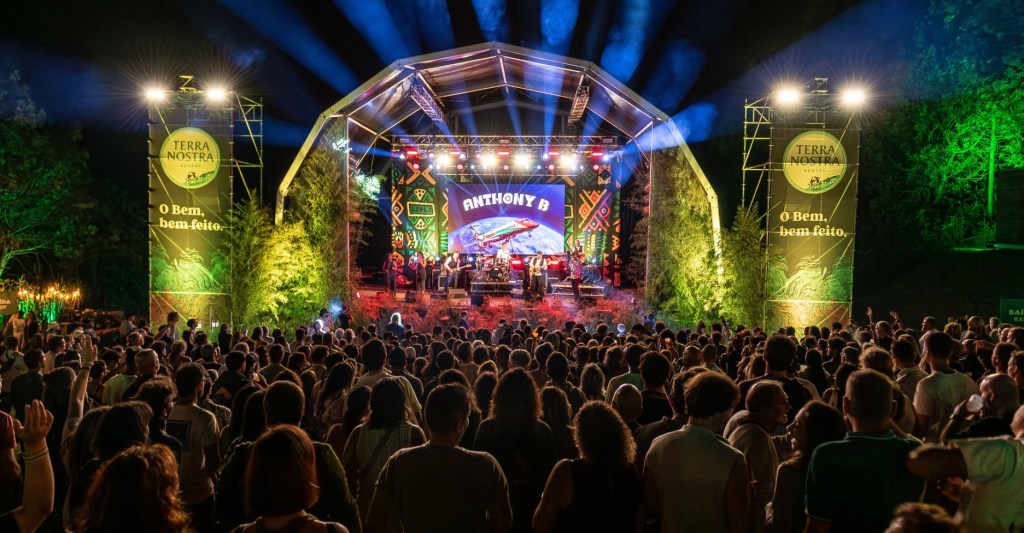
Praia dos Moinhos is not a neutral backdrop. It is an active presence. The cliffs, the ocean, the open horizon—all become part of the experience, dissolving the boundaries between stage and landscape. Here, proximity matters: between artist and audience, between sound and place.
The result is an atmosphere that resists the anonymity of large-scale festivals. It is intimate, immersive, and rooted.
Sustainability as Practice, Not Slogan
From its inception, the festival has positioned itself as an eco-conscious event, but its commitment to sustainability extends beyond branding.
Environmental initiatives, community engagement, and cultural programming are woven into the festival’s structure, reinforcing a model where celebration does not come at the expense of the territory that hosts it.
For director Filipe Tavares, the festival is inseparable from its setting: a meeting point for locals, visitors, and residents from abroad, where nature and culture converge in a shared experience of belonging.
In an era where festivals often expand at the cost of their surroundings, Azores Burning Summer offers a counterpoint—growth measured not in scale, but in coherence.
Beyond Music: A Cultural Strategy
The significance of the festival also lies in its broader impact.
By anchoring a major cultural event outside the usual urban centers, it contributes to the decentralization of cultural production in the Azores and strengthens São Miguel’s position within the international festival circuit.
It is, in effect, both a celebration and a strategy: a way of asserting the islands not as peripheral, but as central to a network of cultural exchange that spans the Atlantic.
The Atlantic, Amplified
As the first announcements for the 2026 edition unfold, with additional programming yet to be revealed, Azores Burning Summer once again positions itself at the intersection of music, memory, and movement.
In Porto Formoso, the Atlantic does not divide—it connects.
And for two days in August, that connection becomes audible: in voices that carry histories, in rhythms that traverse oceans, and in a gathering that reminds us that culture, like the tide, is always in motion.
https://www.facebook.com/reel/1672439694067746
Translated and adapted from a story in Atlântico Expresso.
 Filamentos (artes e letras)