
Book review by Victor Rui Dores
Translated by Katharine F. Baker
No small number of these whaling seamen belong to the Azores, where the outward bound Nantucket whalers frequently touch to augment their crews from the hardy peasants of those rocky shores. […] How it is, there is no telling, but Islanders seem to make the best whalemen.
— Herman Melville, Moby-Dick, Chapter 27
It is not with impunity that the Azores witnessed 150 years of whaling in its waters. For that reason the whale is part and parcel of these islands’ culture, memory and history, and of its people’s imaginations.
Much has already been written about the impact of whaling upon the Azores, above all in the central group of islands, with its effects on their social fabric and its economic importance. But we must not forget that before whaling became an established industry in the archipelago, north American whaling ships had served as a source of Azorean labor, for whom it was their preferred means of reaching the territory of the New World when fleeing military recruitment and famine. It is in this way that the course Azorean emigration took in the 19th century is inseparable from whaling, reflected in the language itself, where the word “whaler” became equivalent to emigrant.
The writer who understood this best was the Picaroto Dias de Melo (1925-2008), who gave Portuguese literature a gripping and powerful account of the anonymous collective history of Pico’s whalers, capturing the true human, social and dramatic dimensions of the whaling saga, especially in his novels Mar Rubro [Red Sea] (1958), Pedras Negras [Dark Stones] (1964), and Mar pela Proa [Sea Off the Bow] (1976) — called his whale cycle or whale trilogy.
As a neo-realist writer, Dias de Melo opted to approach the above works in terms of social strife. There is open conflict between whalers (who, not being the bosses of the boats they work on, end up not getting the value of their labor sufficiently remunerated) and shipowners (who, on the pretext of difficulties selling the oil, exploit them egregiously) in a process of class struggle — especially from a Marxist perspective of exploiters against the exploited (whaling company owners versus whalers), due to their interests being at odds with one another.
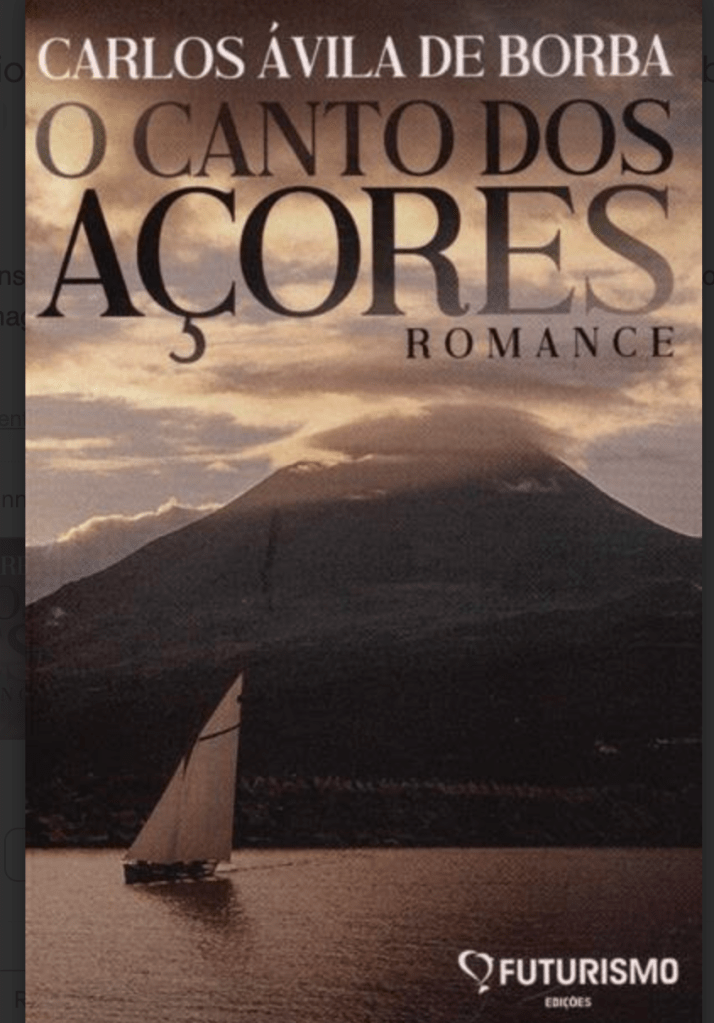
Such conflict no longer exists in later books written about Azorean whaling (for example, Mulher de Porto Pim [Woman of Porto Pim] by Antonio Tabbuchi). That is because the times we live in are different, as is the case with O Canto dos Açores [Song of the Azores] (Futurismo edições, 2025), by Carlos Ávila de Borba of Terceira, a novel that provided me hours of enjoyable reading, and that is, in my opinion, also worthy of a film script.
Indeed I read this book (I had already done so in its German version, Der Gesang der Azoren, Gmeiner, 2024) as I would a cinematic treatment. And that is because throughout the work’s 303 pages I could not stop imagining the author walking around with camera in hand — mastering the cinematographic techniques and devices of flashback and raccord [connection], applying them in a particularly successful way to the narrative technique. In other words, this writer seems to assume the role of a director constructing his narratives image by image, shot by shot, frame by frame, using editing cuts (from the English edition, although I prefer the term “montage”).
Starting from a solid. well-structured script and growing action, Borba assembles his montage of narratives well; his superbly-crafted dialogues also deserve to be highlighted.
A book on the human condition, O Canto dos Açores has as much of a grasp on the real world as the construction of a fictitious one. Well-written in vernacular language and with narrative fluidity, the novel’s action unfolds on various Azorean islands, particularly Pico and Faial.
Since there is no literature without geography, Carlos Ávila de Borba writes through the eyes of memory and distance in a transatlantic prose that sets out for the world from the Azorean islands. Well-documented and informed, it delves deep into whaling imagery, articulating evocation with documentation and research, providing us valuable elements about the history of whaling between 1876 and 1983-84 — that is, during the period from the founding of the first whaling station on Pico until the decline and prohibition of whaling in the Azores.
In this work, the meticulous description of a whale hunt that the author provides in extraordinary detail is an anthology piece, capturing the exact breathing and entire atmosphere that surrounded past sperm whale hunts, relating sensations and feelings, narrating memories, incidents and accidents. In other words, it is the epic adventure of intrepid sea wolves who in fragile vessels and employing primitive methods engaged in an intense and unequal struggle, risking their lives for the death of the majestic Leviathan. They did so not out of hatred for the “Boi do Mar” [Sea Ox] (title of a song with music by Luís Alberto Bettencourt and my lyrics), but as a matter of economic survival.
Something else interesting about this work is how, through the voice of his youthful protagonist Mateus, its author evokes and traces profiles of whalers, a people of great psychological richness and profound human expression. And, above all, how throughout the entire book’s action Borba explains, comments upon and analyzes whaling, bringing testimonials from real people into the narrative — like that of Zé Henrique, the current proprietor of Peter Café Sport.
A love story between Mateus (who represents a third generation of whalers) and the young French sailor Manon blazes trails into the future and inevitably brings a contemporary twist to the epic of whaling — transformed nowadays into a maritime-tourist activity (whale watching), handicrafts (scrimshaw) and what is the Azores’ most visited museum: The Whalers Museum in Lajes do Pico.
A book of impressions and atmospheres, O Canto dos Açores, Borba’s fourth novel, has great evocative power, and is very beautiful and deeply human. Read it while, fortunately, whales still swim free in the Azores’ waters.
Review originally published February 13, 2026, as “Das memórias baleeiras em O Canto dos Açores, de Carlos Ávila de Borba” on Graciosa Digital at:
https://graciosadigital.blogspot.com/2026/02/opiniao-victor-rui-dores-das-memorias.html
O Canto dos Açores, by Carlos Ávila de Borba. Ponta Delgada, Azores: Futurismo, 2025
 Filamentos (artes e letras)