

Brief Introduction
This book is born of a long conversation across the Atlantic—between islands and continents, memory and movement, language and belonging. In these essays, literary criticism becomes not a matter of classification but of listening: to voices shaped by departure and return, by inherited geographies and adopted homelands. Writing from both shores, I approach literature as a living space of exchange, where Azorean, Portuguese, American, and Luso-American imaginaries intersect and illuminate one another. What follows is a critical journey inward and outward at once, guided by the conviction that literature does not recognize borders, only crossings. – Diniz Borges
Preface
On the Journey Inward
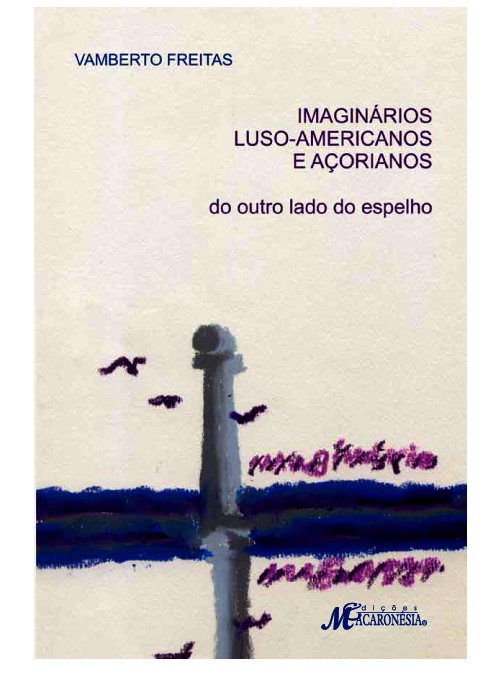
Luso-American and Azorean Imaginaries: On the Other Side of the Mirror is a body of work originally directed to several academic journals and other publications, as well as to conferences and colloquia in which I participated in the Azores, in Lisbon, and in the United States. The truth is that, alongside George Monteiro, Onésimo T. Almeida, and Diniz Borges, we gradually cleared a new territory of art and affect. Much has taken place since the mid-1990s, when the prose and poetry of a significant number of Luso-American authors began to appear—writers who would quickly become familiar to us and who, in different ways, rediscovered their ancestral land directly and intimately. They became unavoidable reference points for those who read and studied them here, within a dialogue between two languages and literary traditions, united by the shared memory of the long and often painful pilgrimages from the islands to the New World.
To the discomfort—and occasional misunderstanding—of certain “nationalists,” Azorean experience as transfigured in literature can no longer be separated from what these authors have contributed, and will surely continue to contribute, perhaps inspiring the next generation of Luso-descendants to carry forward a small but undeniably powerful canon that already exists. What I mean is this: the work presented here already contains sufficient material to prompt others—and myself—to make the considerable effort, without delay, to ensure that no deserving Luso-American (and Canadian) writers remain unacknowledged. They merit sustained critical attention so that they may fully belong to a living literary culture that is ours. Without this vital attention, they would remain in semi-obscurity among us, and that would constitute the gravest cultural injustice we could commit in the face of so much work of quality and significance for a people dispersed between two nations, as we are.
Borders no longer hold. National passports increasingly hinder less the movement between countries long bound by history. In the same way, those accustomed to thinking in terms of “national literatures” will find it increasingly difficult to separate and categorize postmodern writing in a globalized world. Was Nabokov a Russian writer or an American one? Is Salman Rushdie an Indian writer or a British one? Indeed, it was from his Imaginary Homelands: Essays and Criticism 1981–1991 that I borrowed the title of my first chapter here, “Imaginary Homelands.” Are Katherine Vaz and Frank X. Gaspar merely American writers, or—especially when translated into images and metaphors that are deeply ours—are they not also Portuguese, or Azorean-American writers?
In truth, the labels matter little, as does the shelf on which we place them. There they are, speaking to us directly. Only those who do not read them lose out—those who refuse to approach the voices that return to us other worlds and worldviews that are also ours, that belong to everyone. Even those who never left this land have not escaped—nor do they escape—what the New World has done to us, and above all what it has offered us in successive moments of regeneration (and survival) of our people.
Throughout Luso-American writing there are repeated returns to ancestral origins, enacted by narrators and characters alike—returns made through imagination and through the mythic transmission of stories passed down by parents and grandparents, stories later transformed into literature. Others weave these inheritances together and enter into dialogue with canonical figures of Portuguese literature, particularly Camões, Fernando Pessoa, and Eça de Queirós, as in the work of Frank X. Gaspar and Katherine Vaz. Lara Gularte, the California poet, lacking concrete information about her ancestors, excavates memory itself: she studies a photograph, visits a place, invents and reinvents what life might have been like for her people in the American West.
At the same time, daily life in the new land becomes vivid and meaningful in all these writers, marked by a fascination that is at once celebratory and ironic, dramatic and comic. As a constant reference throughout this history of emigration and immigration—where the lives of our people unfolded and took root in communities often isolated yet never fully severed from the country and culture they entered—Catholicism appears repeatedly, blending pious and profane belief, thus preserving continuity with the homeland. When we read these works, in English or especially in translation, there is always that Melvillean “shock of recognition”—but here it is an intimate recognition, as though we had finally rediscovered a part of the “nation” that was lost yet never forgotten.
In their prose and poetry—already recognized across a wide range of North American literary circles and within academia—these writers bring us “news” of the ancestral departure, of how one survives intact within a vast nation whose languages and cultures are sometimes radically different from our own. When a Holy Spirit procession moves proudly through Anglo-American streets and those of other ethnicities, in colors both joyous and solemn, and all fall silent in a gesture of respect and astonishment, we understand how strong the roots were that allowed us to remain a fully integrated national group without ever permitting the violation of our deepest core. This is the most powerful and indelible testimony offered by the best of Luso-American literature.
I am fully aware of the significant absences in these pages, but a book of this nature cannot be exhaustive; it too has its limits of space. In some cases, I will need to address certain authors for the first time; in others, I have already included them in earlier books. Two examples: from the United States, among others, Julian Silva is indispensable, as are Art Coelho, Darrell Kastin, and Sue Fagalde Lick; from Canada, following Erika Vasconcelos—whose frame of reference lies in her homeland and in continental Portugal—Anthony De Sa emerged forcefully with the novel Barnacle Love, recently translated and published in Lisbon by D. Quixote under the title Terra Nova. This work, indeed, speaks directly to us. I intend to return to all of them shortly.
In an interview with Provincetown Arts, when asked why I devote myself to Luso-American literature, I replied that after spending a substantial portion of my life reading, studying, and writing about Azorean literature and immigration, I realized that through the writing of this generation of Luso-American authors—those rescuing the history of our lives on the other side of the Atlantic—I was bringing together my two most significant worlds, the Azores and America, in a continuous effort to better understand myself and our bifurcated lived experience. It is “the journey inward” of which Edward W. Said spoke, after we have spent so long moving between the worlds and texts of Others.
Ponta Delgada
August 30, 2010
Luso-American and Azorean Imaginaries: On the Other Side of the Mirror will be publicly presented at a FLAD session with the participation of writers Katherine Vaz and Frank X. Gaspar, in Angra do Heroísmo on October 27 and in Ponta Delgada on October 28. The event is part of a 2010 colloquium titled “Portugal in America.”
From the Back Cover of the Book
A plural figure—part essayist, literary critic, and cultural journalist—Vamberto Freitas is a bold, independent intellectual whose work is marked by formidable critical intelligence. The vast body of his publications stands as living testimony to his tireless commitment to culture, repeatedly returning to themes such as cultural discourse and the memory of time, articulated through the dynamics of departure and return, communion and solitude. What we read in Vamberto Freitas’s texts is the program of a free individual, one that may be defined as an uncompromising defense of an ethics of plurality—an ethics grounded in awareness of cultural interdependence in a context of progressively dissolving borders, while simultaneously affirming the imperative need to preserve specific identities and the values of ancestral communities. In his defense of journalism as a force of political and cultural democratization, and in his insistence on the link between thought and action, Vamberto Freitas situates himself—with courage, acuity, and passion—within the lineage of our great civic and cultural thinkers, whose voices remain indispensable in any time and place.
Teresa Martins Marques
Essayist / Researcher
There are people who, through their art and ingenuity, are capable of reshaping their time. This is the case with Vamberto Freitas. His work as professor, critic, and essayist has long established bridges across our Atlantic, securing them as bonds between homelands grounded in a shared Lusophone linguistic and cultural base. His persistent labor revitalizes the Azorean literary system at a higher level, weaving it into the continental Portuguese matrix while articulating its multiple possibilities and metamorphoses on American soil. He is an intellectual both “from here” and “from there,” moving always with refinement, effectiveness, and originality. A new book by Vamberto Freitas is not merely a release; it is a celebration.
Luiz Antonio de Assis Brasil
Pontifical Catholic University of Rio Grande do Sul
Vamberto Freitas’s audacious writing analyzes the multiple worlds that constitute the Azorean world. He has long understood that the Azores extend far beyond their nine islands in the middle of the Atlantic. Azorean identity is scattered across the American continents. Fully grasping the complexities of the Azorean world, the American world, and the fusion of the two—the Azorean-American world—Vamberto Freitas carries us, in each essay, through a universe of ideas and debates that confront prejudice and dismantle borders. His prose is direct and elegant, as free as the seagulls that circle the islands of mist.
Diniz Borges
Writer and Professor at California State University, Fresno.

 Filamentos (artes e letras)