
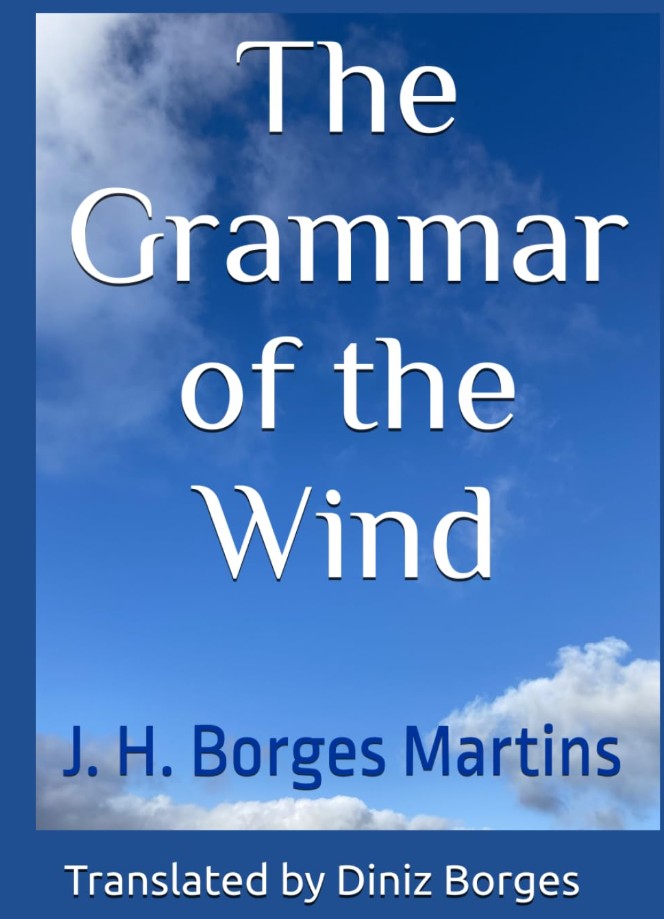
Filamentos is honored to introduce The Grammar of the Wind, a landmark English-language poetry collection published by Bruma Publications in collaboration with Moonwater Editions. This volume presents selected poems by J. H. Borges Martins in English, translated and curated by Diniz Borges, and framed by a resonant afterword by Álamo Oliveira.
From its opening dedication—addressed to my grandchildren as “the newest syllables / in our family’s long poem of migration”—the book declares its deeper purpose: to carry Azorean poetry forward into another linguistic future. In the opening remarks, I try to situate Borges Martins as a poet who writes from the threshold where matter and spirit meet. These poems do not translate a place; they transfigure it. The Azores emerge not as nostalgic scenery, but as a metaphysical terrain shaped by wind, basalt, labor, exile, and endurance.
The poems gathered in The Grammar of the Wind move with elemental force. Cities appear as silences without messages; islands breathe through stone and birds; the sea becomes a living archive of departures. Borges Martins’ voice is at once visionary and grounded—rooted in the lives of workers, emigrants, improvisers, and the forgotten. His imagery is volcanic, his syntax often incantatory, and his ethical stance unwavering: poetry, for him, is a form of attention to what history tries to erase.
In his afterword, Álamo Oliveira reads Borges Martins as both poet and chronicler of the people—a figure who listened deeply to popular voices and island rituals, preserving them not as folklore but as living knowledge. This dimension is essential to understanding the book’s gravity. Borges Martins does not aestheticize poverty, exile, or struggle; he gives them language capable of dignity and resistance.
The importance of The Grammar of the Wind lies in its act of translation as revelation. By offering these poems entirely in English, the book opens Azorean literature to second-, third-, and fourth-generation readers who may no longer speak Portuguese, yet remain bound—often invisibly—to the emotional and ethical landscapes of their forebears. It allows these readers to encounter the Azores not through memory alone, nor through inherited myth, but through contemporary poetic consciousness.
At the same time, this collection carries Azorean poetry into the broader world of English-language literature. Borges Martins’ work speaks powerfully to readers everywhere who are drawn to poetry shaped by islands, exile, labor, and metaphysical inquiry. Translation here is not a secondary gesture; it is the very condition that allows this poetry to travel, to belong, and to endure.
The Grammar of the Wind reminds us that heritage is not something we simply inherit—it is something we learn to hear. And when poetry crosses languages with care and rigor, the wind does not lose its voice. It finds a grammar capable of speaking to generations yet to come.
The book can be ordered on Amazon
 Filamentos (artes e letras)