The Portuguese language is not merely a means of communication. It is a lush, melancholic, rebellious, and sublime garden where poets, novelists, and philosophers have wandered for centuries, plucking metaphors like ripe fruit and sowing verses like seeds that bloom across oceans and generations. From the sonorous grandeur of Camões to the dreamlike fables of Mia Couto, from Lisbon to Luanda, Rio to Maputo, São Tomé to Bissau and Dili, Portuguese has become a borderless field of imagination.
We begin with Luís Vaz de Camões, the towering figure of Portuguese letters, who wrote in the sixteenth century with a grandeur and musicality that forged the foundation of Portuguese as a literary language. In Os Lusíadas, the epic of Portuguese discovery, Camões gives voice to the ocean itself:
“As armas e os barões assinalados / Que da ocidental praia Lusitana…”
“The arms and the illustrious heroes / Who from the western Lusitanian shore…”
In his sonnets, Camões turns inward, exploring love and paradox:
“Amor é fogo que arde sem se ver; / É ferida que dói e não se sente…”
“Love is a fire that burns unseen; / A wound that aches yet isn’t felt…”
The language becomes paradox and pulse—an alchemy that reveals the essential mystery of being.
Then comes Fernando Pessoa, who unspooled the Portuguese language into multiple selves. His heteronyms—Caeiro, Reis, de Campos—each wielded language like a prism. Pessoa famously wrote:
“A minha pátria é a língua portuguesa.”
“My homeland is the Portuguese language.”
In Mensagem, his poetic manifesto, he declares:
“O mito é o nada que é tudo.”
“The myth is the nothing that is everything.”
Through Pessoa, the Portuguese language becomes a metaphysical ground, where silence and utterance meet.
The voice of Sophia de Mello Breyner Andresen brings clarity and ethics. Her verse is sculpted in salt and justice:
“Porque os outros se mascaram mas tu não / Porque os outros usam a virtude / Para comprar o que não tem perdão / Tu ficaste de pé entre os escombros.”
“Because others wear masks but you do not / Because others use virtue / To buy what cannot be forgiven / You stood upright among the ruins.”
Portuguese here is not only lyrical but moral—a stance against the erosion of truth.
José Saramago, with his sinuous, flowing sentences, turned the language into a philosophical labyrinth:
“Dentro de nós há uma coisa que não tem nome, essa coisa é o que somos.”
“Inside us there is something that has no name; that something is what we are.”
From there, we sail to Brazil, where the Portuguese language evolved with tropical rhythm and sensual cadence. The 19th-century genius Machado de Assis infused it with irony, psychological subtlety, and a quiet revolution:
“A mentira é muitas vezes tão involuntária como a transpiração.”
“A lie is often as involuntary as perspiration.”
Cecília Meireles, one of Brazil’s most lyrical poets, elevated Portuguese into a language of transcendence:
“Aprendi com as primaveras a deixar-me cortar e a voltar sempre inteira.”
“I learned from the spring how to let myself be cut and still come back whole.”
Jorge Amado, the bard of Bahia, brought the earthy, flavorful language of Brazil’s northeast to life:
“A amizade é o sal da vida.”
“Friendship is the salt of life.”
His Portuguese is bodily and generous, filled with sensuality, magic, and resistance.
In Mozambique, Mia Couto remakes the Portuguese language, merging it with African cosmologies and dreamscapes:
“O tempo não é relógio, o tempo é um ventre.”
“Time is not a clock, time is a womb.”
Couto bends the language, making it fluid and mythic, grounded in the soil and spirit of his land.
In Cape Verde, the poet Vera Duarte weaves a language of longing and diaspora:
“Sou a mulher de todas as ilhas, / toda a água me pertence.”
“I am the woman of all the islands, / all the water belongs to me.”
Portuguese here becomes archipelagic—fragmented, tender, expansive.
Olinda Beja, from São Tomé e Príncipe, conjures memory and sensuality:
“Levo comigo os cheiros da terra, / o gosto doce do matabala.”
“I carry with me the scents of the land, / the sweet taste of matabala.”
Her language is filled with fragrance and belonging.
In Angola, Pepetela writes with irony and revolutionary fire:
“A história é uma serpente que se enrola em si mesma.”
“History is a serpent coiled around itself.”
His work speaks to the complexity of post-colonial identity, using Portuguese as a blade and balm.
From Guiné-Bissau, the revolutionary poet Helder Proença gives voice to liberation:
“A palavra é uma lança que canta.”
“The word is a spear that sings.”
Here, Portuguese is a song of struggle—a colonial language turned into an instrument of memory and defiance.
In Timor-Leste, where the language survived suppression, Luis Cardoso reflects on its fragile endurance:
“A língua é o que nos sobrou quando tudo se perdeu.”
“Language is what remained when everything else was lost.”
Portuguese, in Timor, is a reclaimed legacy—relearned, revoiced, and made whole again.
Back in the Azores, Vitorino Nemésio ties language to landscape and existence:
“A palavra é um ser que vive, e morre, e renasce.”
“The word is a being that lives, dies, and is reborn.”
Natália Correia, the volcanic poetess of Lisbon and the Azores, sings of hope and fire:
“Não percas a rosa / que o vento doira / na haste breve / da tua esperança.”
“Do not lose the rose / that the wind gilds / on the brief stem / of your hope.”
Across all these voices—continental and insular, African and American, Asian and Atlantic—the Portuguese language is not one music but a symphony. It flows through fado, samba, morna, batuque, and laments whispered under colonial skies. It carries myth and irony, sensuality and exile, memory and insurrection.
Portuguese is a language born in an empire and redeemed through poetry. Once carried in caravels, it is reborn in classrooms, songs, and stories across five continents. Portuguese was imposed and yet chosen, wounded and yet sung. It survives not only through its grammar but also through its dreams, cadences, and capacity to feel the world aloud.
It is a language that tastes of salt and cinnamon, that carries in its breath the fog of the Azores, the dust of Luanda, the green silence of the Amazon, the laughter of Mindelo, and the grief of Timor’s mountains. It is at once epic and intimate, a tongue of sailors and saints, rebels and revolutionaries, mothers and migrants, children and prophets.
This language—this infinite garden—is still blooming. In every poem that dares to reinvent its music. In every novel that reframes its history. In every voice that dares to speak truth through it. To write in Portuguese is to inherit centuries of echo—and to add to them your own murmur.
As Sophia de Mello Breyner Andresen reminds us:
“Digo o nome das coisas / Com a exatidão da sua presença.”
“I say the name of things / With the precision of their presence.”
To speak this language is to name the world with care, carry it forward with courage, and let it flower—again and again—in new mouths, hearts, and worlds.
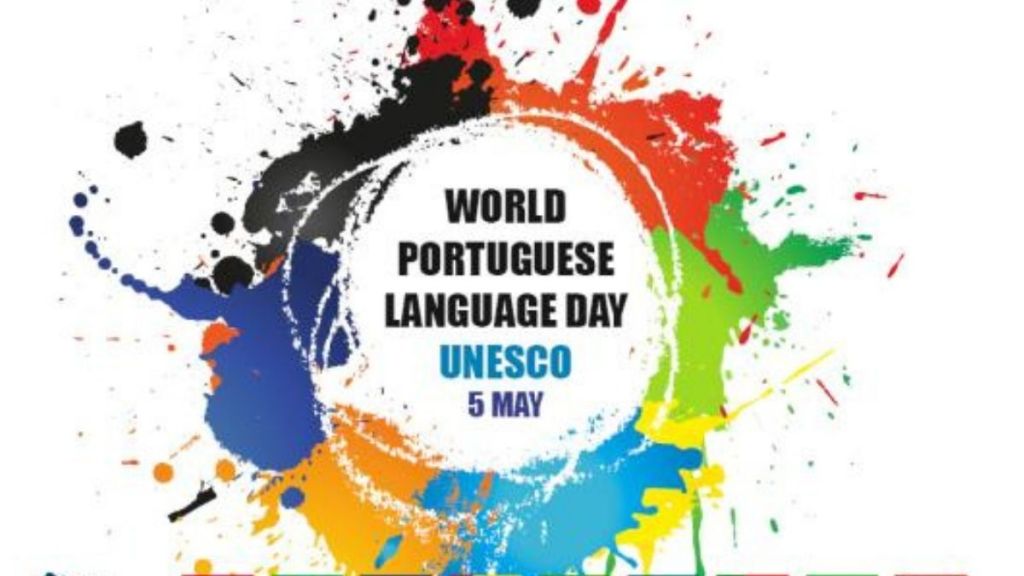
Portuguese is not just a language. It is a continent of voices, a raft of memory, a mirror of imagination, and on this May 5th, it is a celebration of everything we dare to say and sing in it.
Abraços! Feliz dia Mundial da Língua Portuguesa.
Diniz Borges
 Filamentos (artes e letras)