

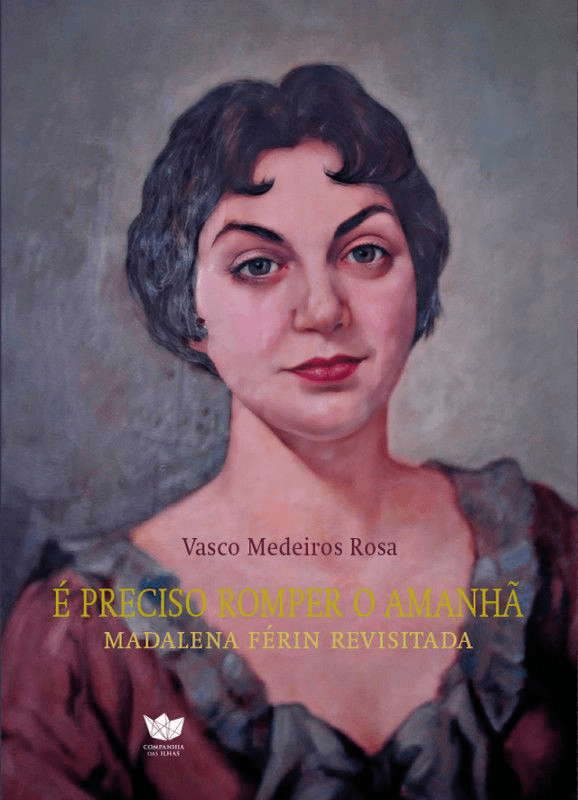
Twenty-twenty-three was notable as the year of Madalena Férin (1929-2010), with the coincidental publication of two books that have rescued this writer from oblivion: Violinos Ocultos sob a Relva, Poesia Reunida (1957-2003), Instituto Açoriano de Cultura), organized and introduced by Ângela de Almeida; and É Preciso Romper o Amanhã – Madalena Férin Revisitada (Companhia das Ilhas), coordinated by Vasco Medeiros Rosa.
Ângela de Almeida (a specialist on Natália Correia) and Vasco Medeiros Rosa (a renowned Brandonian) are the undisputed embodiments of a genuine vocation as literary researchers. We are in the presence of well-documented and informed essayists who accord careful and meticulous treatment to what they write – as they have the ability to inform, clarify, decipher and evaluate, incorporating methodologies from the most diverse branches of literary research into their work.
Maria Madalena Velho Arruda Monteiro da Câmara Pereira Férin belonged to a family that made its mark in literature and the arts at both the regional and national levels. She was the granddaughter of the physician and historian Manuel Monteiro Velho Arruda (1873-1950) and the daughter of neo-romantic poet Armando Monteiro da Câmara Pereira (1898-1974), and her brothers were Fernando Monteiro (engineer), Armando Monteiro (philosopher and poet), Jacinto Monteiro (priest and historian), and José Nuno da Câmara Pereira (1937-2018) (artist of national and international repute). From an early age she had the courage to fight for democratic principles and values. Her narrative fiction most clearly reflects her concerns with defending freedom.
At 27 she published her first book, Poemas (Coimbra Editora, 1957), then spent nearly two decades in silence, returning to poetry in 1984 with her book Meia-noite no Mar (Instituto Histórico de Ponta Delgada), followed by other publications: A Cidade Vegetal e Outros Poemas (DRAC/SREC, 1987), O Anjo fálico (DRAC/SREC, 1990), Pão e Absinto (Espaço XX1, D.L., 1998), Prelúdio para o Dia Perfeito (Salamandra, 1999), Quarteto a Solo, of which she was co-author (2000), and Um Escorpião Coroado de Açucenas (Hugin Editores, 2003) – titles now gathered into the above-cited book Violinos Ocultos sob a Relva.
Represented in several poetry anthologies and having won a number of literary prizes in the meantime, Madalena Férin also dedicated herself to fiction, publishing four titles: O Número dos Vivos (Instituto Açoriano de Cultura, 1990), and Salamandra’s Bem-vindos ao Caos (1996), Dormir com um Fauno (1998) and Africa Annes: o Nome em Vão (2001).
I became close to Madalena Férin in the ‘80s and’90s of the last century, when writers’ conferences organized by Daniel de Sá were held in Maia, São Miguel, and I surveyed some of her books. Since at the time I was early into my poetry phase, I received wise pieces of advice from her, one of which I have never forgotten: “Don’t sully poetry with words, but with ideas.”
What still strikes me as strange – because if there is one thing I appreciate about Madalena Férin’s poetry, it is, in fact, the splendid ambiguity of her poems – is the rhythm of her words, the pulsations and sounds of her verses. Proof positive that poetry has no end other than itself. It is up to the reader to uncover the side beyond the fog of the verse, so the text can be enjoyed (“le plaisir du texte,” per Roland Barthes).
Violinos Ocultos sob a Relva, Poesia Reunida (1957-2003) is irrefutable proof of a poetics of intimacy and an exaltation of the senses. Of the senses of a woman’s body, in all its secret plenitude. Of the woman from Creation as bearer of fire and proclaimer of the signs and mysteries of life and death – in the sense that woman is the beginning and end of all things.
Leaving behind her amorous lyricism for concerns of an existentialist and metaphysical nature, I have always been attracted to Madalena Férin’s enchanting poetry in her (erotic) search for love, dreams and happiness on the one hand, and on the other hand the symbolic universe: mythological imagery, biblical breath, search for cosmic unity. Where her ideas truly abound is doubtless in her narrative fiction – she who, a very attentive observer of reality, dissected her life (her soul) like Claude Joseph Vernet clinging to a ship’s mast in order to study a storm. I refer to the retroactivity of memory: the island’s sacred and initiatory space, childhood as an irretrievably lost paradise, life’s disillusionments and disappointments, the tragic grandeur of passions, interior journeys, reflections on the ephemerality of human existence, the questioning of the destiny of mankind on the world stage.
É Preciso Romper o Amanhã – Madalena Férin Revisitada brings together biographical data and literary archives about Madalena Férin. The objective is also to rescue from oblivion this writer born on the island of São Miguel (Vila Franca do Campo), but taken as a menina e moça to Santa Maria, her father’s island. After living there until 1958, she settled in Lisbon. From 1965 to 1975 she was in Faro, where she completed her secondary studies. She graduated in Philosophy from the University of Lisbon’s Faculty of Arts, and was a Senior Technician at the Instituto de Meteorologia e Geofísica in that city.
It is precisely about Madalena Férin’s life, poetry and prose that this book speaks through the critical reception of her work and testimonies from a vast gallery of authors: Álamo Oliveira, Amândio César, Ana Cristina Correia Gil, António Ferreira Monteiro, Armando Côrtes-Rodrigues, Eduíno de Jesus, Fernando Mendonça, Félix Rodrigues, Irene Amaral, Jaime Brasil, João Afonso, João Rui Mendonça, José Enes, José de Almeida Pavão, José Henrique Borges Martins, Maria Estela Guedes, Rebelo de Bettencourt, Ruy Galvão de Carvalho, Urbano Bettencourt, and the author of these lines.
We must hope that henceforth, the prose by this writer of undeniable quality will be collected so it can be read and understood as it deserves to be.
Originally published as “Madalena Férin Revisitada” in:
https://graciosadigital.blogspot.com/2024/03/opiniao-victor-rui-dores-madalena-ferin.html
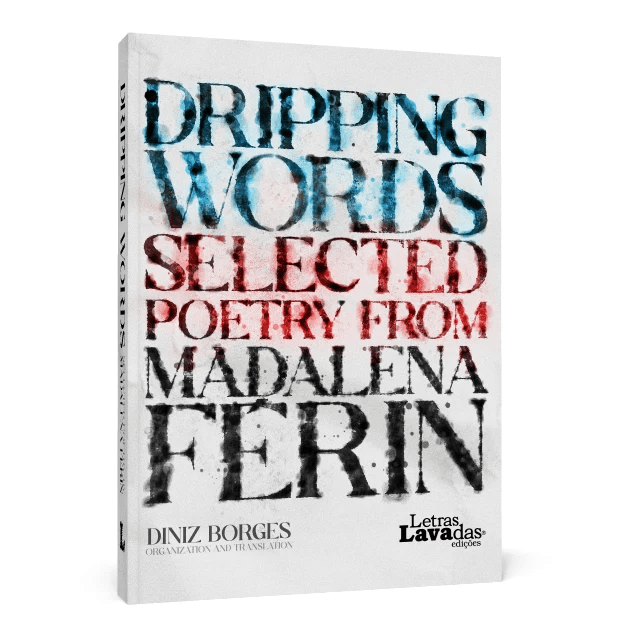
Note from Filamentos -PBBI-Fresno State: A selection of Madelana Férin’s work has now been translated into English and is available through Bruma Publications – PBBI, Fresno State.
 Filamentos (artes e letras)