
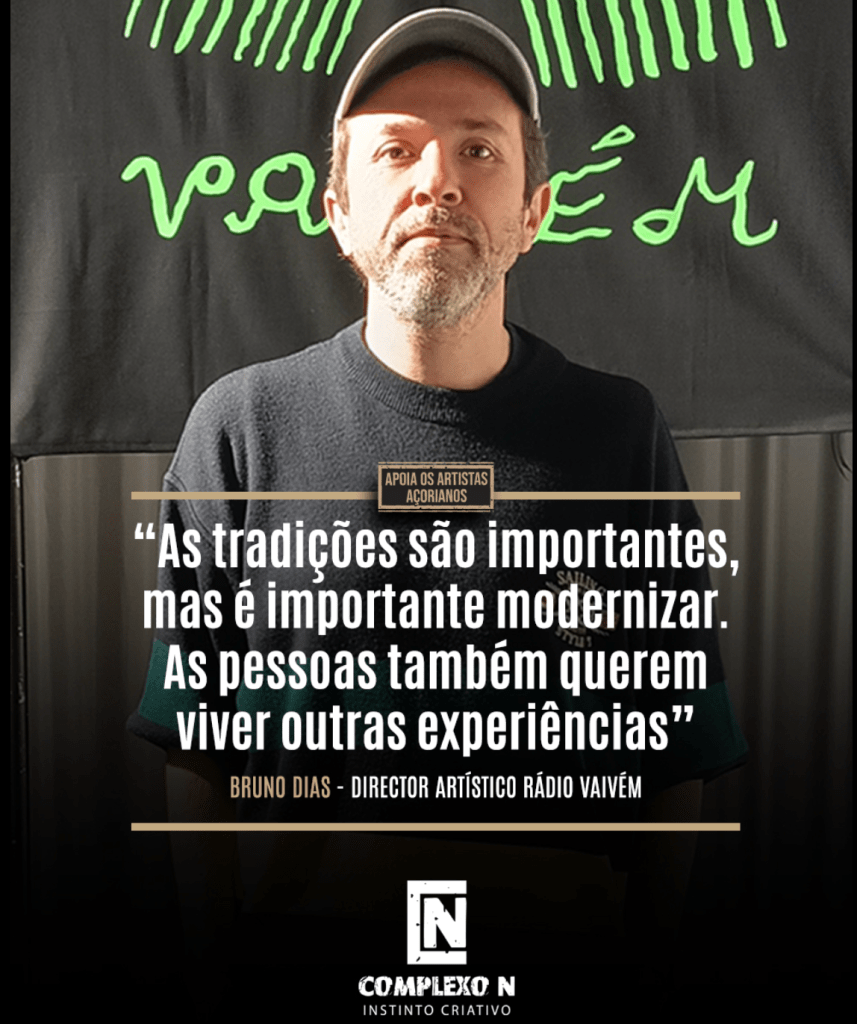
There are places where silence is not the absence of sound, but the absence of possibility—a quiet that settles not over landscapes, but over imagination itself. In the Azores, where the sea both isolates and connects, such silences have long shaped the rhythm of cultural life: the distance between islands and continents, between creators and audiences, between what is dreamed and what is made possible. It is within this delicate, often fragile interval that Rádio Vaivém emerges—not merely as a project, but as an act of insistence.
To call it a radio station is, in a sense, insufficient. It is not radio in the traditional, institutional meaning of the word, bound by frequencies, protocols, or commercial logics. Rather, it is a gesture—a movement, as its name suggests, a coming and going of voices, of ideas, of presences that seek one another across the dispersed geography of the archipelago. It is, above all, an attempt to restore something fundamental: the possibility of speaking and being heard.
Bruno Dias, one of the project’s guiding forces, speaks of its creation not as a sudden breakthrough, but as a slow, almost stubborn unfolding. More than three years passed between conception and realization—a period marked not by steady support, but by hesitation, misunderstanding, and, at times, indifference. Institutions, encountering the word “radio,” assumed commerce where there was none, structure where there was only an open invitation.
And yet, if the project was delayed, it was not diminished. What could not be built directly was approached obliquely. In the absence of recognition, they turned to creation—residencies for emerging artists, small, deliberate gestures that allowed the idea to breathe before it could fully speak. For four years, these residencies functioned as a kind of rehearsal, not only for Rádio Vaivém as a medium, but for a broader reimagining of what cultural participation might mean in the Azores.
There is something profoundly revealing in this trajectory. Rádio Vaivém did not begin as infrastructure; it began as relation. Before it became a platform, it became a network—of artists, collaborators, listeners, voices. In this sense, its eventual “permanent broadcast” is less a beginning than a continuation, the audible surface of a deeper, slower process of connection.
At its core lies a principle both simple and radical: that culture must be lived collectively, not consumed passively. The open calls that structure its programming reflect this ethos. They are not merely invitations to participate, but invitations to co-create—to shape the very fabric of the station’s voice. Some come from within the islands, others from beyond, drawn by the gravitational pull of a space that privileges experimentation over conformity.
And yet, even here, there is a careful balance. The project remains rooted in the Azorean context—not as a closed identity, but as a point of departure. It seeks the participation of those who inhabit the islands, whether by birth or by choice, insisting that the local is not a limitation but a foundation. The world may enter, but it must do so in dialogue, not in substitution.
What emerges from this structure is a form of radio that resists the conventional hierarchies of production. There is no strict adherence to journalistic codes, no pretense of academic authority. Instead, there is a space—what Dias himself calls a “pulpit”—for discourse, for conversation, for the unpredictable unfolding of thought in real time.
This refusal of rigidity extends to the very form of the broadcasts. Recorded programs coexist with the possibility of live transmissions, envisioned not as static studio events but as mobile encounters—voices carried into public spaces, into gardens and streets, where culture can intersect with the everyday. The image is almost poetic: a radio that leaves its own enclosure, that seeks the listener not through distance but through proximity.
Such gestures reveal the deeper ambition of Rádio Vaivém: not merely to produce content, but to transform atmosphere. To enter spaces marked by fragmentation or neglect and to infuse them with presence, with dialogue, with the subtle but powerful energy of shared experience. In this sense, the project becomes inseparable from the broader work of Silêncio Sonoro, the youth cultural association behind it—a collective committed to integration, to accessibility, to the idea that art must remain open, porous, and alive.
And yet, this vision does not exist without tension. The cultural landscape of the Azores, as Dias observes, is marked by a persistent negotiation between tradition and innovation. There is, on the one hand, a deep and necessary attachment to regional forms—histories, practices, identities that anchor the community. On the other, there is the pressing need to expand, to evolve, to make room for new expressions that do not always fit within established frameworks.
It is here that the limits of institutional support become most visible. Policies, shaped by electoral considerations and bureaucratic logic, often struggle to accommodate the fluidity that projects like Rádio Vaivém require. The result is a cultural ecosystem that can feel, at times, constrained—its potential partially realized, its energies unevenly distributed.
And yet, rather than retreat into critique alone, Dias and his collaborators choose action. There is, in his words, a quiet pragmatism: better to build than to complain. It is this ethos that lends the project its particular force—not an abstract idealism, but a grounded commitment to making something where there was nothing, to opening spaces where none existed.
The relationship with the Tremor festival further amplifies this dynamic. While the festival attracts an international audience, it also reveals a certain distance between global cultural circuits and local participation. The challenge, then, is not merely to bring the world to the Azores, but to ensure that the Azores remain present within that encounter—that the local voice is not drowned out by the global echo.
Rádio Vaivém, in this context, functions as a counterpoint: a space where that voice can be cultivated, sustained, and projected outward without losing its specificity. It is not an alternative to larger cultural events, but a complement—a quieter, more continuous form of engagement that persists beyond the temporal intensity of festivals.
Perhaps the most striking aspect of the project, however, is its insistence on remaining organic. The question of expanding into traditional broadcasting—acquiring a frequency, formalizing its structure—reveals an internal tension. For some, this represents growth, recognition, legitimacy. For others, including Dias, it risks losing the very spontaneity that defines the project.
There is, in this hesitation, a deeper philosophical stance: a refusal to equate scale with success, to assume that formalization necessarily leads to greater meaning. Rádio Vaivém, as it exists, is fragile—but it is precisely this fragility that allows it to remain open, adaptable, alive.
Looking ahead, the project continues to expand—not through grand gestures, but through sustained attention. Monthly concerts featuring emerging artists, free and accessible, extend its reach beyond the digital into the physical, creating moments of encounter that reinforce its central ethos.
And always, there remains the invitation: to listen, to participate, to contribute. To recognize that culture is not something given, but something made—together, imperfectly, persistently.
In the end, Rádio Vaivém is less a response to silence than a redefinition of it. It does not seek to eliminate silence, but to transform it—to turn it into a space of possibility, a threshold where voices may emerge, overlap, and resonate.
And in that resonance—in that fragile, necessary exchange between presence and absence—something like a community begins to take shape.
Based on an interview in Complexo
https://www.facebook.com/complexon.instintocriativo
 Filamentos (artes e letras)