
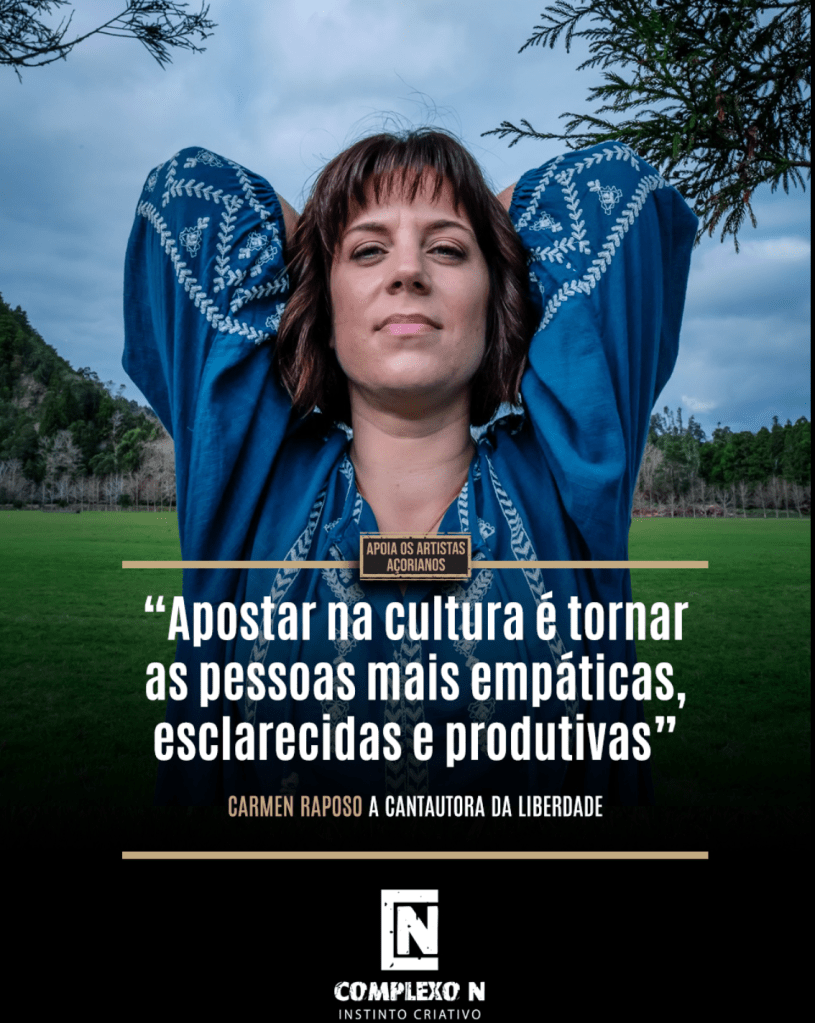
There was, perhaps, only one woman to sit behind a drum kit in a metal project in the Azores. For reasons that remain difficult to fully explain, the presence of women in this genre—and especially behind this instrument—continues to be rare. If only for that, Carmen Raposo stands as a monument to emancipation.
Yet it would be far too reductive to approach the musical journey of the 39-year-old artist from São Miguel, a professor of Economics, through that lens alone. Carmen Raposo grew up surrounded by music, instruments, and a constant current of inspiration—drawn not only from her father, Aníbal Raposo, one of the most significant figures in the Azorean songbook, but also from an “Azoreanness” that permeates her being. The Portuguese proverb “the child of a fish knows how to swim” seems almost tailor-made for her, especially when we consider family projects such as Bracinhos no Ar—a book/CD released in 2018—or Abril de Viva Voz, a tribute to the Carnation Revolution.
To speak of Aníbal Raposo is almost inevitable—and Carmen will forgive us for that. Projects like Construção, Rimanço, Albatroz, and countless others bearing her father’s imprint shaped her artistic environment, alongside the creative presence of figures such as Zeca Medeiros and Luís Alberto Bettencourt. Carmen grew up immersed in this constellation of wisdom and creativity. Yet she has carved her own path. Trained at the Regional Conservatory of Ponta Delgada in piano and classical voice, she carries that formation into her work as a composer—though not rigidly.
“Is it decisive? Yes and no,” she reflects. “There are those who compose great music without knowing theory. In truth, up until now I’ve composed mostly by intuition—starting with melodic fragments that come to me, and only later going to the piano to find the chords and develop them. Of course, knowing what chord I’m playing, whether it’s major or minor, what key I’m in—that helps, especially when trying to evolve and move beyond repetition. That’s exactly what I’m working on now: studying theory more deeply, harmonic fields, and so on, in order to grow.”
Though the piano is now her closest companion, it was through the drums that she first entered the world of bands. That band was SCHISM, and between 2002 and 2004 it spread gothic doom metal across festivals such as Rock in Ribeira Seca and Garage Hell. That pioneering—if brief—experience, interrupted by academic commitments, left a lasting imprint.
“I think it did,” she says. “Above all, it gave me a taste for original musical creation. Even though João Tiago, André Contente, and Ricardo Cabral created the base of the songs, I would shape the drums—sometimes following their guidance, but often with creative freedom. That desire to experiment, to try something different, came from that time. Also, the joy of playing with others, who become friends through musical complicity. And perhaps my inclination toward deeper lyrics and more intense sonic landscapes comes from that ‘metal school.’”
What Carmen Raposo has developed since 2021 is not entirely removed from metal, even if that may be the immediate impression when listening to her debut album, Estios e Tormentas (2023). Its ethnic, folkloric, indie, and even jazz-inflected textures—organic and emotionally resonant—remain connected, she explains, to that earlier world:
“There are differences, of course. Metal leans toward melancholy, introspection, darker tonalities, strong rhythmic patterns. But fundamentally, not so much separates them. We are still composing songs—writing lyrics, building structures, shaping intros, verses, choruses, bridges. In many ways, what unites us is greater than what divides us.”
Her words reveal a deeper truth: we are shaped by the paths we walk. Carmen does not forget the endless afternoons spent in a garage with friends who once believed they would always remain tied to music. Some did, others did not—but the friendships endured.
Asked whether she might return to metal, she smiles: “More likely a collaboration than forming a band—but life is full of surprises.”
Similarly, she reflects on the drums, her idols, and what that instrument offers that the piano does not:
“With drums, we exorcise emotions in a more physical way—sometimes more intense. But when I wasn’t playing in a band, I missed something: melody. I carry rhythm within me, but also a deep sense of melody. And singing became inevitable. Back then, my idol was Mike Portnoy. Today, listening to a lot of jazz fusion, I’d say Larnell Lewis.”
Carmen remains attentive to the regional music scene, including metal, though she notes fewer opportunities for live performance. Still, she insists, the Azores are filled with talented musicians.
Her current work brings together a remarkable ensemble: producer Mário Raposo, guitarist Stepan Kobyakin, Vasco Cabral, António Feijó, and Lázaro Raposo—artists of varied backgrounds, from metal to jazz, whose fusion of influences creates a richly textured soundscape. Portuguese popular music meets electric riffs, jazz-inflected drums, atmospheric keys—a synthesis both bold and organic.
It was with this formation that she captivated audiences at Música no Forte in Pico, on July 13—a long-awaited moment following logistical delays. Other milestones include the live debut of Estios e Tormentas at Lava Jazz in December 2023 and performances across the archipelago.
Carmen Raposo stands today as one of the most vital cultural voices of the Azores. Yet her path is not without difficulty.
“There is still much work to be done,” she says. “Artists should not have to chase opportunities. There is little spontaneous support. Not valuing what is ours is like killing the goose that lays the golden eggs. And yet, artists continue—often for the love of creation alone.”
Her critique extends further:
“We now have access to more music than ever before, yet I see a growing uniformity—people listening to the same things. Musical quality is declining. The tendency is toward what is easy, what sells quickly. And this is not just an Azorean issue—it’s global.”
Still, she persists. Planning concerts for 2026, developing a collaboration with Brazilian artist Ozi dos Palmares, and deepening her musical studies, she continues forward—writing, composing, evolving.
As her Ode to Liberation waits patiently for change, and her Essay on Time reminds her of the work ahead, Carmen Raposo moves with quiet determination—unshaken, unwavering, and deeply attuned to the music that continues to rise within her.
Listen to «Estios e Tormentas» aqui: https://carmenraposo.bandcamp.com/
«Dois Olhares» (videoclip): https://www.youtube.com/watch?v=PNNl-JoPhCk
«Compromisso» (videoclip): https://www.youtube.com/watch?v=c5DZC9t7nCg
Facebook:
Photo: Your Dance Insane
https://www.facebook.com/complexon.instintocriativo

 Filamentos (artes e letras)