
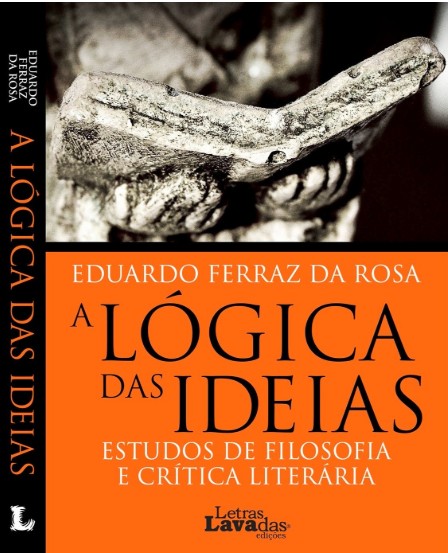
Not all books open—they unveil themselves. Others, rarer still, ask for silence before any reading begins, as if they demanded from the reader not merely attention, but an inward disposition, a readiness to enter a terrain where thinking itself becomes a mode of inhabiting the world. The Logic of Ideas – Studies in Philosophy and Literary Criticism, by Eduardo Ferraz da Rosa, belongs unmistakably to that demanding and luminous realm: not as a mere collection of essays, but as an architecture of the spirit, where each idea is tested, each concept interrogated, and each word becomes a threshold into meaning.
From its opening pages, the reader senses that this is not a systematic treatise in the conventional mold of academic philosophy, but rather a work of living thought—traversed by experience, memory, and a profound awareness of language as a site of revelation. The author himself acknowledges, in his introductory note, that many of the texts gathered here originated in diverse circumstances—lectures, colloquia, public interventions—and that they deliberately retain traces of orality, as if thought refused the enclosure of the page and insisted on remaining voice, breath, dialogue.
This is not a minor editorial detail; it is, rather, a hermeneutic key—a declaration of principles. For in this book, thinking is always situated, incarnate, lived. There is no cold distance of abstraction; instead, we encounter a philosophy inscribed in the density of time, in the sedimentation of readings, in the slow accretion of experience. Ferraz da Rosa confesses the impossibility of separating reading from life, language from thought—a gesture that condenses the essence of his project: “these two acts of life and existence… are those of Language and Thought.”
The division of the book into two parts—one devoted to philosophy, the other to literary criticism—is, in truth, merely formal. What sustains the work is a deeper unity, wherein philosophy and literature are in continuous interweaving. The former does not simply interpret the latter; the latter does not merely illustrate the former. Both coexist as complementary modes of access to the real, as distinct yet convergent ways of interrogating the human condition. Throughout, the reader is guided by a thinking that moves across authors, traditions, and disciplines without ever losing its center: the search for meaning—what the author himself calls his “determinative logic of ideas.”
In the first part, devoted to philosophical studies, we encounter a trajectory at once rigorous and profoundly personal. The chapters trace an expansive intellectual cartography, where ontology, noetics, ethics, theology, and the philosophy of language intersect. Yet Ferraz da Rosa does not merely revisit authors; he re-inscribes them within a living dialogue, reactivating each thought in the present, as if tradition itself were an unfinished conversation.
The opening study on José Enes is paradigmatic. Here, Ferraz da Rosa does more than pay homage to a master; he develops a meditation on philosophy as a project of life. From Enes’s work emerges the conviction that thinking is inseparable from existence—that philosophy is not an abstract exercise but a way of dwelling in the world. The notion of “expectant analysis,” which traverses several essays, embodies precisely this posture: a vigilant attentiveness to the real, a readiness to receive meaning before reducing it to categories. It is a philosophy that waits, that listens, that places itself in availability before being.
This availability extends to the author’s engagement with tradition. Far from uncritical adherence, Ferraz da Rosa practices a demanding reading, capable of discerning tensions and limits. In his discussion of Thomism and its encounter with Heideggerian phenomenology, he demonstrates not only analytical rigor but also the necessity of reopening thought to the originary experience of being—to that which precedes all conceptual construction. Hence his insistence on a “noetic-ontological experience… the origin and foundation of predicative knowledge.”
This search for the originary runs throughout the work. It is not a nostalgic return to the past, but a reencounter with the inaugural moment of thinking—the instant in which the human being “becomes aware that being is,” in a region prior to predication, where thought has not yet hardened into system.
It is here that language assumes a decisive role. Language is not merely an instrument; it is a site of manifestation. It is within language that being gives itself, that thought becomes possible, that the human is constituted as such. The author’s sustained attention to language—deeply influenced by Heidegger, yet critically distanced—reveals a conception of philosophy as a listening to the “speaking speech,” an attempt to access what is said before it is said.
Yet this listening is not purely intellectual; it is also ethical. For Ferraz da Rosa, thinking entails responsibility. Ontology cannot be severed from ethics; the understanding of being is inseparable from the ways in which we inhabit the world and relate to others. Ethics thus emerges as the dwelling place of existence—the space in which the human fulfills itself in openness to the other and to transcendence.
In the second part, devoted to literary criticism, this same logic of thought unfolds in another register. Literature appears as a privileged site of the revelation of the human, where language attains its maximum density. In reading Portuguese and universal authors, Ferraz da Rosa does not merely analyze; he listens, converses, and recognizes in them what philosophy itself seeks: a response—always provisional—to the question of meaning.
The literary criticism practiced here is thus a thinking criticism. It does not confine itself to formal or historical analysis, but seeks access to the ontological core of the work—to what it reveals about the human, about time, suffering, and hope. Each essay becomes an exercise in deep reading, in which the literary text emerges as interlocutor, mirror, and challenge.
It is precisely in this fusion of philosophy and literature that the work finds one of its greatest strengths. Rather than separating domains, the author builds bridges, demonstrating how thought can be at once rigorous and sensitive, analytical and symbolic. In this respect, his approach recalls a certain American essayistic tradition—one might think of Ralph Waldo Emerson or William James—in which philosophy emerges from lived experience rather than abstract system.
Yet Ferraz da Rosa remains distinctly anchored in the European tradition and its theological inheritance. His thought engages in dialogue with figures such as Augustine of Hippo, Thomas Aquinas, Immanuel Kant, Martin Heidegger, and Karl Rahner, situating itself within a continuity that affirms the spiritual dimension of existence. The human being is not merely a knowing subject; it is a being of transcendence—a dweller in mystery, a pilgrim of meaning.
This dimension becomes especially evident in the author’s conception of hope. In one of the most resonant moments of the book, hope appears not as illusion, but as a structure of thought itself—what sustains the possibility of meaning in the face of finitude. It is an ontological hope, rooted in the very mode of human being, rather than a mere psychological consolation.
The scholarly rigor of the work is undeniable. Its breadth of references, conceptual density, and sustained engagement with the Western philosophical tradition reveal an author of formidable erudition, fully aware of his place within it. Yet this erudition never devolves into display. It is placed at the service of a prose that remains close to experience—to life, to that which resists the abstractions of pure thought.
As Mendo Castro Henriques observes, we are confronted with a thinking that exists “between the rigor of thought and the vibration of the word,” where philosophy becomes a mode of presence before the world. To think is not merely to know; it is also to live, to feel, to listen. It is an act that engages the entirety of being.
There is, in many passages, a cadence akin to prayer—not in a strictly religious sense, but as a form of recollection, of openness to the invisible. The word is no longer merely a vehicle of ideas; it becomes a meeting place between the human and the mystery. As the author suggests, philosophy may become a form of fidelity—to being, to the world, to the other, to the unseen.
In the end, what remains is the sense of having traversed not merely a book, but a horizon. The Logic of Ideas offers no definitive answers, nor does it seek to enclose thought within formulas. Instead, it opens paths, suggests possibilities, invites continuous reflection. It demands of the reader not only intelligence, but availability—an openness to think, to doubt, to inhabit language as a space of encounter with the real.
In an age in which thought so often succumbs to fragmentation and superficiality, this work stands as an act of resistance—against haste, simplification, and the forgetting of the essential. It reminds us that thinking is a demanding act, but also a profoundly human one: a gesture of fidelity to the real, to the other, to the invisible.
And so we return to silence—not an empty silence, but a fertile one, where words remain in vigil and thought continues to germinate within time. For this book does not end: it extends, it lingers, it questions. And in that rare gesture of lucidity and beauty, Eduardo Ferraz da Rosa emerges as one of the major voices of contemporary Portuguese thought—an author who does not merely write ideas, but restores them to their originary place: as dwelling, passage, and destiny of the human
Diniz Borges
Note: This is a translated version of an essay I wrote in Portuguese and published in the newspaper Atlântico Expresso.
 Filamentos (artes e letras)