
“In central California, on the outskirts of Tulare—a city twinned with Angra do Heroísmo since 1966—where I grew up and became a man.”
—Diniz Borges, The Infinite Blue
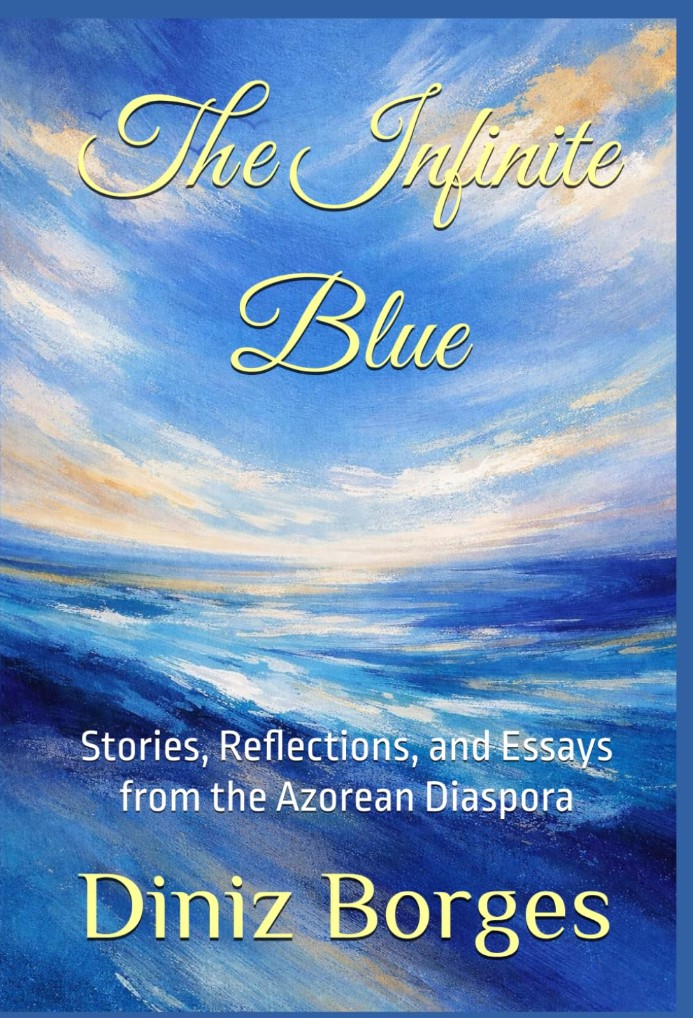
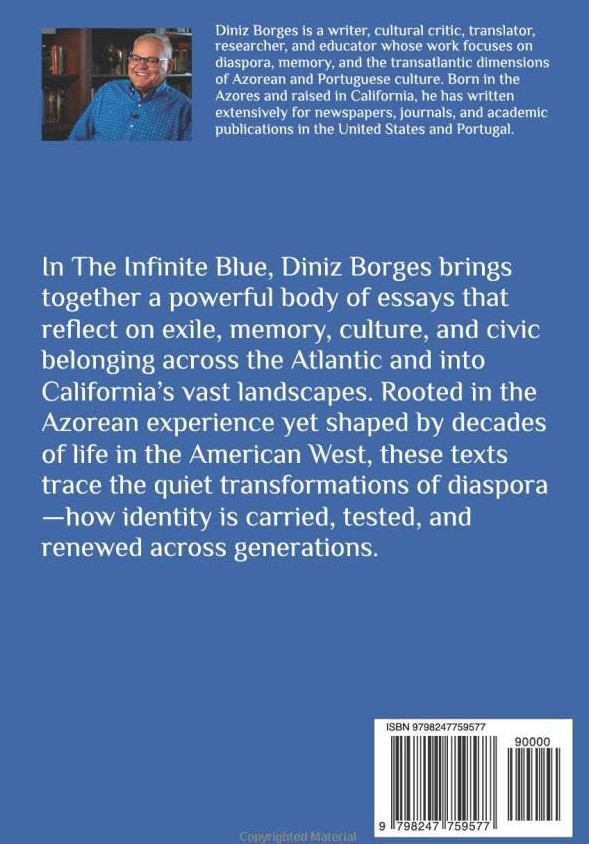
The most recent book by Diniz Borges, The Infinite Blue: Stories, Reflections and Essays from the Azorean Diaspora, is by far the finest book in English of essays on the history and experience of our diaspora in North America. Its subtitle says everything else: Stories, Reflections and Essays. At last, our first immigrant generation in the United States begins to write—brilliantly—in English, in order to pass on the word of our immigrant epic to those already born there, those who follow us and continue to carry their Portuguese ancestry as one of the defining references of their lives and their destiny.
This is not merely a book of essays. It is a book in whose pages both pain and happiness flow: literature and stories, across their various genres, as witnesses to what we once were here in the Azores and to what we are on that other distant side of the Atlantic—a side that never separated us, that was always our path to salvation in times of misery, of unconsciousness, or even the brutality of regional elites and of the rest of the country, which scarcely saw us depart in tears from the miserable docks where we boarded ships and later airplanes that carried us in our sorrow. That departure, once so traumatic, was nonetheless marked by a wounded calmness and by courage.
Most of those who governed us in those muddy times—mud in the streets and in the soul—did not even see us leave. They remained in their inherited comfort, never earned through their own labor. The Azores have a double history: Portuguese and American. The miracle is that those who were, in effect, voluntarily expelled forgave everything—and continue to forgive even today—and, with the passing of the years, have always helped sustain the well-being of those same men and women who once strolled through our finer streets and through other privileged geographies. Each of our emigrants who lands today in the Azores annually can scarcely imagine how they continue to sustain both their former and their new exploiters. We were and remain the greatest source of their wealth, for we owe nothing anymore, beyond our loyalty to our origins and to the land of our love—here and on that other side which was always our destiny.
The Infinite Blue, for those who may not know, simply means O Azul Infinito. Then comes the subtitle: Stories, Reflections and Essays from the Azorean Diaspora. Yes, it is a tribute to our homeland, but it is also a vision of our communities in movement beyond the Espírito Santo and its sopas. The literature, reflections, and essays in this book contradict almost everything we once thought about our lives in North America. Manual laborers, certainly—but then came the generation that now tells our story, that elevates us in some of the finest pages written in its native language, the language of the country where they were born. Novels, poetry, essays, testimonies in the most varied contexts have given—and continue to give us—the “news” of both our misfortune and our happiness.
This modernist immigrant literature, which begins in the 1990s, opens a wide breach that continues without pause in both the United States and Canada: who we are, where we came from, how we lived and survived. From the labor of milking other people’s cows to the entrances into the finest universities of California. Diniz Borges recalls his past and those closest to him in order to advance, through literature—especially now in the language of our first immigrants’ descendants—stories that continue to be told of the islands and of the great country to which their ancestors went. No one among us had done this before: a book in the language of our descendants so that they would never forget. Literature as memory—his thought begins with departure and moves toward our balanced integration into the new society, without ever wounding our own being.
The writers Diniz Borges cites in this book are many, too many to name without omission. Yet one must necessarily open a kind of parenthesis: from Katherine Vaz in California to Anthony de Sá and Erika de Vasconcelos in Toronto, some of these supreme works have even been translated in our country. Our literature in the English language owes nothing to the best Portuguese literature, whose thematic calls never cease to absolve our history, our “condemnation,” and our joy in the discovery of new worlds and new lives. The inattention of Portuguese criticism is what it is—nothing. Its arrogance, almost always confined to theoretical questions that signify little, says little, or merely repeats the worst of criticism imported from Paris and eagerly adopted by academic criticism in certain North American faculties. Their loss. Never the loss of the greatness of this new literature of portugalidade in another language. I know well that they are “universalists”—it is only the neighbor who is excluded, confined to his own street or his own house.
The Infinite Blue says what we needed to hear—or to read. It affirms respect for and continuity of our traditions, and then the step forward. Fortunately, Diniz Borges has always fought for this cause: the memory of the past and, once again, our essential integration into the great North American society. The dignity of a great people has little to do with language, or with living in two languages, or even in languages that are carved between English and Portuguese. Portugal expands in this way: with its people, masters of themselves in another country, never forgetting where they came from, in their dual and never conflicting loyalties.
The blue—The Infinite Blue—is the sign of our existence: the blue of our triumph at the edge of the Atlantic and the Pacific. The joyful dreams and the tragic yet triumphant feeling of our destiny. The Infinite Blue is not just any book; it is that testimony of an immigrant who has made—and continues to make—his work within the university, at California State University, Fresno—incidentally, my own university system, alma mater, though I am at another campus farther south, in Fullerton. When a colleague of mine writes a book of such greatness, it is as if it were my own, or the book I never wrote. The greatness of a friend and colleague becomes, in part, my own.
To read this book is to understand—to understand fully—who we were and what we are.
Vamberto Freitas, Literary Critic.
Diniz Borges, The Infinite Blue: Stories, Reflections and Essays from the Azorean Diaspora (graphic composition: Avelina da Silveira; Bruma Publications and Moonwater Editions – printing and distribution: Amazon, 2026).
Originally published in BorderCrossings, Açoriano Oriental, April 3, 2026.
 Filamentos (artes e letras)