
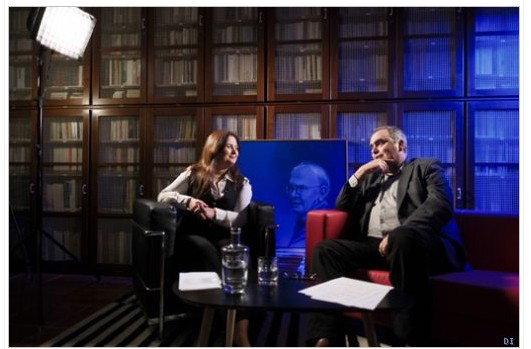
In the quiet, almost reverential atmosphere of the conversation series “Na Biblioteca do Álamo,” organized by the Parish Council of Raminho with the support of the municipality of Angra do Heroísmo, the voice of maestro Antero Ávila offered more than recollection—it offered testimony. Interviewed by Andreia Fernandes, Ávila did not simply remember Álamo Oliveira; he reconstructed, through memory and music, the contours of a creative partnership grounded in instinct, trust, and an unspoken understanding of the Azorean soul.
Their meeting, as Ávila recounts, was born not of familiarity but of need. At the time, he was searching for a text to accompany a musical commission—Arquipélago, a work envisioned as a kind of symphonic poem, guided by words that could evoke the islands beyond sound. Acting on intuition, he sought out Álamo Oliveira, a writer he did not yet know personally. He went to his home in Angra, introduced himself, and explained what he was looking for.
The response was immediate, generous, and revealing of Oliveira’s creative clarity: “Give me two or three days, and it will be done.” And it was. What might have been a single collaboration became, instead, the beginning of a sustained artistic dialogue.
From that moment forward, the two continued to work together in ways both formal and festive. In the tradition of the Azores, where the marchas de São João animate communities with color, rhythm, and collective memory, they created several pieces together—modest in number, perhaps, but rich in resonance. They also collaborated on occasional works, composed for specific moments and purposes, each carrying the signature of a shared sensibility.
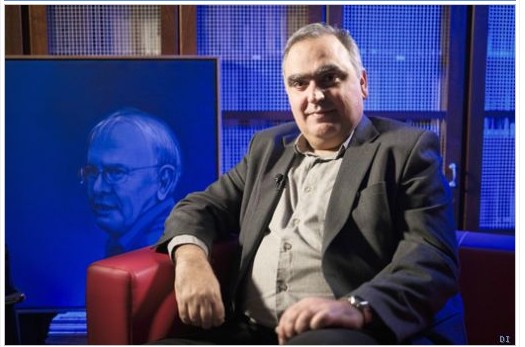
Among these, one stands above the rest in scale and significance: the opera Boas Festas Senhor Natal. For Ávila, it remains one of the most ambitious compositions of his career—and the most substantial project he shared with Álamo Oliveira. It is in works like this that Oliveira’s lyrical strength found its fullest musical expression, expanding beyond the page into the realm of performance, voice, and communal experience.
And yet, what most astonishes Ávila is not simply Oliveira’s productivity or versatility, but the paradox at the heart of his talent: he had no formal musical training.
“He didn’t study music,” Ávila reflects, “but he had an extraordinary sensitivity.” This sensitivity is perhaps most vividly captured in the song “O Povo Todo”, a piece Ávila describes as “spectacular”—a rare instance in which Oliveira shaped both word and music into a unified artistic gesture. “He did exactly what he wanted there,” Ávila notes, suggesting a kind of intuitive mastery that bypasses convention.
That instinct extended even into sacred music. Long before many knew him for his literary work, Oliveira had written lyrics for liturgical compositions—some now difficult to find—set to music by Dionísio Costa, who would later emigrate to the United States. Among these, Ávila highlights “Esta Noite,” a Christmas hymn he describes as one of the most beautiful of its kind. Its power lies not only in its theological depth, but in its profoundly human tone—an echo, perhaps, of Oliveira’s enduring preoccupation with dignity, community, and the shared condition of being.
When asked how such musical thinking is possible without formal education, Ávila resists easy explanation. His own life in music began early, shaped by teachers and structure, and for a time he believed music to be a universal language, accessible to all in the same way. Experience has taught him otherwise.
“There are people,” he says, “who understand without being able to explain, or without ever having been taught.” These individuals possess a rare capacity—to feel structure without studying it, to intuit rhythm without naming it. “All musicians need a bit of that,” he adds. “But some have it entirely on their own.”
Álamo Oliveira belonged to that rare category.
In his words, music was already present. In his silences, one could hear its form. And in the collaborations he forged—with Antero Ávila and others—he revealed that lyricism, at its highest level, is not confined to literature or composition, but lives in the delicate space where both meet, and recognize each other.
Adapted from an interview by Andreia Fernandes, published in Diário Insular, José Lourenço-director.

 Filamentos (artes e letras)