There are artists who carve objects, and there are those who carve memory itself. Catarina Alves belongs to the latter. In her hands, stone is not inert—it breathes, it remembers, it carries the slow pulse of volcanic time and the quiet insistence of identity.
Born in the parish of Candelária, on São Miguel Island, she grew up where the land is both teacher and inheritance. Rural life, she recalls with pride, offered not scarcity but abundance—of textures, of silence, of materials waiting to be understood. As a child, she gathered fragments of the natural world, as if already rehearsing the gestures of her future. The basalt underfoot, the weight of earth and sky, the quiet discipline of island life—all of it would one day find form in her work.
Her path, though shaped by the Azores, extended outward. She studied sculpture at the Faculty of Fine Arts in Lisbon, completing her training in 2004, yet never abandoning the gravitational pull of her origins. Even then, her work—such as Ao Romeiro, a sculpture rooted in Azorean ritual and devotion—spoke in the language of return. The islands were not a subject; they were the grammar of her art.
And so, it is perhaps inevitable that her work now travels across the Atlantic—not as departure, but as continuation.
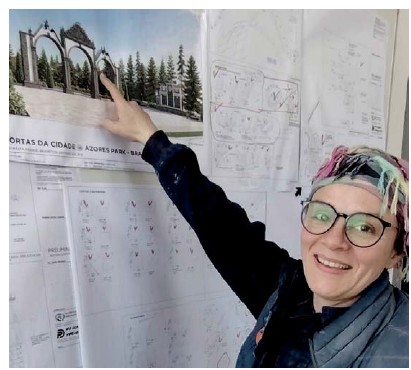
In Canada, where the Azorean diaspora has long replanted fragments of the archipelago, Catarina Alves has been invited to create and coordinate the construction of a replica of the Portas da Cidade of Ponta Delgada, to be installed in Brampton. The project is at once architectural and symbolic: stone crossing ocean to rebuild a threshold of belonging. Each piece, carved with urgency and care, will be shipped by sea, taking weeks to arrive—an echo of older journeys, when crossing the Atlantic was both rupture and hope.
What she builds, then, is not merely a structure. It is a passage. A memory rendered in basalt. A way for those who left to recognize themselves again in stone.
Her work moves between scales with remarkable fluency. From monumental structures to intimate objects, she sustains a singular vision: that material matters, that origin matters, that identity can be both rooted and evolving. Through her project Pedras de Lava, she transforms volcanic rock into jewelry—pieces that carry the weight of geology yet rest lightly on the body. These works, now present in places like Toronto, are not ornaments alone; they are portable fragments of the Azores, worn close to the skin.
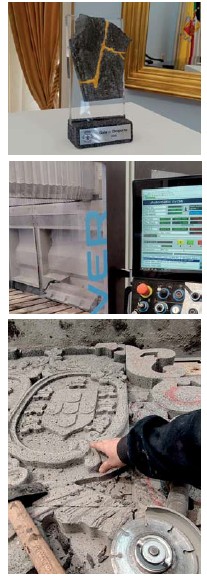
There is also a quiet politics in her work—one not shouted, but inscribed. The trophy she designed for the Gala do Desporto de Ponta Delgada, inspired by the ancient Greek figure of Victory, becomes in her interpretation something more intimate: a tribute to women who endure, who persist, who reshape themselves against the grain of expectation. Even in absence—the missing head and arms of the original statue—there is power. Perhaps especially there.
“Working with stone is gratifying,” she says. It is a simple sentence, but it contains an entire philosophy. Stone resists. It demands patience. It requires the body. In a world increasingly mediated by speed and surface, her work insists on weight, on friction, on time.
And yet, she does not reject the present. She embraces new technologies that ease the physical burden of sculpting, calling them allies rather than replacements. The ancient and the contemporary coexist in her practice, much as they do in the Azores themselves—a place where lava flows and digital networks share the same horizon.
Between her atelier in Candelária and her work abroad, between the basalt of São Miguel and the diaspora communities of North America, Catarina Alves inhabits a space of continuity. She is not simply exporting art; she is extending a cultural vocabulary across oceans.
There is something deeply Filamentos about her work—the way it threads together place and displacement, matter and meaning, the island and its many elsewhere.
And in the end, what remains is this: stone that travels, stone that remembers, stone that, in the hands of an Azorean sculptor, becomes not just form, but story.
A story first brought to light by journalist Marco Sousa, Correio dos Açores-Natalino Vieiros, director.
 Filamentos (artes e letras)