
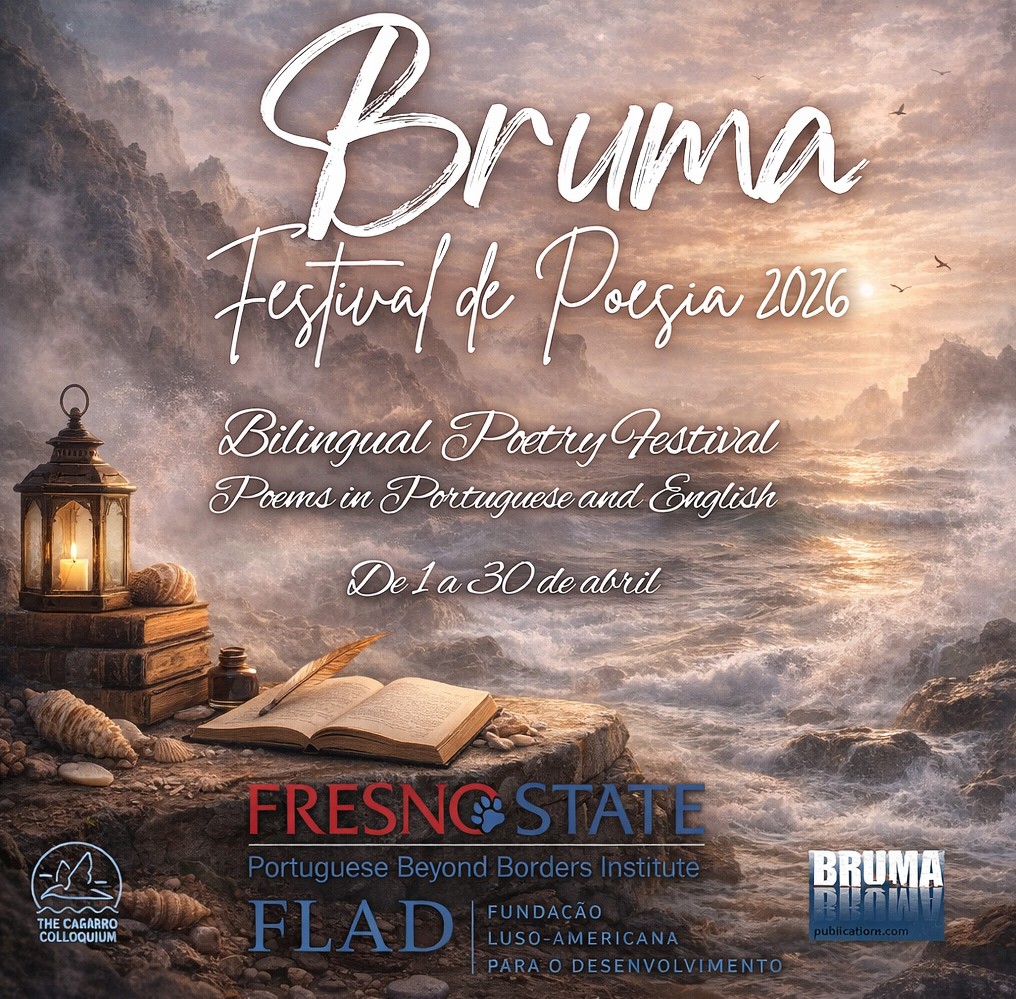
In the first five days of April, something quiet and luminous unfolded. Not with the noise of spectacle, nor the urgency of headlines, but with the patient rhythm of words finding their way into human hands. Fifteen poems—fifteen distinct voices—rose from the Azores, mainland Portugal, Brazil, and the Portuguese diaspora across North America, gathering not as fragments, but as a chorus.
And in that brief span of days, nearly six thousand people paused—if only for a moment—to listen.
This is the quiet revolution of poetry. It does not shout; it reaches. It does not impose; it invites. Through screens and shared pages, through the intimate gesture of reading and passing along a poem, Bruma Poetry Festival has become something more than an event. It is a space of encounter. A crossing of geographies and generations. A place where language remembers its oldest purpose: to connect.
Each poem carries a different tide—the insularity of the islands, the vastness of Brazil, the layered memory of the mainland, the lived experience of the diaspora. Yet together, they form something singular: a testament to the enduring need for voice. For in a world often saturated with noise, poetry offers something rarer—attention. It teaches us to listen not only to words, but to one another.
To thank those who read, who share, who carry these poems beyond their original moment, is to recognize that culture is not sustained by institutions alone, but by people. By the simple, radical act of saying: this matters, and I will pass it on.
For what is poetry, if not a rehearsal for empathy? A way of stepping into another life, another landscape, another silence? It is through poetry that we learn to see more deeply, to feel more honestly, to inhabit the world with greater care. In its lines, we are reminded that we are not alone—and that our responsibility to one another does not end at the edge of our own experience.
Bruma believes, fundamentally, in the democratization of culture. That no voice is too small, no language too distant, no experience too marginal to be brought to the center. That poetry belongs not to the few, but to all who are willing to listen—and to speak.
And perhaps, in these fifteen poems, in these six thousand quiet encounters, we glimpse something essential: that a better world does not begin with grand declarations, but with small acts of attention. With the willingness to read, to reflect, to be moved—and then, to act with greater kindness, greater awareness, greater humanity.
Join us—read a poem you love, in Portuguese or in English, and take a moment to explore the links below, where these voices continue to live.
https://www.facebook.com/reel/2380970489037144
https://www.facebook.com/reel/1426377258746294
https://www.facebook.com/reel/1378053870729153
https://www.facebook.com/reel/1496124965256894
https://www.facebook.com/reel/968848968945935
https://www.facebook.com/reel/1457668712492789
https://www.facebook.com/reel/1669344074056906
https://www.facebook.com/reel/1859688194729870
https://www.facebook.com/reel/937864205529319
https://www.facebook.com/reel/2828712590854544
https://www.facebook.com/reel/2392469084607332
https://www.facebook.com/reel/1440675824463090
https://www.facebook.com/reel/1346294560652762
https://www.facebook.com/reel/25967996879566740
 Filamentos (artes e letras)