Poetry has never belonged to the clamor of crowds or the restless hunger for spectacle. It begins elsewhere—in the quiet margin, in the breath between words, in the intimate act of one voice reaching toward another. And yet, in this age of luminous screens and shared distances, poetry has found a new way of traveling. Through the democratization of culture and the quiet, persistent force of social media as a vessel for the arts, the poem now crosses oceans in an instant, enters homes unannounced, and gathers not masses, but moments. The whisper, carried far enough, becomes a chorus.
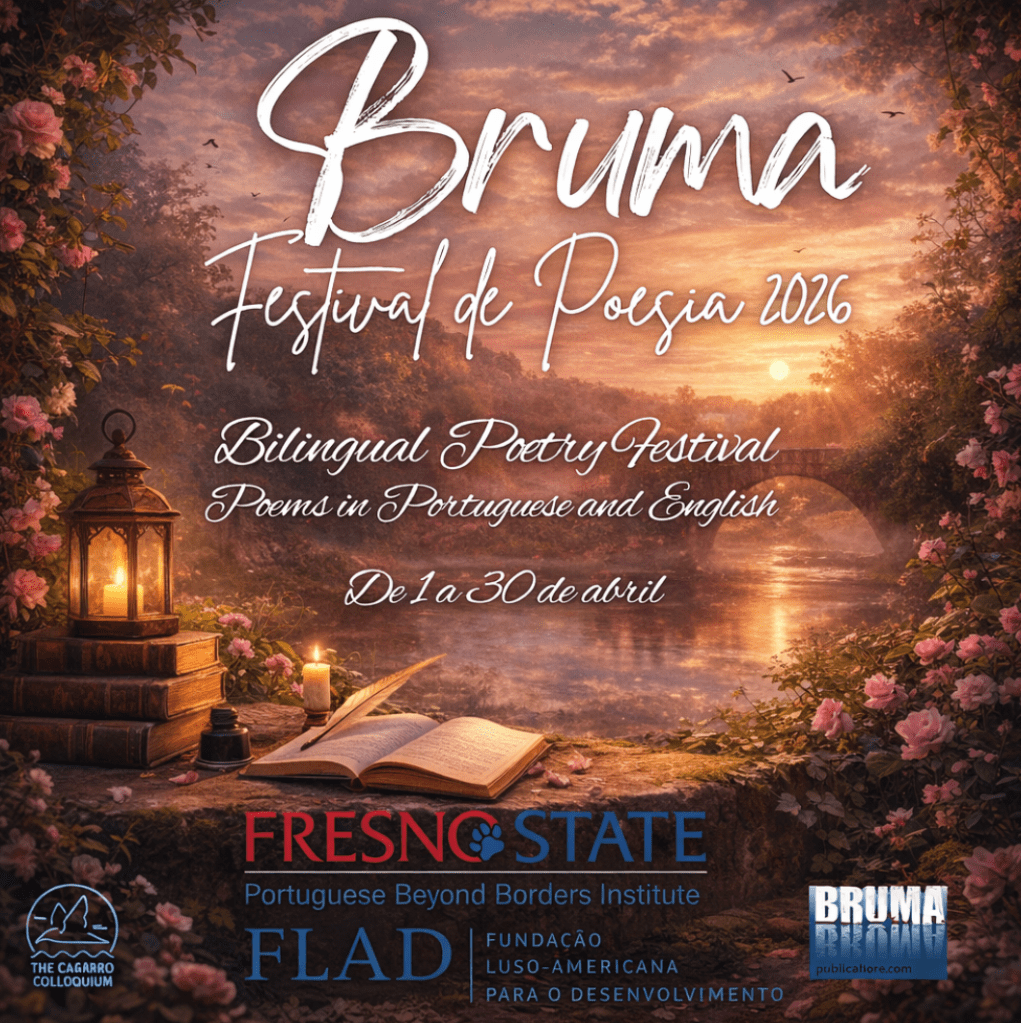
It is within this expanded, borderless space that the Bruma Poetry Festival, the largest Portuguese poetry festival in North America, unfolds—not as a single place, but as a constellation of voices. Portuguese and English meet here not as translations alone, but as living crossings. Poets from across the Portuguese-speaking world stand beside voices of the diaspora, and beside them, readers—those who carry poems not as profession, but as a quiet necessity of being.
The opening day is marked by memory and continuity, by the presence of those who are no longer with us and the voices of those who carry their fire forward. Two poems by Natália Correia rise like constellations over the festival’s first hours. Correia, fierce and unyielding, remains one of the great moral and imaginative forces of Portuguese letters. Her poetry, at once lyrical and incendiary, reminds us that language can be both sanctuary and weapon. To read her today is to feel the urgency of freedom, the necessity of dissent, and the sacredness of human dignity. In Bruma, her voice is not remembered—it is reawakened.
And then, from the Azores—those islands that have always known how to speak through silence and storm—comes Avelina da Silveira, offering two poems that seem to emerge from the volcanic breath of the Atlantic itself. Avelina’s poetry carries within it the cadence of resistance and tenderness, often intertwined. Her lines move between the intimate and the political, between the body and the land, between memory and a future still being carved. In her voice, one hears not only the Azores, but the enduring pulse of those who refuse to be erased.
Across the ocean, yet bound by that same invisible thread of heritage, Sam Pereira brings his own offering—poems shaped in the landscapes of California but haunted, gently, by ancestral echoes. Pereira’s work is marked by clarity, wit, and an understated emotional precision. He writes of place, of family, of the quiet negotiations of identity, where the past is never fully past, and where language itself becomes a bridge between what is inherited and what is chosen. In his reading, the diaspora is not a loss—it is a widening.
This is how Bruma begins: not with spectacle, but with convergence. Three poets—one remembered, two present—yet all part of the same unfolding conversation. Portuguese and English intertwine. The islands speak to the continent. The past leans toward the future.
But this first day is only an opening gesture. Bruma is not a closed circle—it is an invitation.
Throughout this month of April, the festival calls upon poets, readers, and lovers of poetry from across the world to join in this shared act of attention. You may bring your own poem, or the poem of a poet you admire. You may read in Portuguese, or in English translation. What matters is not the origin of the voice, but the sincerity of its offering.
In a time that too often fractures, Bruma insists on gathering. It asks, quietly but firmly, that we listen—to language, to one another, to the fragile music of being human. It calls for peace not as abstraction, but as practice; for respect not as rhetoric, but as daily gesture; for empathy and kindness not as ideals, but as necessary acts of survival.
Send your poem. Lend your voice. Enter this tide of words.
Because somewhere, in the space between languages, between islands and continents, between memory and hope—
a poem is waiting to be heard.
Abraçoos,
Diniz Borges
Please tsake a look at today’s poems:
https://www.facebook.com/reel/2380970489037144
https://www.facebook.com/reel/1426377258746294
 Filamentos (artes e letras)