
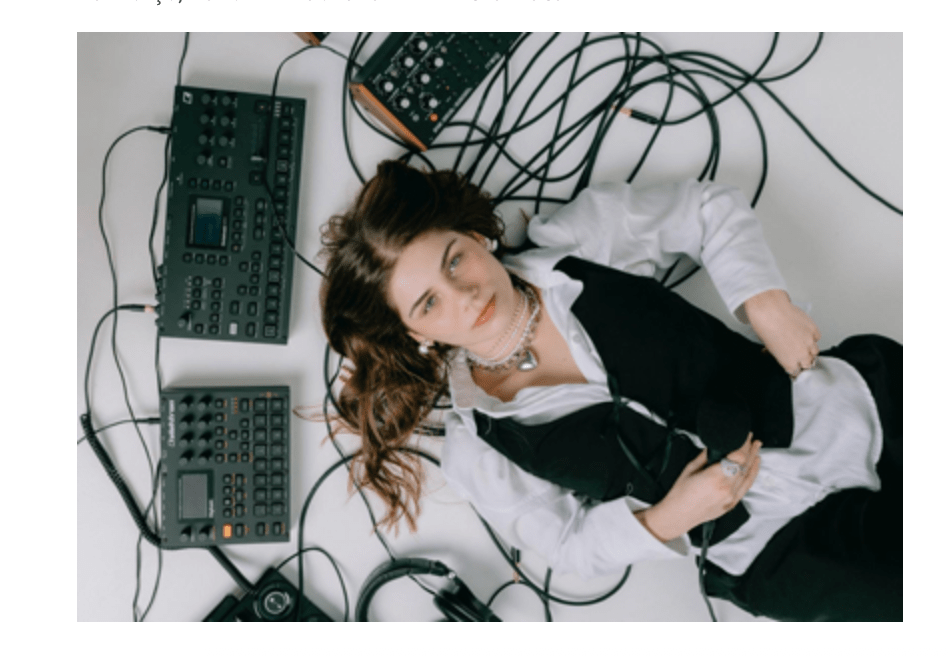
There are artists who compose music, and there are artists who listen—to the world, to the moment, to the fragile and fleeting pulse of human presence. BETIX belongs to the latter. Her work does not begin in the studio nor end on the stage; it unfolds somewhere in between, in that trembling space where sound becomes breath and time dissolves into rhythm.
She was not born into silence. Her earliest memories are shaped by an island alive with culture, where festivals echoed across the landscape and music lingered in the air like salt. Family, too, carried this inheritance—bands, instruments, the quiet insistence that sound matters. And yet, the path toward techno was not inherited but discovered, as if unearthed from within. Curiosity became her compass. She listened widely, wandered across genres, and, in that restless search, found a language that felt like her own—a language made not only of beats, but of emotion, texture, and depth.
But to call her a DJ would be to misread the essence of her craft. Her true allegiance is to creation. From the beginning, her desire was not to play what already existed, but to give shape to something new—music drawn from the interior, from that intimate space where feeling becomes form. This impulse led her toward production, and from there, toward an even more radical act: the refusal of fixity.
In her live performances, nothing is predetermined. Sound is not reproduced; it is born. Each set is an act of emergence, an unfolding conversation between artist and audience. She constructs her music in real time, allowing imperfection, accident, and intuition to guide the process. There is, in this, a profound humanism. For what is more human than the unfinished, the evolving, the uncertain?
She speaks of energy as if it were a shared language—and perhaps it is. In the space of performance, something circulates: she offers, the audience returns, and between them a fragile symbiosis takes shape. Music becomes collective, co-authored by presence. If the room leans inward, the sound follows. If it surges outward, so too does the rhythm. Nothing is fixed because nothing is separate. The artist listens as much as she creates.
And therein lies the quiet radicalism of her work: the insistence on being fully present. In an age defined by acceleration, distraction, and digital fragmentation, her performances demand attention—not as discipline, but as surrender. To create in real time is to risk, to trust, to inhabit the now without guarantee. It is, in its own way, an ethics of existence.
Her journey has not been without milestones—stages across Portugal, from Plano B to Ministerium, a moment in Berlin’s iconic Hör, the gradual widening of a career that now begins to move outward, toward an international horizon. Yet these markers feel almost secondary. What matters more is the continuity of search: the building of identity, the finding of community, the slow articulation of a voice that resists simplification.
To understand BETIX, however, one must return to the islands. The Azores are not merely a place of origin; they are a condition of being. Isolation, vastness, the constant dialogue between land and ocean—these elements shape not only landscape but sensibility. There is, in her work, a kind of insular authenticity, an affinity with the underground precisely because it resists spectacle. Here, music grows in small gatherings, in informal spaces, in moments unburdened by commerce. It is shared because it must be, because it belongs to those who feel it.
And yet, she does not romanticize limitation. The Azorean scene, she acknowledges, is still fragile, still emerging. It holds immense potential, but also constraint. Festivals like Tremor stand as proof that something is changing—that the islands can become not only a periphery, but a center of experimentation, a site where difference is not diminished but amplified.
To perform at Tremor, then, is not merely a professional achievement; it is a return. A circle closing. Years ago, she wrote its name in a notebook, as one writes a dream. Now, that dream becomes sound, carried across the same landscape that first taught her to listen. There is pride in this, but also something quieter: a recognition that place and creation are inseparable.
And so she prepares—not with a fixed script, but with openness. The set will not be delivered; it will be discovered. Fragments, references, possibilities—all will be shaped by the energy of the room. Once again, the symbiosis. Once again, the act of listening.
In the end, what BETIX offers is not simply music, but an experience of time reclaimed. A reminder that creation can still be immediate, that art can still be shared in its most vulnerable form, that presence—true presence—is perhaps the rarest and most necessary form of resistance.
For in her work, sound does not fill silence.
It reveals it.
Adapted from a marvelous interview done by journalist Jose Henrique Andrade for Correio dos Açores-Natalino Viveiros, director.
 Filamentos (artes e letras)