
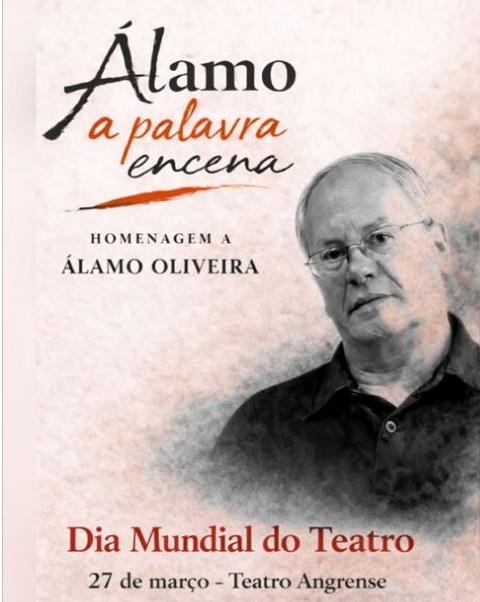
On World Theatre Day, a stage in Angra becomes more than a stage—it becomes a memory, a conversation, a living archive. Tonight at the Teatro Angrense, a group of actors, collaborators, and disciples gather to honor Álamo Oliveira, a towering figure widely regarded as the father of modern theater in Terceira and across the Azores.
You are staging and performing in Álamo, the Word on Stage, a tribute to Álamo Oliveira. How did this production come to life?
The production began as an invitation from the City Hall of Angra do Heroísmo—a way to mark World Theatre Day with a tribute to someone who, quite simply, reshaped what theater meant here. Of course, theater existed before Álamo. But what he created in the 1970s and 1980s—those years of transition, of open wounds, of a fragile and uncertain freedom—was something else entirely. He gave us what we came to call a new theater. Not a comfortable one. Not theater as harmless entertainment or as an illustration of ideas already accepted. His was a theater that unsettled, provoked, demanded. It asked questions before it offered answers.
What dimensions of his life and work does the performance explore?
We trace his journey, though necessarily in broad strokes—his life was too vast to fit into a single evening. We touch on his poetry, and because this is World Theatre Day, we focus on his foundational role in shaping modern Azorean theater: the creation of Alpendre, the invitations he extended to pioneering artists, the boldness he brought to the stage. But we also return him to the place that shaped him—the parish of Raminho. Álamo was a man of the land, of community. In Raminho, he did everything: decorated the church, rehearsed choirs, designed embroidery patterns, wrote lyrics for local musical groups, staged bailinhos. As people say there, “there are stories of him in nearly every house.”
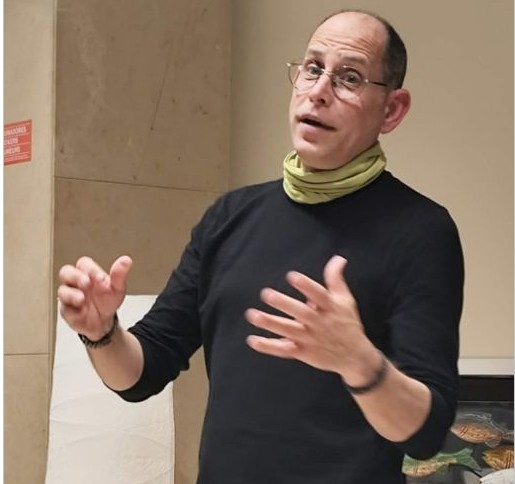
Who joins you on stage for this tribute?
Some of us walked beside him in the theater and in life—Mimi Bertão, Judite Parreira, Carmo Amaral, Jorge Medeiros, and me. But we also have four performers who embody different facets of Álamo—Pedro Marques, Luís Cabral, Luís Peixoto, and Hugo Mendonça—each carrying fragments of his voice, his thought, his presence. The visual component is by João Gomes, with essential support from Ana Rocha Bertão, Belarmino Ramos, and Belinha Simões. It’s a collective act of remembrance.
What was it like to work with Álamo Oliveira? What stays with you?
For me—and for so many of us—Álamo was formation in the deepest sense. Not just theatrical or artistic, but cultural. Working with him meant growing from the inside out. It meant being in constant dialogue with intelligence, with rigor, with a kind of lived erudition. He was demanding—precise, exacting—but also disarmingly human. There were moments when he argued with us, moments when he laughed with us. But never—not once—did he humiliate or diminish anyone. That was his measure. I worked on many productions with him. Being alongside him shaped my entire career. He was not the one who gave me my first steps in theater—but he was, without question, my father in it.
What is his legacy in theater today? And is it fully recognized?
His legacy is so vast that it depends on who you ask. If you are from Raminho, you will speak of everything he gave to that community. If you are part of the diaspora, you will point to his extraordinary writing on emigration. If you are a reader of poetry, you will hold his verses close. And if you love theater, you understand that he transformed it. He gave us a new language for the stage. For me, though, his greatest legacy lies in something rarer: his ability to be both an erudite writer and a man of the people—to write with the people, not above them. That duality is what endures. That is what remains.
In the end, the performance is not simply a tribute—it is an act of continuity. On this night, in Angra, Álamo Oliveira returns not as memory, but as presence: a voice still shaping the stage, still asking what theater can be when it dares to mean something.
Interview in Diário Insular-José Lourenço, director.
 Filamentos (artes e letras)