
It is often said—perhaps too easily—that island societies exist in a state of “isolation.” What conclusions have Island Studies begun to reach in response to this assumption?
One of the most significant contributions of Island Studies has been its sustained and rigorous critique of isolation as the defining condition of insularity. The persistence of this perception, I would argue, stems largely from a continental gaze—one that mistakes geographic discontinuity for cultural marginality. Yet historically, and even today, many islands have functioned as vital nodes within broader systems: along trade routes, within migratory circuits, in military logistics, and across the infrastructures of global tourism.
This colloquium seeks precisely to create a space where such assumptions can be unsettled. Without denying the singularities of insular life, it invites us to deepen and complicate our understanding of insularity—to move beyond both its romanticization and its reduction to a mere condition of separation.
When we consider different islands—or different archipelagos—do we encounter more commonalities or more differences in the experience of insularity?
We encounter both, though we must resist the temptation to essentialize. There are, of course, structural features that recur: territorial discontinuity, the omnipresence of the sea, small scale, and a heightened exposure to environmental risk. These elements shape experience in meaningful ways.
Yet insular life unfolds within profoundly diverse historical, economic, and geopolitical contexts. The lived reality of a European Atlantic island differs markedly from that of a Caribbean archipelago or a small Pacific island. Insularity, then, is not a singular condition, but a field of variations—a constellation rather than a category.
Does life on islands—contrary to expectations of fragmentation—allow for a deeper cultivation of human relationships and a closer bond with nature?
This notion belongs to a long-standing imaginative tradition in which the island appears as a space of authenticity, communal cohesion, and ecological harmony. In certain contexts—particularly in smaller communities—there may indeed be traces of such a dynamic.
But contemporary islands are fully embedded in the currents of globalization: mass tourism, international mobility, technological transformation. The accelerated tempo of modern life does not halt at the shoreline. Insularity, in itself, does not determine a way of life; rather, it creates conditions within which particular relationships to place may emerge.
The forthcoming colloquium, to be held on São Miguel, offers precisely this interplay between concept and lived experience—encouraging participants to think insularity not only as an abstraction, but as something inhabited, situated, and felt.
Is there, in island contexts, a stronger preservation of collective memory?
In some cases, the spatial concentration of communities and the continuity of generations may indeed foster a heightened attention to memory and heritage. Yet even here, caution is necessary. Many islands are shaped by migration, diaspora, forced displacement, and ongoing processes of cultural recomposition.
Memory, in these spaces, does not simply endure—it is continually reworked. Preservation and reinvention exist side by side, each informing the other in a dynamic interplay of identity.
Do literature and the arts produced by those who live on—or come from— islands possess distinctive characteristics?
Space undoubtedly exerts an influence on artistic creation, though not in a deterministic or linear way. Across many insular literatures, we find recurring motifs: the tension between land and sea, the dialectic of departure and return, migration, liminality, the consciousness of boundaries.
Yet the island itself is a figure of remarkable symbolic plasticity. The insular imagination is not confined to those who inhabit islands; rather, the island occupies a central place in the broader Western literary and cultural tradition.
It is precisely this multiplicity of representations that inspired the creation of the doctoral program in Island Literatures and Cultures at the University of the Azores. To think cultural production through the lens of insularity is to open pathways toward comparative and interdisciplinary readings—approaches that are, to my mind, especially generative.
Do climate changes pose a particular threat to island populations—human, animal, and vegetal? How is this question being approached in the Azores?
In island environments, environmental transformations often become visible with greater immediacy: rising sea levels, the increased frequency of extreme weather events, mounting pressures on fragile ecosystems. In the Azores, such concerns have assumed an increasingly central place within both public discourse and academic inquiry.
At the same time, literature and culture play a crucial role in cultivating awareness—rendering visible, through narrative and form, the urgency of these transformations.
The first colloquium on “Island Literatures and Cultures” took place in 2023. What were its principal contributions to the field of Island Studies?
The inaugural colloquium, under the theme “Islands, Identities, Alterities,” allowed us to consolidate a genuinely interdisciplinary space of dialogue. Bringing together around fifty scholars from diverse geographies, it fostered a network of research committed to thinking islands not as isolated cases, but as interconnected sites shaped by shared historical and cultural dynamics.
Its most enduring contribution, perhaps, lies precisely in that network—a community of inquiry that continues to evolve.
The second edition, scheduled for October 2026, takes as its theme “The Island as Crossroads: Mobility, Domination, and Hybridity.” Why this focus?
The choice reflects the historical moment we inhabit. Islands are once again emerging as strategic spaces within global dynamics—geopolitical, environmental, migratory, and touristic.
To think the island as a crossroads is to shift the interpretive frame: away from marginality and toward circulation; away from periphery and toward encounter. It is to recognize islands as sites where movement, conflict, and cultural recomposition converge—places not at the edge of the world, but at the very intersections through which the world is continually remade.
Original publication available via CHAM – Centre for the Humanities.
Available in Portuguese at: https://cham.fcsh.unl.pt/destaque.php?p=5739
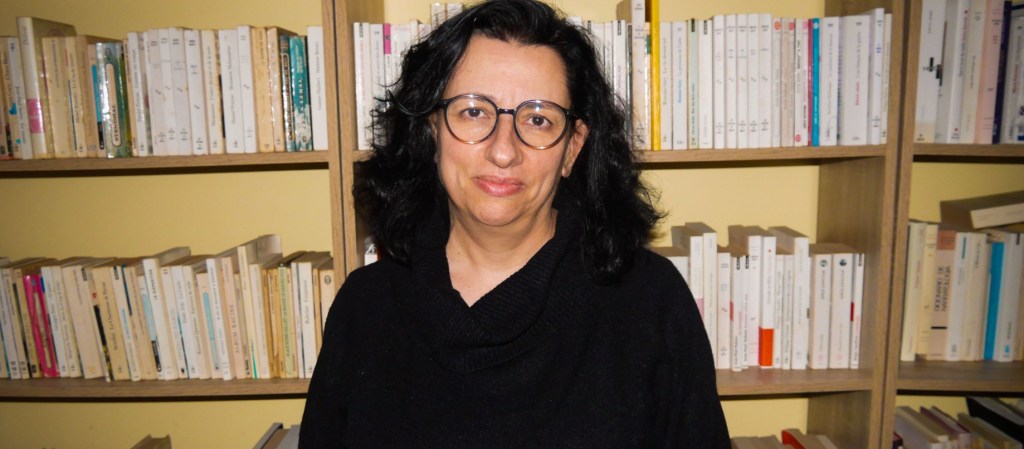
The Portuguese Beyond Borders Institute at California State University, Fresno, thanks CHAM for allowing the translation and publication of this interview with Professor Dominique Faria from the University of the Azores, and we encourage academics and researchers in North America to consider presenting at this unique conference.
 Filamentos (artes e letras)