
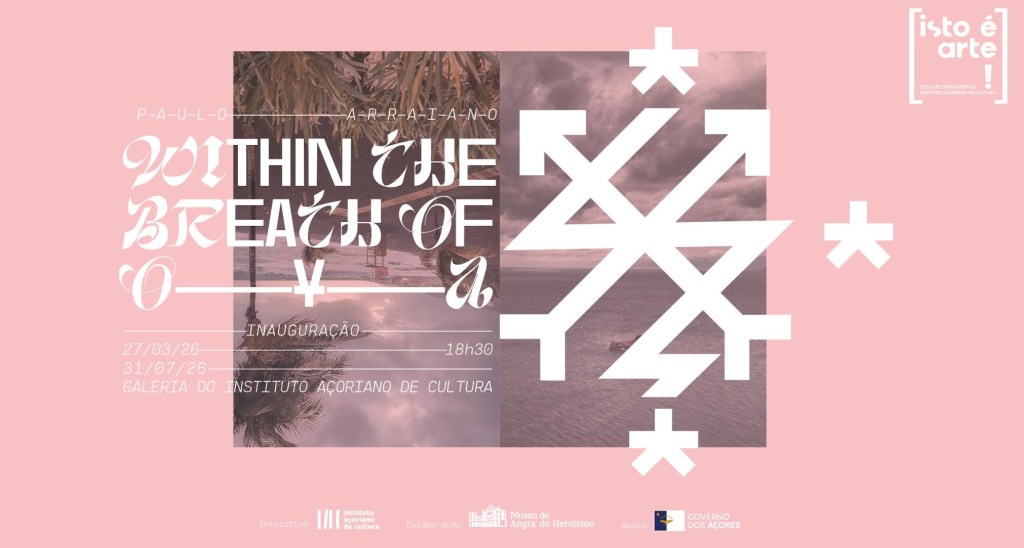
Some exhibitions unfold quietly; others arrive like weather. Within the Breath of Oyá, opening March 27 at the Galeria do Instituto Açoriano de Cultura in Angra do Heroísmo, belongs to the latter—an atmosphere as much as an exhibition, a gathering of forces that move between the visible and the sensed, the historical and the immediate.
Presented by the Instituto Açoriano de Cultura, this new body of work by Paulo Arraiano situates itself within the vast, unsettled field of the Atlantic. It is not the ocean as postcard or horizon, but as archive—dense with crossings, memories, fractures, and continuities. The exhibition invites viewers into a space where geography becomes thought, and where the sea speaks in layers: of migration, of displacement, of return, of transformation.
Arraiano, born in Portugal in 1977, has developed a practice that resists fixed categories, moving across visual art, digital inquiry, and ecological reflection. Trained in visual communication and shaped by an interdisciplinary sensibility, his work has been exhibited internationally, from Lisbon to Madrid, London to Los Angeles. Across these contexts, he has consistently explored the entanglements of technology, nature, and human experience—how systems, both natural and constructed, shape the ways we see, move, and belong.
In Within the Breath of Oyá, these concerns converge around a powerful conceptual axis: Oyá, the Yoruba orisha of wind, storm, and transformation. More than a reference, Oyá becomes a presence—an organizing force that animates the exhibition’s inquiry into change and instability. Wind, here, is not metaphor alone; it is movement itself, the unseen energy that carries histories, signals, bodies, and voices across time and space.
The Azores, suspended between continents and narratives, emerge as a privileged site for this meditation. Arraiano reads the archipelago as both witness and participant in the long history of Atlantic circulation—colonial routes, diasporic trajectories, and the ongoing flows of globalization. The sea appears as both connective tissue and open wound: a space of encounter, but also of rupture, where inequalities have been inscribed and sustained.
One of the exhibition’s most compelling gestures is its quiet reconfiguration of historical continuity. The caravels of the early modern Atlantic find their echoes in today’s satellites, submarine cables, and digital infrastructures. What once crossed the ocean in wood and sail now moves through fiber optics and orbit—yet the underlying dynamics of exchange, power, and mobility persist. Arraiano does not draw this parallel didactically; rather, he allows it to surface gradually, as a recognition that the present is never as new as it claims to be.
Throughout the exhibition, there is a sustained attention to relationship: between community and environment, between identity and movement, between the local and the planetary. Scientific perspectives, artistic intuition, and diasporic memory are brought into a shared field of reflection, suggesting that no single framework can fully account for the complexity of contemporary experience.
Open through July 31, Within the Breath of Oyá offers more than an encounter with contemporary art—it proposes a way of thinking through the conditions of our time. In an age shaped by acceleration, climate uncertainty, and technological saturation, Arraiano’s work returns us to elemental forces, reminding us that transformation is not an exception, but a constant.
To stand within the breath of Oyá is to feel the world in motion—to recognize that we are carried within larger currents, historical and atmospheric alike. And in that recognition, perhaps, lies the beginning of a different kind of awareness: one attuned not only to where we are, but to the forces that continue to shape how we arrive there.
Adapted from a Press Release from the Institute Açorian de Cultura (IAC).
 Filamentos (artes e letras)