There are distances that cannot be measured in miles, nor reduced to the neat geometry of maps. They exist instead in the body—in the tightening of the chest, in the quiet dread of departure, in the arithmetic of sacrifice that precedes every necessary journey. Dona Fulana knows this distance well.
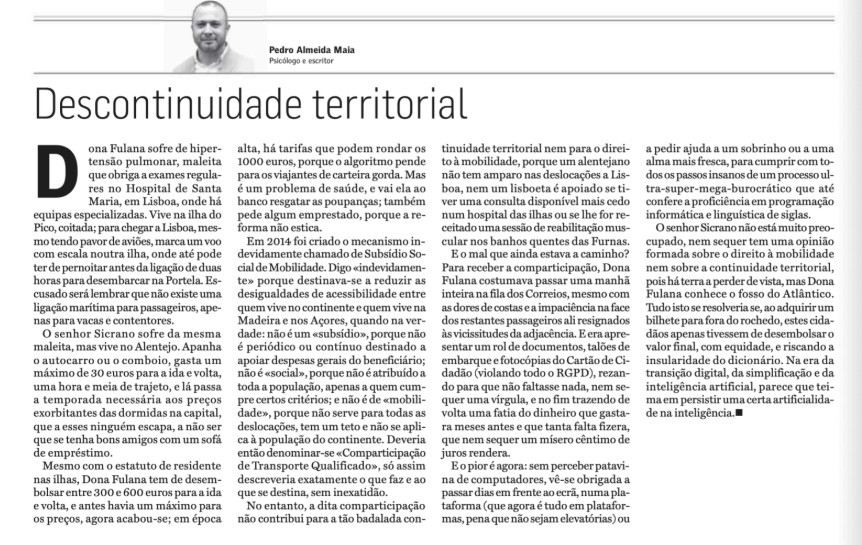
She lives on Pico Island, where the Atlantic presses against the land with both beauty and indifference. She suffers from pulmonary hypertension, a condition that requires regular examinations at the Hospital of Santa Maria in Lisbon, where specialized teams can attend to her. To get there—despite her fear of flying—she must book a flight with a layover on another island, where she may even be forced to spend the night before catching a second, two-hour connection that will finally bring her to Lisbon’s Portela airport. There is, needless to say, no passenger ferry to carry her across the sea—only ships for cattle and containers.
Meanwhile, Mr. Sicrano suffers from the very same illness, but he lives in the Alentejo. He boards a bus or a train, spends no more than thirty euros for a round trip, and travels for an hour and a half. Once in Lisbon, he endures the same punishing cost of lodging as everyone else—unless, of course, he is lucky enough to have a friend with a spare couch. His journey is burdensome, but it is not prohibitive.
For Dona Fulana, even with her status as a resident of the islands, the cost of travel ranges between three hundred and six hundred euros for a round trip. Once, there was a cap on these prices; now, that ceiling has vanished. During peak season, fares can climb to nearly a thousand euros, as algorithms tilt their favor toward those with deeper pockets. But illness does not negotiate. So she goes to the bank, withdraws her savings, borrows what she must, and makes the journey anyway—her pension, like so many others, stretched to its breaking point.
In 2014, the Portuguese government introduced what it called the Social Mobility Subsidy. The name, however, is a fiction. It is not truly a “subsidy,” since it is neither periodic nor designed to support the general expenses of its recipients. It is not “social,” because it does not apply universally, but only to those who meet specific criteria. And it is not about “mobility,” because it does not cover all travel, is subject to caps, and excludes mainland residents altogether. A more honest name might be Qualified Transportation Co-Payment—a term as inelegant as it is accurate, and therefore unlikely ever to be adopted.
Yet even this so-called support fails to uphold the much-invoked principle of territorial continuity or the basic right to mobility. An Alentejan receives no assistance when traveling to Lisbon. A Lisboeta is not supported if an earlier medical appointment becomes available in the islands, or if a doctor prescribes rehabilitation in the thermal baths of Furnas. Continuity, it seems, is a word more often spoken than practiced.
And then there is the machinery of access itself. To receive reimbursement, Dona Fulana once had to spend entire mornings standing in line at the post office—back aching, patience thinning, surrounded by fellow travelers resigned to the bureaucratic rituals of insularity. She would present a stack of documents: boarding passes, photocopies of her Citizen Card—sometimes in ways that skirted the edges of data protection laws—hoping that nothing was missing, not even a comma. Months later, a portion of the money would return to her, stripped of any interest, long after it had been needed most.
Now, the process has been “modernized.” Not understanding computers, she finds herself forced to spend days in front of a screen, navigating a platform—because everything now happens on platforms, though rarely the kind that lift people up. She must ask a nephew, or some younger, more digitally fluent soul, to help her through the labyrinth of an ultra-super-mega-bureaucratic system, one that demands not only patience but a working knowledge of programming logic and an alphabet soup of acronyms.
Mr. Sicrano, for his part, does not give much thought to the right to mobility or to territorial continuity. He has land stretching as far as the eye can see. But Dona Fulana knows the depth of the Atlantic—not as a poetic abstraction, but as a lived divide.
All of this could be resolved, quite simply, if, when purchasing a ticket off her island, she were asked to pay only a fair and final price—one that acknowledged her condition not as a disadvantage, but as a reality to be addressed with equity. It would mean erasing insularity not from geography, but from policy—from the quiet injustices that persist beneath the language of modern governance.
We live, we are told, in an age of digital transition, simplification, and artificial intelligence. And yet, stubbornly, there remains something profoundly artificial about our intelligence still.
Translation by Diniz Borges
Notes elaborated with online research and personal knowledge:
In Portuguese, names like Fulano and Sicrano—sometimes joined by Beltrano—are not real people at all (or might be to describe someone without their name), but stand-ins for anyone and everyone. They function much like the American “John Doe,” “so-and-so,” or “what’s-his-name,” depending on the tone. They appear when the speaker either doesn’t know, doesn’t remember, or simply doesn’t find it necessary to name the person. In everyday speech, they carry a certain ease, a shorthand for the anonymous figures who populate our stories, complaints, and passing conversations.
Fulano (or Fulana, in the feminine) is usually the first figure to appear—the generic “this guy” or “that woman,” the unnamed subject of a story. Sicrano follows as the second, the “other guy,” the one who comes after, as if the narrative needed another shadow to complete the scene. And when the phrase expands to Fulano, Sicrano e Beltrano, it takes on a broader, almost symbolic meaning: not just a few unnamed people, but anyone at all—“Tom, Dick, and Harry,” or “this person, that person, and the next.”
There is something quietly poetic in these names. They suggest that the story being told is not about a single individual, but about a condition, a pattern, a shared human circumstance. In that sense, Fulano is never just one person. He—or she—is all of us when we become interchangeable in the face of larger systems, when our names matter less than the roles we are forced to play.
The words themselves trace back to Arabic—fulān—meaning simply “a certain person,” someone undefined. And perhaps that is their deeper resonance: they remind us that behind every unnamed figure in a story, there is a real life, a real struggle, even if the name has been momentarily set aside
These creative non-fiction chronicles are being published in Portuguese in the newspaper Açoriano Oriental.
 Filamentos (artes e letras)