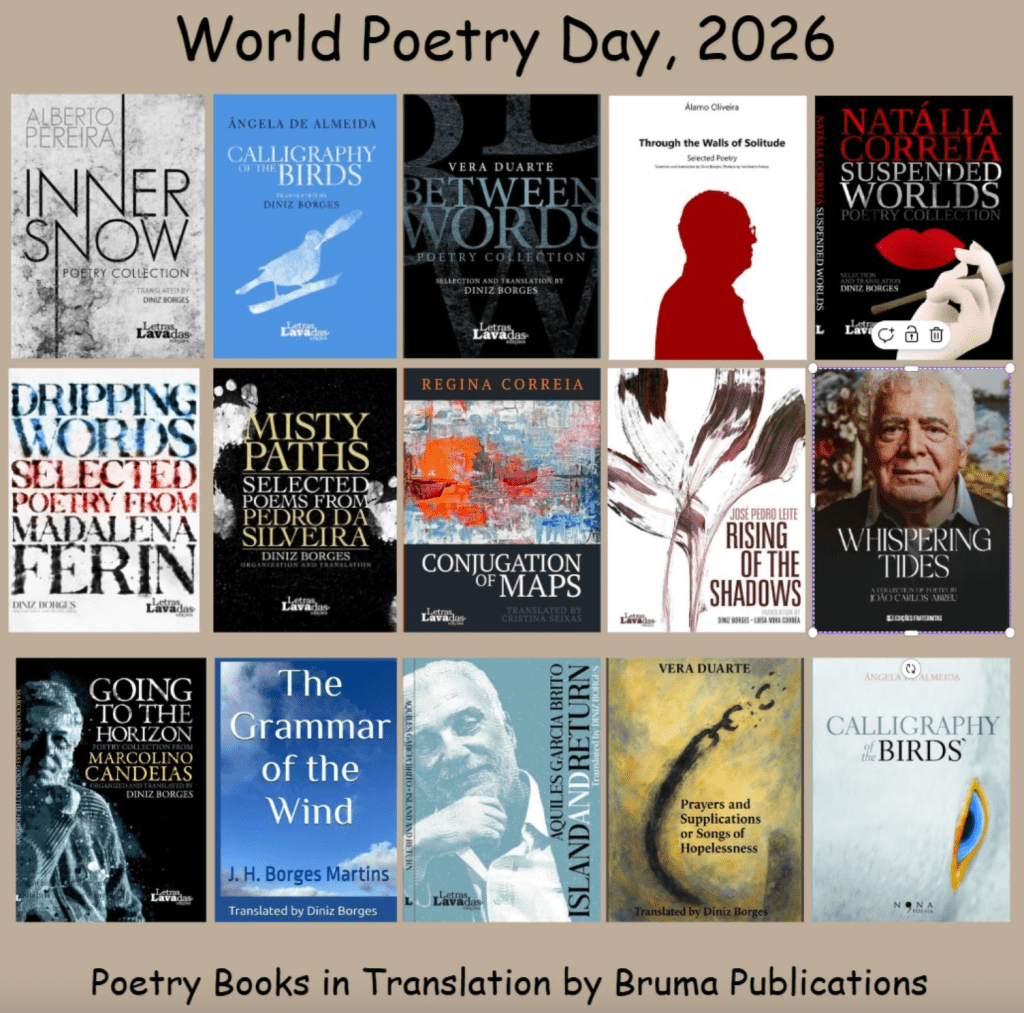
There are journeys that take place across oceans, and others that unfold quietly across pages. Over the past three years, I have had the privilege—and the responsibility—of living both at once. Fifteen books of Azorean, Portuguese, and Lusophone poetry have crossed into English through the work of Bruma Publications and its partners. Fifteen voices, fifteen worlds, fifteen acts of trust placed in the fragile, necessary art of translation. I have translated the vast majority, a couple as a co-translator.
On this World Poetry Day, I do not see these books as a list or a milestone. I see them as encounters. Each manuscript arrived with its own weather—its own silences, its own urgencies, its own music. To translate is to listen before writing, to inhabit before rendering. It is to recognize that language is not only words, but breath, history, and place. And in these works, place is never incidental. The islands are always present—sometimes as landscape, sometimes as memory, sometimes as wound, sometimes as horizon.
As a translator, one learns quickly that fidelity is not a matter of literal equivalence, but of emotional truth. How does one carry across the density of a word shaped by volcanic earth, by migration, by centuries of departure and return? How does one render the cadence of a language that has lived so long beside the Atlantic, absorbing its rhythms? Each poem demanded its own answer. Each poet required a different form of listening. And in that process, I found myself not simply translating texts, but negotiating between worlds—between Portuguese and English, between origin and destination, between what is said and what resists being said.
For the Portuguese diaspora in North America, these translations are, I hope, more than literary artifacts. They are a way back—a way of hearing echoes that may have grown faint across generations. I have thought often of readers who carry Portuguese in memory rather than in daily speech, who recognize a cadence without fully grasping its vocabulary. These books are for them as much as for anyone: an invitation to re-enter a cultural space that belongs to them, even if language has shifted.
But I have also translated with another reader in mind: the one encountering these voices for the first time. The student, the poet, the curious reader in California, in Canada, in any corner of the English-speaking world. To them, these books offer an opening into a poetic tradition shaped by insularity and expansiveness at once—a tradition where the sea is not metaphor alone, but condition, where distance is lived, where identity is always in motion.
And then there are those who come to the Azores as visitors. Increasingly, I have thought of them too—standing on a cliff, looking out at the Atlantic, sensing that the landscape carries a depth not immediately visible. These translations offer a way into that depth. They suggest that the islands are not only to be seen, but to be read—to be understood through the voices that have named them, questioned them, loved them, and, at times, resisted them.
Fifteen books in three years is, on paper, an achievement. In lived experience, it has been something else: a sustained act of attention, a discipline of listening, a crossing that is never entirely complete. Translation humbles. It reminds us that no language fully contains another, that something is always lost—but also that something unexpected is gained. A new resonance. A new possibility of connection.
On this World Poetry Day, I think of these books not as finished works, but as bridges still being crossed. They carry with them the voices of poets who trusted that their words could travel, and the hope that those words will find new homes in new readers. If they succeed, it is because poetry itself insists on movement—across languages, across generations, across the wide and restless Atlantic that, for so many of us, is not a barrier, but a beginning.
I hope all of will consider buing one of our Bruma Books.
 Filamentos (artes e letras)