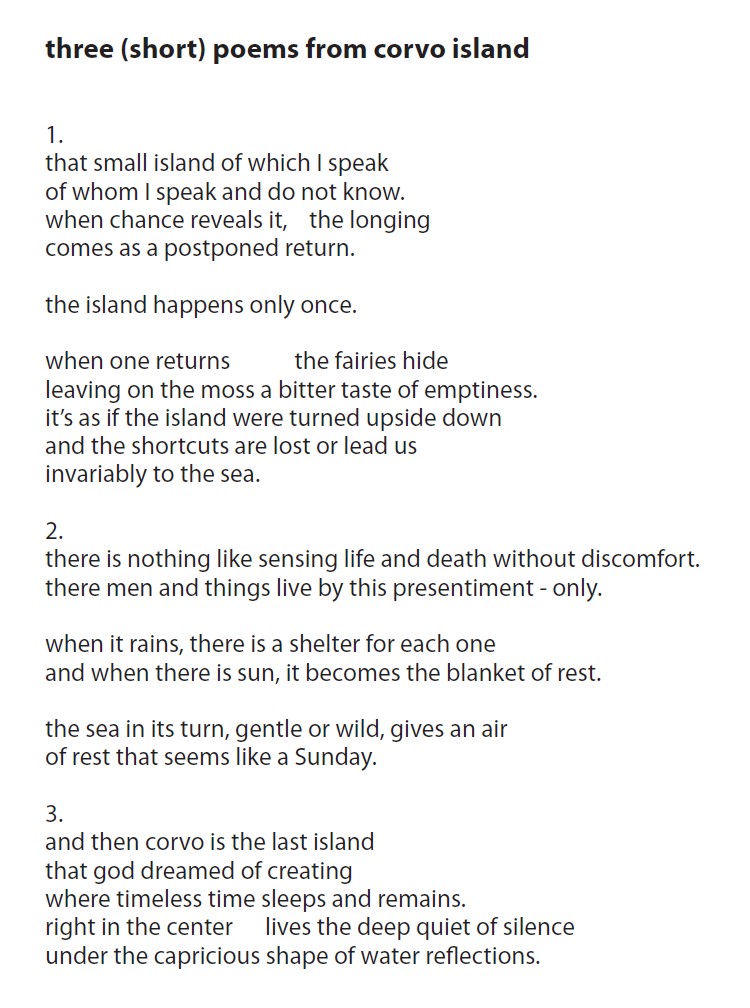
In these “three (short) poems from Corvo island,” Álamo Oliveira distills insularity into its most essential gestures: distance, return, and the fragile clarity of presence. Corvo emerges not merely as geography, but as an experience that resists possession. It “happens only once,” slipping between memory and encounter, as if the island exists most fully in longing rather than in arrival. The language is spare yet evocative, capturing the paradox of knowing a place intimately while never fully grasping it. Even return becomes uncertain—paths dissolve, fairies hide, and the sea quietly reclaims all direction.
At the same time, Oliveira offers a vision of life stripped to its core. In Corvo, existence unfolds in immediacy—rain as shelter, sun as rest, the sea as a kind of quiet Sabbath. There is a profound simplicity here, but also a metaphysical depth: the sense that this “last island that god dreamed of creating” holds within it a stillness where time itself seems to pause. Silence, reflection, and presence converge, suggesting that what is smallest and most remote may also be what is most enduring.
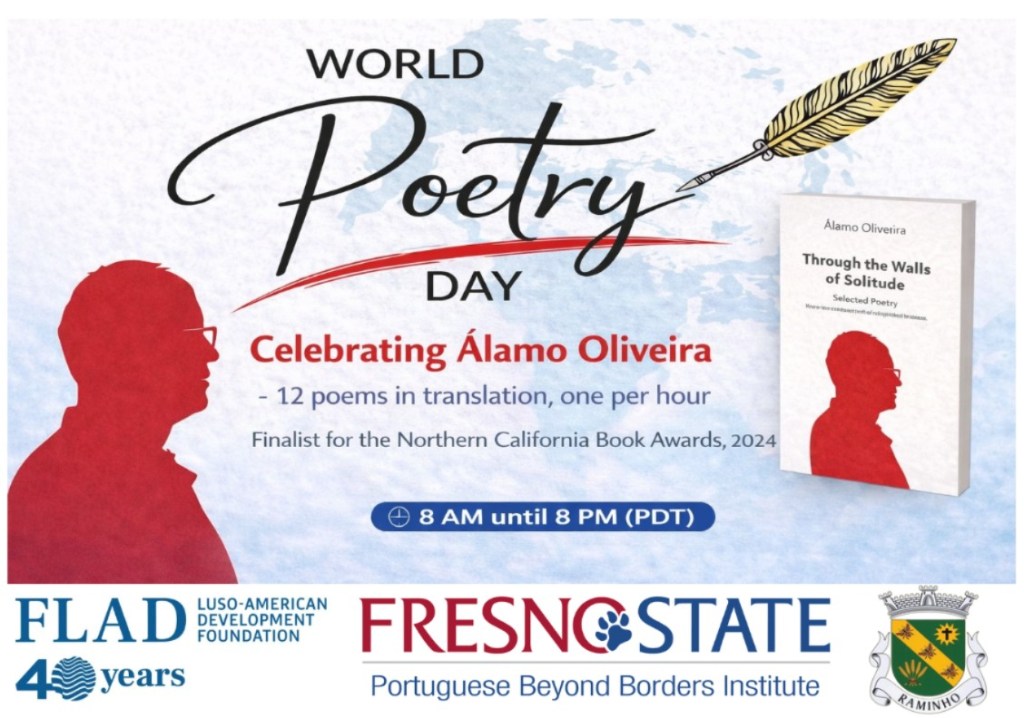
On this World Poetry Day, we invite you into this reflection. What do these poems reveal to you about island life, memory, and belonging? Have you ever experienced a place that feels both real and unreachable? Share your thoughts with us and join this cultural dialogue around poetry and the enduring work of Álamo Oliveira.
Vision Statement
To create a living bridge between the Azores and its global diaspora through poetry—where translation becomes an act of cultural continuity, and where voices like Álamo Oliveira resonate across languages, generations, and geographies. This World Poetry Day initiative envisions a community that not only reads poetry, but inhabits it: reflecting, remembering, and reimagining identity through the shared cadence of words.
Mission Statement
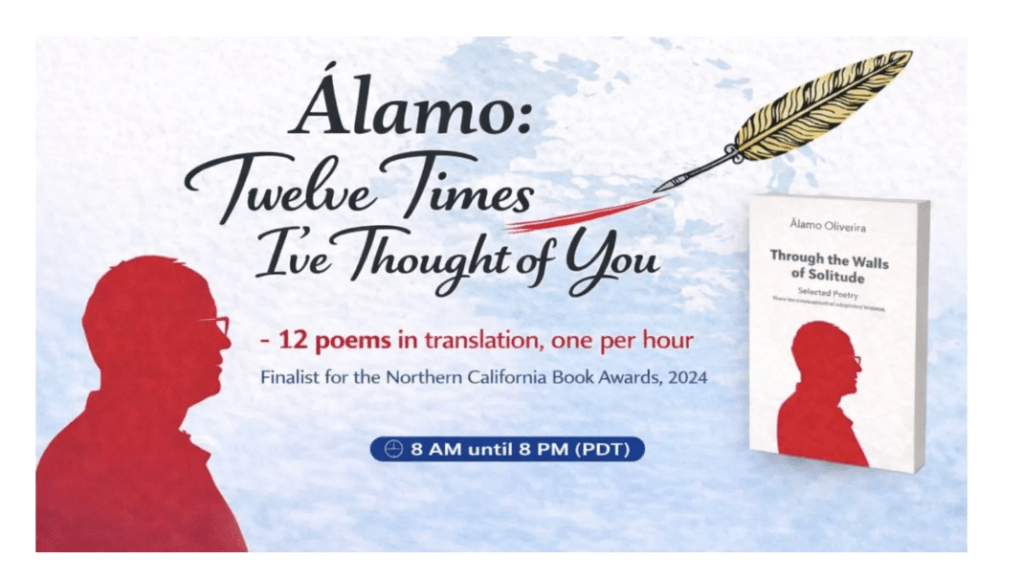
Through Álamo: Twelve Times I’ve Thought of You, we seek to celebrate poetry as a daily, unfolding experience—offering twelve translated poems, one per hour, as moments of pause, reflection, and connection. This project aims to amplify Azorean literary voices in English, foster dialogue within the Portuguese-American community, and engage broader audiences in the beauty and depth of Lusophone expression. By bringing poetry into the rhythm of the day, we invite readers to participate in an ongoing cultural conversation—one that honors memory, embraces translation as a creative act, and affirms the enduring power of language to unite us across oceans.
 Filamentos (artes e letras)