
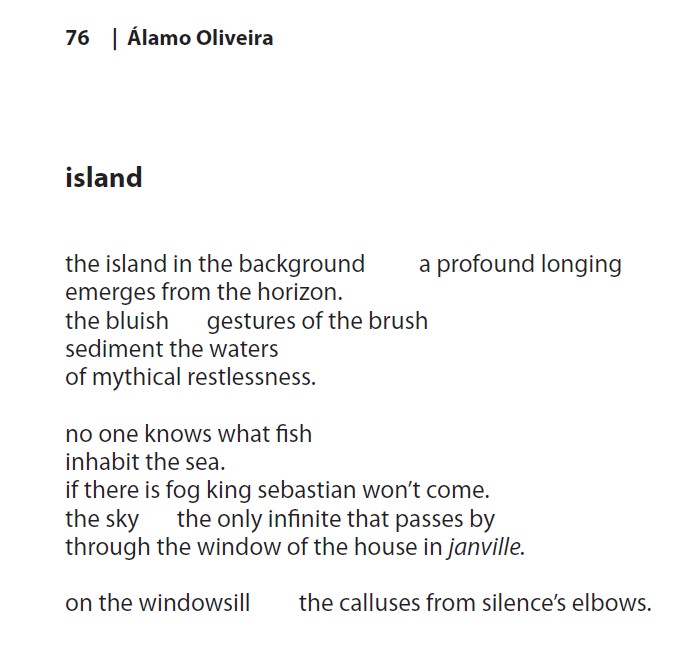
Álamo Oliveira’s “island” unfolds as a meditation on distance, memory, and the elusive nature of belonging. The island appears not as a fixed geography, but as something emerging—almost hesitantly—from the horizon, shaped as much by longing as by landscape. The imagery is painterly, fluid: brushstrokes, sedimented waters, mythic restlessness. Oliveira invites us to see the island not simply as place, but as perception—something glimpsed, imagined, and never fully grasped.
Yet beneath this quiet lyricism lies a deeper uncertainty. The sea remains unknowable, the fog obscures return, and even history—echoed in the mention of King Sebastian—feels suspended between myth and absence. The domestic image of the window, the house, the stillness of silence, anchors the poem in intimate space, but does not resolve its tension. Instead, Oliveira leaves us in a state of watchfulness, where the island exists as both presence and distance, both home and horizon.
On this World Poetry Day, we invite you into this reflection. What does this “island” represent for you? Is it memory, longing, identity—or something else entirely? Share your thoughts with us and join this cultural dialogue around poetry and the enduring work of Álamo Oliveira.
Vision Statement
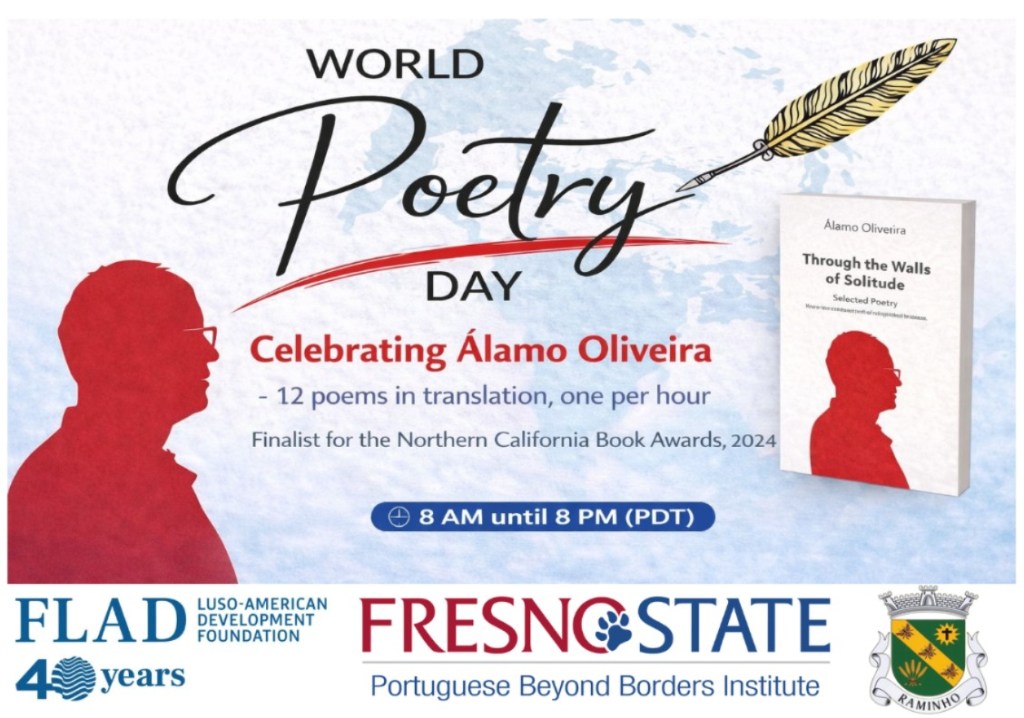
To create a living bridge between the Azores and its global diaspora through poetry—where translation becomes an act of cultural continuity, and where voices like Álamo Oliveira resonate across languages, generations, and geographies. This World Poetry Day initiative envisions a community that not only reads poetry, but inhabits it: reflecting, remembering, and reimagining identity through the shared cadence of words.
Mission Statement
Through Álamo: Twelve Times I’ve Thought of You, we seek to celebrate poetry as a daily, unfolding experience—offering twelve translated poems, one per hour, as moments of pause, reflection, and connection. This project aims to amplify Azorean literary voices in English, foster dialogue within the Portuguese-American community, and engage broader audiences in the beauty and depth of Lusophone expression. By bringing poetry into the rhythm of the day, we invite readers to participate in an ongoing cultural conversation—one that honors memory, embraces translation as a creative act, and affirms the enduring power of language to unite us across oceans.
 Filamentos (artes e letras)