
The universal is the local without walls
Miguel Torga, Portuguese Writer
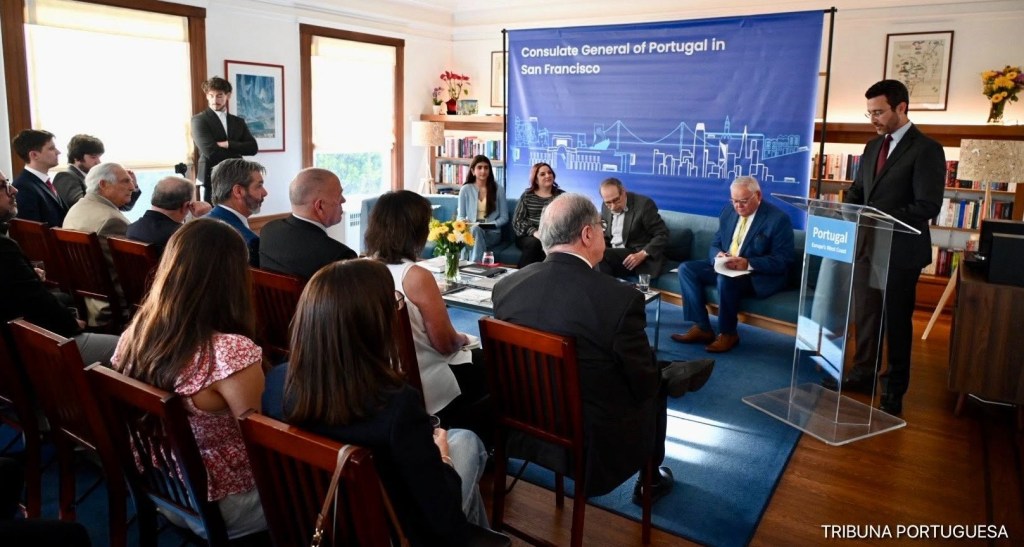
There are evenings that pass politely through the calendar and leave behind only the clink of glasses, the murmur of greetings, and the customary photographs taken before the night dissolves into memory. And then there are evenings that gather a community not simply to celebrate itself, but to think itself—to pause, however briefly, before the rushing current of daily life and ask where it has come from, what it has become, and what shore it may yet reach. The gathering at the Consulate General of Portugal in San Francisco was one of those rarer evenings: thoughtful without losing warmth, ceremonial without becoming stiff, convivial without surrendering to superficiality. Yes, there was wine. Yes, there were appetizers. But what truly nourished the night was reflection.
Hosted by Consul General Filipe Ramalheira and Dr. Sofia Ventura Ramalheira, and co-sponsored by the Portuguese Fraternal Society of America and the Portuguese Beyond Borders Institute at Fresno State, the event became something more than a formal reception. It became a civic and cultural act of self-examination, a moment in which the Portuguese-American community of California was invited to hear itself speak across generations. In that elegant diplomatic space—so often associated with passports, protocols, and state formalities—another function of the consulate revealed itself. It became, as I suggested at the start of the evening, a house of memory, a place where the story of a people continues to unfold across oceans.
To speak of the Portuguese-American experience in California is to speak of a story that is too often simplified by outsiders and fragmented even among us. It is not merely a tale of immigration, nor solely one of adaptation. It is a long and unfinished narrative of labor, faith, association, language, sacrifice, reinvention, and endurance. It is a history rooted in the Azores and mainland Portugal, certainly, but equally shaped by the valleys, ports, schools, churches, dairies, festas, and civic institutions of California. It belongs to the old immigrant who crossed an ocean with a suitcase and a prayer, to the middle generation raised between home and school, between Portuguese obligation and American possibility, and to the young Portuguese-American now asking how to belong to an inheritance without merely repeating it. It was precisely these layers of time that the panel brought into dialogue.
The evening unfolded through the voices of three members of our community—José Machado, Monique Vallance, and Sofia Ávila—whose perspectives, placed side by side, offered not merely three opinions but three temporal registers of Portuguese California: memory, transition, and emergence. Their words, taken together, formed a meditation on the past, present, and future of a people whose identity has never been static, but tidal—always moving outward, returning altered, and reshaping the shore.
José Machado spoke with the authority of one who has spent decades studying, preserving, and interpreting the Portuguese presence in California. In his reflections, the community emerged not as abstraction but as geography made human. He reminded us that the Portuguese did not arrive in California all at once, nor did they live one single version of the immigrant experience. They settled across an astonishing range of landscapes and occupations: in the fog of the redwoods, along salmon rivers, in the tuna industry of San Diego, in the sheep camps of the Sierra, in the dairies of Marin and the Central Valley, in the mills and trades and railroads that helped build modern California. His language carried the weight of archival knowledge, but also something more intimate: an ethical admiration for those who built lives from scarcity. The phrase he invoked from his own work, the power of the spirit, gave the evening one of its deepest motifs. For Machado, the Portuguese-American story in California rests not merely on economic success or demographic persistence, but on a moral architecture: the willingness to work hard, to save, to sacrifice, to take risks, to plan for one’s children, and to care for one another.
That formulation deserves attention. Too often, the history of immigrant communities is flattened into either sentimental nostalgia or sociological data. Machado restored to it a human density. He reminded us that churches were not simply buildings; they were acts of collective will. Associations were not merely clubs; they were systems of mutual recognition in a world that often offered immigrants little security. The festas were not quaint ethnic performances; they were public enactments of belonging. The Portuguese-American community did not survive in California by accident. It built itself, often in adverse conditions, through institutions sustained by faith, labor, and solidarity.
Yet the evening did not romanticize the past. Monique Vallance, speaking from the generation that stands between inheritance and reinvention, brought needed candor to the discussion. Her testimony was among the most compelling precisely because it refused easy comfort. She described what it meant to grow up with “one foot in each world”: the Portuguese world of family, festas, societies, and community oversight, and the American world of school, peers, and the broader social landscape. Her recollections captured the discipline and the enclosure many in her generation experienced. There were limits, obligations, expectations. One could go to the festa, but not necessarily to the football game; to the society hall, but not always to the dance at school. It was a world of immersion, but also surveillance, of belonging, but sometimes of constraint.
And yet Vallance did not dismiss that world. On the contrary, she recognized its gifts with moving honesty. What had once felt confining could later be seen as formative. In those festas and gatherings, she noted, generations mixed naturally: children, teenagers, adults, elders, all inhabiting the same social space. That intergenerational texture—so rare in much of contemporary American life—was one of the community’s great strengths. But Vallance also identified the cost of transmitting culture through compulsion alone. Some in her generation, having experienced heritage as obligation, responded by loosening their hold when raising their own children. The result, she suggested, is a younger generation that may know it is Portuguese but may not know what that means in any substantial sense.
This diagnosis was not bitter. It was lucid. And in that lucidity lay one of the evening’s central truths: that tradition cannot survive solely as command. It must become intelligible, meaningful, even desirable to those who inherit it. Vallance argued persuasively that Portuguese institutions in California must adapt—not by surrendering their essence, but by discerning what is essential and what is merely habitual. This is, perhaps, the decisive challenge before the community. Every culture must ask itself what can change without self-betrayal and what must remain if identity is to endure. Her answer was not to abandon associations, festas, dance groups, or fraternal organizations, but to renew them through flexibility, inclusion, and genuine participation from younger generations. A community cannot ask youth merely to do the heavy lifting while denying them the dignity of a voice. If younger Portuguese Americans are being raised to think, choose, and lead, then institutions that hope to keep them must make room for precisely that.
If Machado gave us the architecture of the past, and Vallance the tensions of the present, Sofia Ávila gave the evening its forward gaze. Her reflections were especially striking because they revealed a Portuguese-American identity that is at once inherited and self-fashioned. For her, being Portuguese-American is not reducible to one thing—not simply family heritage, nor only language, nor only tradition. It is a combination of domestic rituals, religious celebrations, school leadership, travel, and the conscious act of representing one’s culture in places where it is not automatically visible.
Her remarks about youth organizing were particularly important. In speaking about efforts to establish Portuguese cultural recognition in school settings, she illuminated something larger than a campus matter. She showed that identity today must often be argued for institutionally; it must be named, articulated, and defended in multicultural contexts that do not always know where Portuguese-Americans fit. Her generation does not simply inherit a ready-made community. It must explain itself to others and, in doing so, also define itself to itself. That work is intellectual as much as emotional. It requires research, advocacy, and confidence.
Ávila also spoke with clarity about language, inclusion, and accessibility. For many young people, she noted, the inability to speak Portuguese fluently can lead to alienation within their own community. This is one of the more painful paradoxes of diasporic life: language is both treasure and threshold. It carries memory, worldview, humor, tenderness, and forms of feeling that resist translation. But it can also become a gate if used without generosity. The evening returned to this theme repeatedly. Vallance rightly defended Portuguese as central to cultural memory, while also insisting that one need not speak it perfectly to belong fully. That balance is crucial. If language becomes only a test of authenticity, it may wound the very continuity it hopes to preserve. But if it is cherished as an invitation, as music, as an inheritance offered rather than imposed, it may continue to bind generations even in partial fluency.
Running through all three panelists’ remarks was the question of institutions. The Portuguese-American community in California has long relied on churches, Holy Ghost associations, fraternal organizations, media, and cultural groups as the scaffolding of communal life. Machado called them, in effect, the early pillars of the community—something like a “primitive internet” through which information, ritual, leadership, and solidarity traveled. That formulation was both humorous and profound. Before digital networks, communities survived through embodied ones. News was carried by priests, newspapers, halls, festas, and word of mouth. To understand the history of the Portuguese in California is to understand how indispensable these structures were.
And yet the panel did not evade institutional fatigue. Declining membership, aging leadership, changing lifestyles, and new expectations all place immense pressure on older forms of organization. The question is not whether these institutions were necessary, but whether they can transform without dissolving. The answer offered that evening was cautious but not despairing. The old organizations remain vital, but they must learn to distinguish between ritual fidelity and rigid habit. Leadership matters. Hospitality matters. Trust matters. Most of all, the willingness to imagine a future that does not look exactly like the past matters.
The discussion inevitably turned toward Portugal and the Azores. Here, Machado reminded us how radically the diaspora’s relationship to the homeland has changed. For earlier generations, return was rare, difficult, and often impossible. A phone call required choreography; travel required resources beyond reach. Today, the Atlantic has not shrunk, but it has become more traversable. Travel is more frequent, communication is more immediate, and younger generations can encounter Portugal not only through inherited stories but through direct experience. This change matters enormously. The relationship is no longer sustained only by memory and myth, but by circulation—of people, images, music, language, and ideas.
Still, as Ávila observed, the Portugal encountered there is not always the Portugal imagined here. The Portuguese spoken by grandparents in California may contain archaisms, island inflections, and hybrid words forged in migration. Young people who travel “back” discover, sometimes with surprise, that the culture across the ocean is contemporary, changing, plural, and not frozen in the forms preserved by diaspora ritual. This is not a crisis. It is an education. Diaspora identity is strongest not when it clings to illusion, but when it accepts that continuity includes difference. One can love the Portugal of memory and meet the Portugal of the present.
Perhaps the most moving part of the evening came in the final, almost liturgical, question posed to each panelist: what must survive for the Portuguese diaspora in California to remain meaningful? Machado answered with the festa. Vallance answered with the associations. Ávila answered more broadly with unity and community. Taken together, their answers formed a kind of triad: ritual, structure, and spirit. The festa matters because it remains the most visible and affective enactment of collective identity, the place where memory becomes embodied in procession, food, music, devotion, and gathering. The associations matter because without institutions, culture becomes abstract, reduced to recollection rather than lived practice. And unity matters because without a sense of communal belonging, every celebration becomes hollow, every tradition merely performative.
What gave them hope? Again, their answers converged in telling ways. Machado placed hope in return—the recurring phenomenon of people who, later in life, rediscover their Portuguese identity and seek reconnection. Vallance placed hope in the youth who continue to show up, even when support is uneven. Ávila placed hope in the dedication of those her own age who remain invested in preserving and continuing the culture. Hope, then, was not presented as naive optimism, but as evidence: the evidence of continuity, however imperfect, across generations. For we should remember the momentous words of the Portuguese essayist Eduardo Lourenço: we are what we remember—and what we forget.
For me, as moderator, the evening confirmed something I have long believed: diasporas are never finished. They are not static inheritances but ongoing acts of cultural authorship. Every generation thinks, at first, that it is receiving a story. In truth, it is a revision of one. The first immigrants brought with them faith, labor, custom, and longing. They built churches whose bells echoed island memories. They founded societies, organized festas, and created worlds in which Portuguese life could continue on Californian soil. The generations that followed expanded that inheritance into new forms: universities, literary spaces, oral history projects, artistic collaborations, festivals, films, community archives, bilingual publications. And now another generation is emerging—one connected not only by blood or nostalgia, but by travel, digital exchange, artistic expression, and self-conscious cultural advocacy.
That is why this evening at the Consulate General mattered so much. It did not settle the questions before us, nor should it have. But it created a space in which the community could hear itself think. That, in itself, is rare and necessary. It is easy for diaspora communities to celebrate. Celebration is essential, and no one should disdain it. But celebration without reflection risks becoming repetitive. Reflection without celebration risks becoming sterile. What made this gathering so memorable was precisely its refusal to choose between the two. Under the gracious hospitality of Consul General Filipe Ramalheira and Dr. Sofia Ventura Ramalheira, and with the partnership of PFSA and PBBI at Fresno State, the evening offered a model of what communal life can be at its best: generous, intelligent, rooted, and forward-looking.
The Consul General, in his closing remarks, expressed confidence in the community’s future and suggested that such gatherings might become an annual event, each year devoted to another aspect of Portuguese-American life. One hopes that they do. For communities, like nations, need not only ceremonies of affirmation but forums of thought. We need occasions when wine and ideas may be shared at the same table.
In the end, the Portuguese-American experience in California may best be understood not as a monument, but as a tide. It moves outward across oceans, carrying language, faith, food, music, memory, and labor. It returns, altered by distance and time, bringing new questions, new forms, new generations. And with each return, it reshapes the shore. That night in San Francisco, in a diplomatic house made briefly into a house of memory, we witnessed that tide in motion. Not a community looking backward in resignation, but one looking across its past toward the difficult, necessary, and still radiant work of renewal.
For what we are was never fashioned from permanence alone, but from passage—from departures endured, from names carried forward from gestures repeated until they became inheritance. We are the children of crossings, of bread broken in two languages of songs that survived because someone refused to let them fall silent. And what we may yet become will depend not only on what we preserve, but on what we dare to reimagine: how we open the circle wider, how we teach memory to speak in new voices, how we make tradition less a museum of reverence than a living table with room for those still arriving.
If the future asks anything of us, it asks that we remain worthy of those who came before without becoming prisoners of their exact forms. It asks that we be bold enough to carry the spirit forward, even when the vessel changes. And perhaps that is the deepest lesson of the evening: that identity is not a relic to be guarded in stillness, but a flame passed hand to hand—brightened by care, threatened by neglect, and made meaningful only when it continues to give light. Thus, may the Portuguese-American presence in California move onward: not diminished by time, but deepened by it; not enclosed within nostalgia, but widened by imagination; not merely surviving, but becoming, with dignity and courage, one of the enduring human songs of multicultural California, for at times, and as the Portuguese Nobel in literature, José Saramgo once wrote: Inside us there is something that has no name—that is what we are.
Diniz Borges, PBBI, Fresno State
Photo From Miguél Ávila, Tribuna Portuguesa.
 Filamentos (artes e letras)