
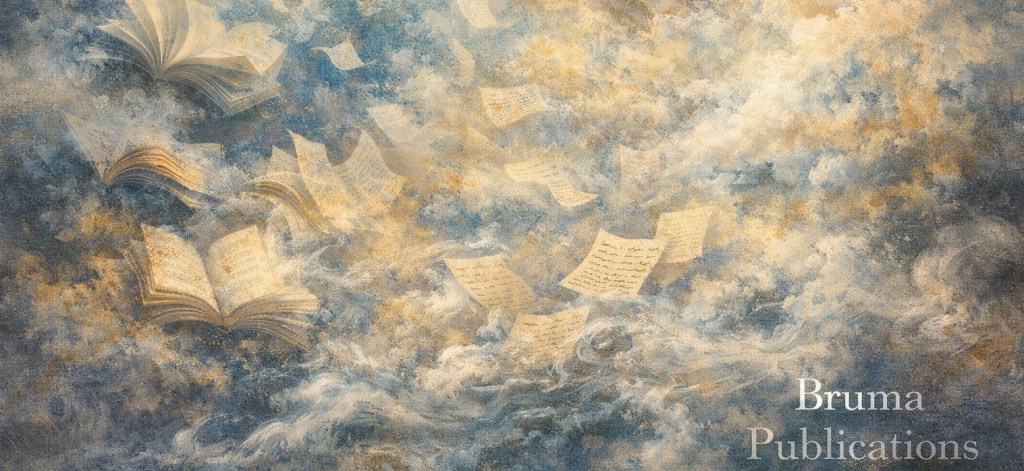
There are books that do not begin on the page, but in the wind.
They rise, first, from a geography—volcanic, uncertain, luminous—where land itself is a kind of sentence written slowly by fire. In the Azores, memory does not sit quietly in archives; it circulates like weather, carried by voices, by departures, by the long echo of those who left and those who remained. And yet, for generations, much of that memory hovered at the edge of silence, contained within a language that did not always travel, within stories that risked dissolving into the very mist—bruma—from which they emerged.
It is against that quiet erasure that Bruma Publications must be understood: not simply as a press, but as an intervention. A crossing. A second ocean.
Founded within the Portuguese Beyond Borders Institute at California State University, Fresno, and sustained by a transatlantic vision, Bruma is animated by a deceptively simple yet culturally urgent premise: that translation is not an accessory to literature, but its continuation. To translate is to refuse disappearance. To publish is to insist on presence.
Across its growing catalog, one encounters not a random accumulation of titles, but a deliberate architecture of memory—an Atlantic library where poetry, history, fiction, and oral tradition speak to one another across time and space.
Consider Bento de Goes, Henrique Levy’s reimagined life of a nearly forgotten figure, brought into English with a translator’s attentiveness that is itself an act of recovery. The novel reads less like historical fiction than like a quiet hymn to endurance, where the margins of history become the center of meaning. Here, Bruma performs one of its most essential gestures: rescuing lives that might otherwise remain unspoken, and placing them within a shared human narrative.
In Island and Return, Aquiles García Brito offers a poetics that refuses linearity, echoing instead the rhythms of the Atlantic itself—cyclical, recursive, unfinished. The island is not merely a place but a condition of thought, and the sea becomes a method of knowing. This is Bruma at its most philosophical: publishing work that does not simply describe the Azores, but thinks through them.
And then there is Suspended Worlds, the arrival—long overdue—of Natália Correia into the English-speaking imagination. Here, Bruma enacts a form of literary justice. Correia’s voice—erotic, insurgent, metaphysical—does not soften in translation; it expands. The book stands as both revelation and restoration, collapsing the distance between one of Portugal’s most formidable poets and the diaspora that has, until now, known her only in fragments.
Yet Bruma’s vision is not confined to the canonical or the poetic. It extends into the pedagogical, the historical, and the communal. Azorean History Themes and History of the Azores: Questions and Answers reframe the islands not as peripheral curiosities but as central actors in broader historical processes—sites of resistance, migration, and identity formation. These are books that democratize knowledge, inviting not only scholars but descendants, students, and readers of all kinds into a deeper understanding of place.
Equally vital is the preservation of oral tradition in Portuguese Folktales from California and Contos Populares Açorianos. These volumes remind us that literature does not begin with the printed word. It begins in kitchens, in fields, in the cadence of voices carried across oceans. In bringing these stories into print—and, crucially, into English—Bruma ensures that the imaginative worlds of earlier generations remain legible to those who inherit them.
If there is a unifying thread across the catalog, it is this: the refusal to allow the Azorean and Lusophone experience to remain untranslated—not only linguistically, but culturally. Books such as Jénifer by Joel Neto, The Elderly by Paula de Sousa Lima, and I No Longer Like Chocolates by Álamo Oliveira confront the complexities of contemporary life—poverty, aging, memory, displacement—without romanticism. They reveal an Azores far removed from postcard imagery, an Azores that insists on being seen in its full human dimension.
At the same time, poetry remains the beating heart of the Bruma project. Collections like Calligraphy of the Birds, Inner Snow, Rising of the Shadows, and Going to the Horizon affirm poetry not as ornament but as necessity—a way of thinking, resisting, and enduring. Through bilingual editions and careful translations, these works open a space where language itself becomes a bridge, allowing readers to inhabit the tension between original and translation, between here and elsewhere.
Even the children’s book O Coelhinho Branco / The White Rabbit participates in this larger vision. It is not merely a story for young readers; it is an initiation into belonging. In its bilingual simplicity lies a profound truth: that heritage must be learned early if it is to survive at all.
What emerges, then, from Bruma Publications is not simply a list of books, but a philosophy of cultural work. A commitment to what might be called literary citizenship. Each title extends the Azores outward while drawing the diaspora inward, creating a shared space of recognition where language, memory, and identity can meet.
This is especially evident in anthologies such as Into the Azorean Sea and One Atlantic, Many Perspectives, where multiple voices converge to articulate a collective imagination. These volumes do not seek to resolve the tensions of diaspora; they inhabit them. They understand that identity, like the ocean, is never fixed.
In this sense, Bruma’s catalog becomes a kind of cartography—not of territory, but of experience. A mapping of exile and return, of loss and continuity, of silence and speech.
And always, at its center, is the act of translation—not as technical exercise, but as ethical stance. To translate, in the Bruma vision, is to honor both the original voice and the new reader, to create a space where neither is diminished. It is, fundamentally, an act of care.
In a time when small literatures are often overshadowed by global markets, Bruma Publications insists on another model: one rooted in community, collaboration, and the long work of cultural preservation. Supported by institutions such as FLAD and sustained by partnerships across the Atlantic, it demonstrates that publishing can still be a form of cultural stewardship.
There is, finally, something profoundly Azorean about this endeavor. The islands themselves have always existed between worlds—geographically distant yet historically connected, small in scale yet vast in implication. Bruma Publications mirrors that condition. It operates in the space between languages, between continents, between memory and future.
And so we return to the wind.
Because we believe that what Bruma has built is not only a catalog, but a current—a movement of words across water, a circulation of voices that refuses stillness. These books travel. They arrive in classrooms, in homes, in the hands of readers who may never have seen the islands but who recognize, in these pages, something essential and shared.
In the end, Bruma Publications reminds us that literature, like the sea, is not defined by its borders but by its crossings.
And in that crossing, something endures—not only the memory of islands, but the possibility that, through literaure,
no distance is ever final.
Please take a look at the site to order any of our Bruma Books
 Filamentos (artes e letras)