
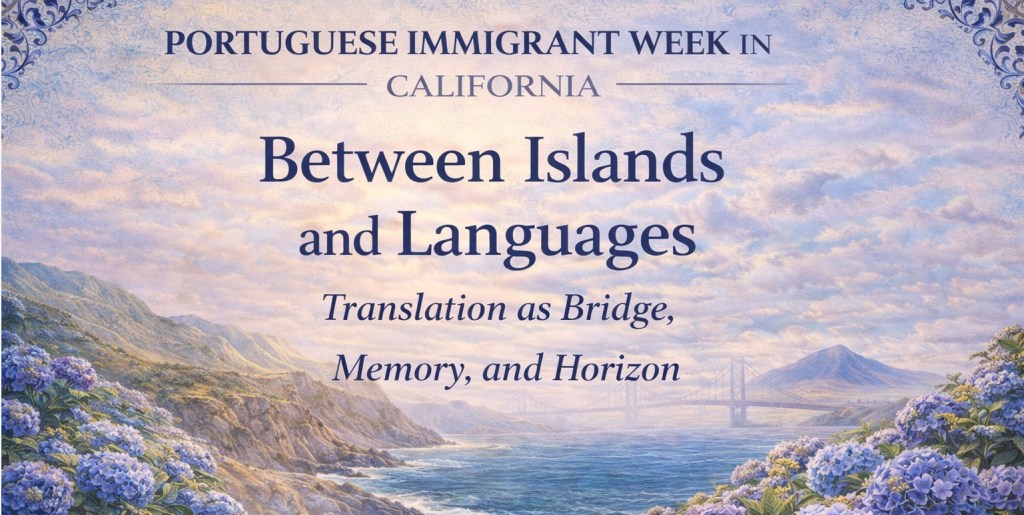
There are islands that survive through stone; the Azores also survive through words. Yet a word that does not travel becomes mist, and mist—no matter how beautiful—dissolves into its own horizon. Literary translation is therefore the archipelago’s second sea: not the one that separates us, but the one that projects us outward. It is the vessel that prevents Azorean creativity from remaining confined within the intimate circle of its own language and transforms it into a shared breath in dialogue with the world. To translate an Azorean poet is not merely to change grammar; it is to move the center of the island to the center of the human conversation. It is to turn insularity into a gesture of expansion and memory into a form of the future.
Azorean literature was born from creative isolation—from the tension between staying and departing, from the experience of living surrounded by water and by the wider world. Yet what does not cross a language cannot cross a century. And what does not open itself to the other eventually closes itself within time.
Translation is not simply the transfer of words. It is the shifting of horizons. It is the transformation of insularity into circulation. It prevents the archipelago from becoming only memory and allows it to become future.
If the diaspora was the great physical movement of the Azorean people, translation must become its great cultural movement. Today we have generations of Azorean descendants whose inheritance is emotional and historical, but whose language is no longer the mother tongue of their grandparents. If we do not translate, we will not enter into dialogue. And if we do not enter into dialogue, we do not exist.
Yet this path has already begun.
Four decades ago, Onésimo Almeida launched, through the Gávea–Brown series, one of the first systematic bridges between Azorean literature and the English-speaking world. That impulse continued with the Bellis Azórica collection at Tagus Press, affirming that translation is not an occasional gesture but a strategic project.
Today that vision gains renewed energy through the partnership between Bruma Publications and Letras Lavadas under the leadership of Ernesto Resendes and his team. In just three years, twenty-six books have been published jointly, with the certainty of ten more in 2026. Added to these are a title with Poética in Lisbon, one with Dois Caminhos by Joel Neto, and five with Moonwater Editions by Avelina da Silveira—small editorial archipelagos that together begin to form a symbolic continent.
But we need more than editorial courage. We need a pact. An Azores–Diaspora–Azores Pact for Literary Translation.
No Casa dos Açores in the United States or Canada should receive public support from the Azorean treasury without a clear commitment to promoting Azorean literature—both in the original language and in translation. Every Casa should host an active reading club. Every community library should be a harbor for books, with a clear plan for those books beyond their quiet display on handsome wooden shelves. The Casas dos Açores must become spaces where the culture of the book thrives and where bridges are built with the American and Canadian cultural landscapes.
The sister-city programs—recently gathered here in the Azores with the support of FLAD and the regional government—should include concrete literary initiatives: sending collections of translated works, organizing author exchanges, and creating reading clubs in the municipal libraries of partner cities.
Every Azorean municipality should invest in sending collections of translated Azorean literature to the libraries of its sister cities. The book should become an instrument of diplomacy.
We should create literary routes for each island. Residencies for writers and translators. Bilingual festivals. Digital literary maps. Youth reading programs for Azorean-descended communities abroad. Online platforms where translated excerpts are freely accessible to readers everywhere.
And translation must also move in the opposite direction: bringing to the Azores the voices of Azorean-American and Azorean-Canadian poets and novelists. Because Azoreanness is circular. It is not static. It is not unilateral.
What is at stake here is not simply cultural promotion. It is civilizational continuity.
To translate is to expand the cultural sovereignty of a small territory. It is to transform an archipelago into a horizon. It is to ensure that the sea remains a passage and not a border.
Between islands and languages, we need more than bridges. We need movement. We need commitment. We need future.
Let this gathering be less an event and more a beginning. Let a pact emerge here. Let a policy emerge. Let a new crossing begin.
Because what does not cross language does not cross time.
Diniz Borges
 Filamentos (artes e letras)