
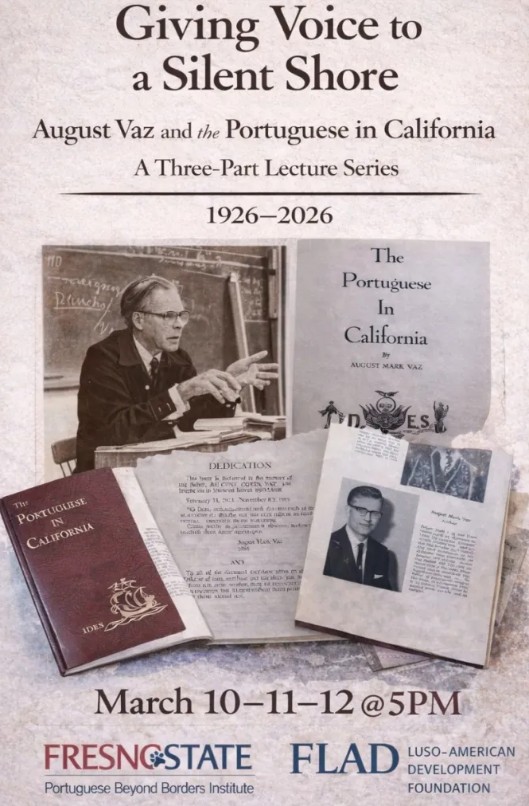
There are histories that survive in monuments, and others that endure in quieter ways—in the fragile persistence of ink upon paper. The Portuguese press in California belongs to the latter tradition. When Portuguese immigrants arrived on the Pacific coast in the nineteenth century, they carried with them little more than memory, language, and the stubborn conviction that their voices deserved to be heard even in a new and unfamiliar land. In the absence of familiar institutions, they built one of their own: the newspaper. Through its columns, they read the world around them in their own language and slowly translated the vast and often bewildering landscape of American life into terms they could understand. August Mark Vaz reminds us that these early publications “acted as a means of communication between the immigrant and his new environment.” Yet they did far more than transmit information. They created a space in which the Portuguese language could continue to breathe across the oceanic distance from Portugal and the Azores, a space where memory and present experience could meet on equal terms.
From the modest presses of Voz Portugueza in San Francisco in 1884 to the later emergence of influential publications such as União Portuguesa, O Arauto, A Liberdade, and eventually Jornal Português, the Portuguese press in California became one of the most important cultural institutions of the diaspora. These newspapers carried news of the wider world but also nurtured a distinctly Portuguese intellectual life in the American West. They published poetry, serialized novels, reflections on faith, commentary on politics, and reports from distant villages that still lived vividly in their readers’ imaginations. They explained elections, debated civic issues, and encouraged education among immigrant families. In doing so, they became what Vaz so memorably described as the immigrant’s school—a place where readers could learn not only about American institutions but also about themselves as participants in a democratic society. Within their pages, the Portuguese community discovered that writing was not merely a record of events but a form of cultural presence.
The significance of this work was not overlooked. When Jornal Português marked its anniversary in 1938, a letter arrived from the White House acknowledging the contributions of Portuguese Americans to the nation. President Franklin D. Roosevelt wrote words that remain as resonant today as they were then: “Ours is a nation composed of many people of diverse origins, all of whom have made their distinctive contributions to the upbuilding of the country and to the maintenance of our American institutions. Among those who have given of their best have been men and women of Portuguese blood.” In that moment, the Portuguese press was recognized not only as a cultural instrument of an immigrant community but also as part of the broader democratic fabric of the United States—a reminder that journalism, even when written in the language of a minority, participates in the life of the republic.
Yet the deeper significance of the Portuguese press lies not only in its past but in the questions it poses to the present. In our own time, the means of communication have multiplied beyond anything the early editors could have imagined. Images move endlessly across screens, information travels instantly, and the daily torrent of digital messages threatens to replace reflection with velocity. But an abundance of images does not necessarily produce understanding. The task of journalism has never been merely to display events but to interpret them, to question them, to investigate them, and to place them within the larger narrative of community life. A photograph may indeed tell a thousand words, but a community cannot live by images alone. The deeper work of a newspaper is to register the life of the people it serves—to record its news, its tribulations, its aspirations, and its debates. Information, formation, opinion, research, and investigative work: these remain the true instruments of journalism, and they are especially vital in the realm of ethnic newspapers where language itself carries the memory of a people.
For that reason, the Portuguese press today stands before an important moment of reflection. The newspapers of the past succeeded because they were sustained by a shared commitment between editors, writers, and readers who believed that the written word mattered. They believed that their community deserved a place where ideas could circulate freely, where questions could be asked openly, and where the life of the diaspora could be documented with honesty and care. That tradition invites us now to consider the future. Where does the Portuguese press stand today? What forms might it take tomorrow? How can it continue to serve as a space of dialogue in an age when conversation itself is often fragmented?
These questions cannot be answered solely by journalists. They require a broader conversation within Portuguese communities in California and beyond—a conversation about language, cultural continuity, and the responsibilities of readers as well as writers. The press does not exist in isolation. It grows from a collective commitment to reflection and inquiry. When a community supports its newspapers, it affirms the value of thoughtful dialogue over silence, investigation over rumor, and language over forgetfulness.
Perhaps this is the enduring lesson left to us by those early editors who labored beside their presses more than a century ago. They understood that a newspaper is never merely paper and ink. It is a living conversation carried across generations. It is a place where a community writes itself into history while events are still unfolding. The Portuguese press in California accomplished that task with remarkable dedication, transforming scattered immigrants into participants in a shared narrative of belonging.
Today, the ink of that history still waits. It waits for new voices, new questions, and new commitments. It waits for readers who understand that journalism is not simply a product but a civic practice. And if the Portuguese press once built a bridge between immigrants and their adopted land, perhaps its next task is to build another bridge—between memory and imagination, between past achievement and future responsibility, between the voices that first printed their words in Portuguese on California soil and the generations who must now decide how that conversation will continue.
Diniz Borges, PBBI-Fresno State.
 Filamentos (artes e letras)