
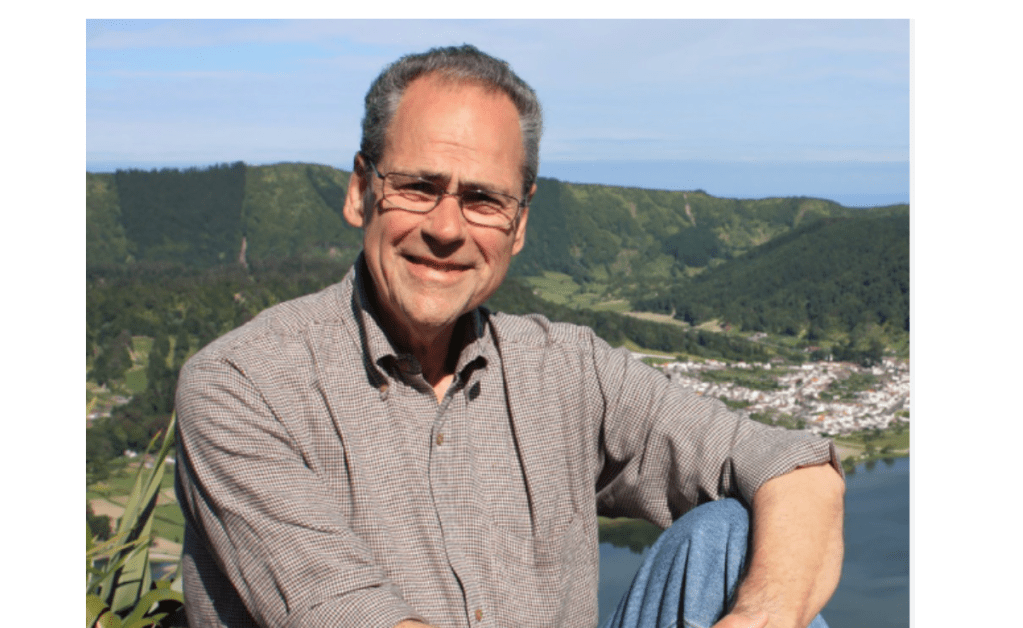
Updated from an article in the April 1, 2024, Portuguese Tribune
José Rodrigues and I were supposed to have met in April 2006 in Tipton, CA., for the launch of Álamo Oliveira’s novel I No Longer Like Chocolates, published by Portuguese Heritage Publications of California, of which José was co-founder and President. I had collaborated with lead translator Diniz Borges on this project, my first English translation, so I was disappointed when illness precluded my attending.
In late 2007 I was invited to translate Álamo Oliveira’s essay for Capelinhos: A Volcano of Synergies, PHPC’s book commemorating the fiftieth anniversary of the eruptions on Faial leading to the 1958 Azorean Refugee Act authorizing non-quota immigrant visas to the U.S. My long-time professor of Portuguese at the University of Pittsburgh, Dr. Bobby J. Chamberlain, co-translated it with me.
Soon thereafter I submitted to PHPC a draft translation I’d been working on intermittently for three years of Vasco Pereira da Costa’s book My Californian Friends: Poesia. This prompted José to ask if I might also be interested in translating and updating Dr. Eduardo Mayone Dias’ brief history A Presença Portuguesa na Califórnia, which PHPC planned to publish in English for wide distribution as part of its educational mission. Dr. Chamberlain — whose career path was inspired by Dr. Dias’ Portuguese 1 course at UCLA decades before, and who used a textbook co-authored by Dr. Dias in his own first-year Portuguese course at Pitt — urged me to seize this opportunity. He and Diniz Borges became my co-translators on this project, while Dr. Dias, by then Emeritus, answered our questions via email.
PHPC’s double launch of The Portuguese Presence in California and a bilingual edition of My Californian Friends: Poetry was set for September 20, 2009, in San Jose, followed by three more presentations over the next week. José and Delminda Rodrigues generously invited my husband John and me to stay with them in San Mateo, where they pampered us with their hospitality and kindness.
The day after the San Jose event, José took Vasco, John and me sightseeing, including a tour of Benicia (which as a child I used to visit with my parents, to see some elderly members of my paternal family), and treating us to dinner at LaSalette restaurant in Sonoma (https://www.lasaletterestaurant.com), where we enjoyed the “Cozinha Nova Portuguesa.” Since Vasco had plans for the next day, José took John and me to Half Moon Bay and Pescadero, to enjoy the refreshing sea breezes during one of California’s typical September heat waves.
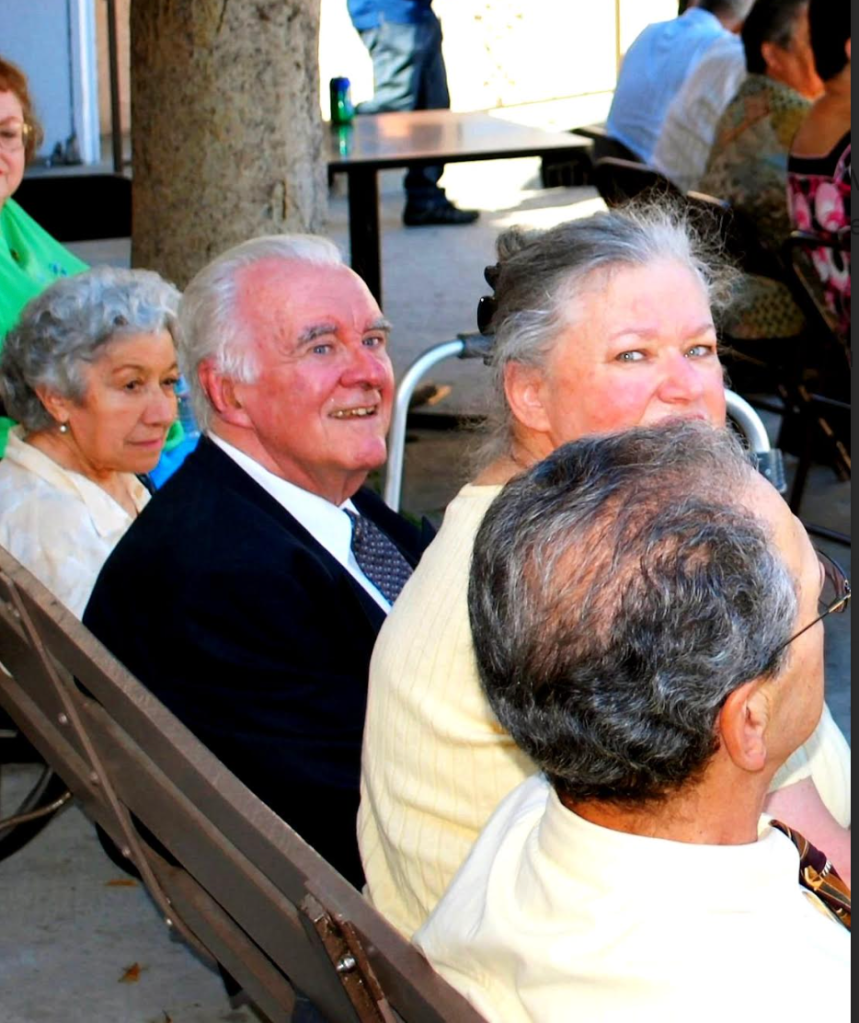
Margarita & Eduardo Mayone Dias, Katharine F. Baker, and José Rodrigues socializing with attendees before the Artesia D.E.S. book presentation, September 26, 2009. Photo by John J. Baker.
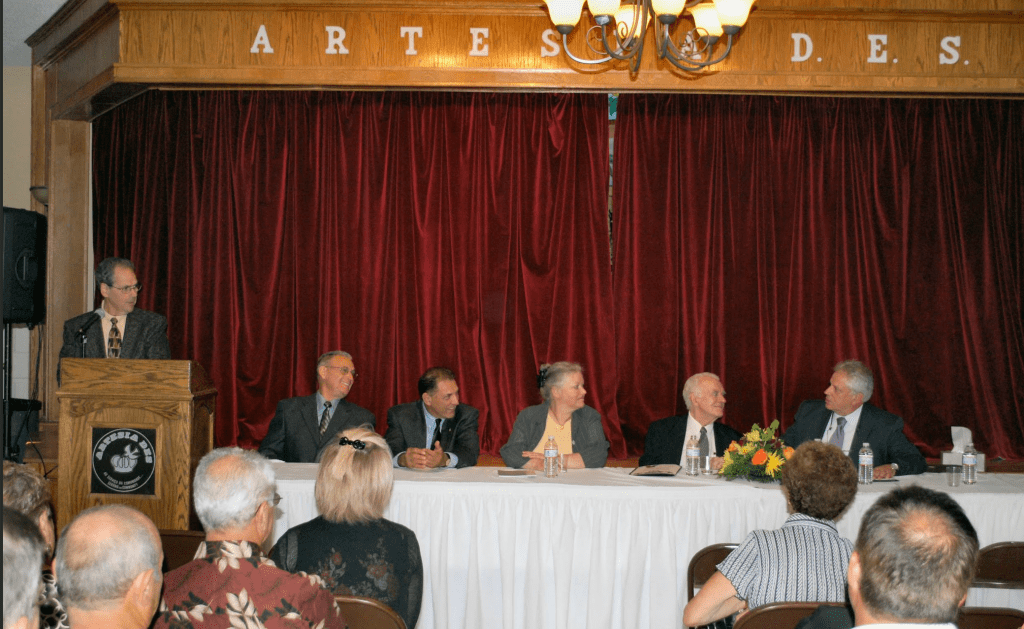
José Rodrigues addressing the audience during the presentation. Photo by John J. Baker.
Following the San Leandro event, John and I needed to rent a car the next day to drive down to Tulare and Artesia (and back) for the remaining presentations that week, so José, having been an executive in the auto rental industry, naturally helped arrange a deal that best suited our needs. He and Delminda were skipping the Tulare presentation, but José flew to Los Angeles on Saturday morning, September 26, rented a car, picked up Margarita and Eduardo Mayone Dias at their home, and brought them to Artesia, whose D.E.S. was hosting our double book presentation as well as honoring Dr. Dias for his decades of service to the Portuguese community. José, ever a loyal friend, remained in contact with Eduardo to the end of his life.
John and I spent another couple days in San Mateo with the Rodrigueses, before flying home to Pittsburgh. José and I stayed in touch over the years. In late 2014 José emailed me about a new project by PHPC: Untamed Dreams: Faces of America, with essays by several dozen contributors that “would look to bring together individuals’ life stories that would represent the qualities that have long distinguished the Portuguese community.”
Besides writing an account about my paternal grandparents’ courtship in Benicia, and editing family stories by my Florentino-American fourth cousins John J. Vasconcelos (1933-2024) and John N. Freitas, I wrote a biographical profile of Dr. Eduardo Mayone Dias titled Towering Scholar. Dr. Chamberlain assisted, while emails I sent out elicited a flood of responses from his colleagues and friends providing additional material, as well as being a testament to the esteem in which Dr. Dias was held.
José contributed his own essay to the book, too, about his uncle Agnelo Clementino, who became a prominent figure in Portuguese radio broadcasting, and got José involved after he arrived in California.
The last time we saw Delminda and José was at a conference of the Associação Internacional dos Colóquios da Lusofonia, which in early autumn 2016 was held in José’s native village of Lomba da Maia, São Miguel. Besides being an honored guest, José gave a presentation about PHPC’s work, and of course we all socialized at mealtimes and other events that AICL organized.
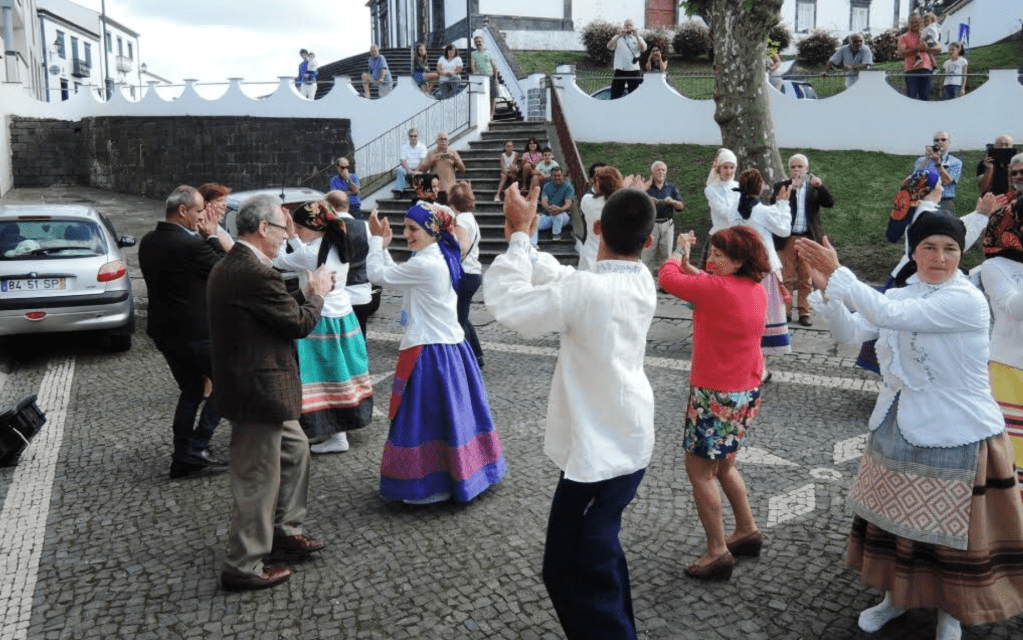
My favorite memory from the conference is of the local folkloric group’s performance of folk music and dances on the plaza in front of the Junta de Freguesia de Lomba da Maia. Toward the end they invited spectators to join them in a circle dance – and José did. It was tricky to photograph, because they were kicking up their heels and the circle was whirling so fast, but what fun everyone had!
In 2023 PHPC published Portuguese Bands of California, 1898-2023, compiled and written by Tony Goulart — incorporating a couple decades of Tony’s massive research and labor. José was credited as one of three people who provided revisions to the book, while I edited the text.
José was generous in sharing memories from childhood. For my paper about “The Role of the Crash of Air France Flight #009 in Adelaide Freitas’s Novel Smiling in the Darkness” (which occurred near his native village) (https://repository.library.brown.edu/studio/item/bdr:fzhxtt7u), he recalled the aftermath of the October 1949 plane crash: “I still remember seeing the large truck with many caskets stopped in front of my house in Lomba da Maia. They were on the way from Pico da Vara to Ponta Delgada, and Lomba da Maia was en route. Why they stopped, although briefly, I don’t know. But I remember seeing it vividly.”
When John and I were researching a paper last year about our “Search for Maria de Fátima’s Sweet Potato Bread-Sponge in I No Longer Like Chocolates” (https://repository.library.brown.edu/studio/item/bdr:w3a36zyb) I wrote to José seeking memories of home bread-making in his youth. “My mother fired up the wood burning oven twice a week so we could have fresh wheat and corn bread,” he replied — adding, “Most people grew their own corn and wheat, and had all the ingredients for bread. They might sometimes buy yeast at the store, but I remember my mother always having a bowl with yeast that she nursed daily for her needs. The padaria was in the next village, and distribution to close-by villages was done in a covered horse-drawn wagon.”
In July 2023, José emailed that he was “battling some medical problems.” I continued emailing him, but did not hear back as often as usual. In January 2024 he emailed, “I just finished reading a book that might be of interest to you, How Words Get Good, The Story of Making a Book by Rebecca Lee. In it there is a chapter on translating that you might find very interesting.” He mailed the book to me, specifying I not return it.
I received one last brief email from José on February 6, 2024. A month later, Tony Goulart sadly notified me of José’s death.
José do Couto Rodrigues passed on March 10th of 2024.
We thank translator and writer Katharine F. Baker for reminding all of us of his passing two years ago and of his dedication to our Portuguese Diaspora in California.
 Filamentos (artes e letras)