
Portuguese Mutual Aid and the Memory of Community in California
In the long history of migration, communities often carry with them more than their belongings. They bring habits of solidarity, rituals of belonging, and the instinct—born from centuries of hardship—that survival depends on collective care. When Portuguese immigrants arrived in California in the late nineteenth and early twentieth centuries, many came with little more than determination and memory. Yet from those fragile beginnings emerged one of the most enduring institutional legacies of the Portuguese diaspora: the network of fraternal societies that would shape community life for generations.
These organizations were not created in comfort but in necessity. Immigrants arriving from the Azores, Madeira, and mainland Portugal entered a world that was unfamiliar in language, law, and custom. Work was often seasonal and physically demanding, and the social safety nets we now take for granted did not yet exist. Illness, accident, or death could plunge a family into sudden poverty. In such circumstances, Portuguese immigrants turned to one another. They organized. They contributed small dues to shared funds. They created structures of assistance that would ensure that no member faced hardship alone. In doing so, they transformed vulnerability into solidarity.
These societies functioned as early systems of mutual insurance, but their importance extended far beyond economics. They were places where language could be spoken freely, where traditions were reaffirmed, and where the rhythms of Portuguese cultural life could continue in a new landscape. Within their halls and meeting rooms, immigrants debated, celebrated, mourned, and organized. These institutions became civic centers for communities scattered across California’s agricultural valleys and coastal towns. They were spaces where immigrants could practice democracy, elect leaders, manage finances, and cultivate a sense of belonging in a country that was still learning to recognize them.
Perhaps most remarkable is the fact that these institutions were shaped not only by the economic realities of immigrant life but also by its spiritual and cultural foundations. Religion—especially the devotional traditions carried from the islands—infused the moral imagination of these societies. Faith was not separate from community life; it was its organizing principle. Annual celebrations, commemorations of the departed, and acts of charity formed a cycle of ritual and responsibility that gave these organizations a deeper meaning. They did not exist merely to distribute benefits. They existed to sustain a community’s soul.
Within this landscape of solidarity, the leadership of Portuguese women stands out as one of the most compelling chapters of the story. At a time when many immigrant institutions elsewhere were dominated by male leadership, Portuguese women in California played a decisive role in organizing societies devoted to mutual assistance and charity. They understood with particular clarity the fragile balance of immigrant households—the risks faced by families living far from extended kin networks—and they responded by building institutions capable of protecting that fragile stability. Their leadership reveals how the story of Portuguese fraternalism is also a story of women’s agency and community vision.
As these organizations grew, they spread across the geography of Portuguese settlement in California. Councils and branches appeared wherever Portuguese immigrants established themselves—near dairies, farms, fishing ports, and urban neighborhoods. Through this expansion, the societies created a network that linked distant communities together. A Portuguese immigrant arriving in a new town could often find a familiar institution waiting there: a place where the language was spoken, where customs were understood, and where support could be found.
Over time these organizations matured into sophisticated institutions capable of managing significant financial resources. Their funds were carefully administered, their benefits expanded, and their administrative structures strengthened. What began as small gatherings of immigrants pooling modest contributions eventually developed into stable financial systems capable of supporting thousands of members. In many ways, these societies embodied the immigrant ethic of collective responsibility—proof that communities with limited resources could create durable institutions through discipline and trust.
Yet the true measure of these organizations cannot be found solely in balance sheets or membership records. Their deeper legacy lies in the cultural continuity they fostered. Through celebrations, commemorations, and communal gatherings, they preserved the language, traditions, and social values of Portuguese life. In their halls, one could hear the echoes of island villages carried across the Atlantic: songs remembered from childhood, recipes passed down through generations, stories of the old country told to children who would grow up speaking both Portuguese and English. These societies created spaces where heritage was not merely remembered but lived.
They also served as bridges between worlds. Portuguese immigrants were learning how to participate in American civic life while maintaining ties to their cultural origins. Through fraternal organizations, they practiced forms of democratic participation—electing officers, debating policies, managing collective resources—that mirrored the civic institutions of their new country. In this way, these societies helped immigrants become active participants in American society while preserving the distinct identity of their community.
Their contributions extended beyond the Portuguese community itself. The financial resources of these organizations were invested in local infrastructure and economic development. Their members participated in civic life and contributed to national causes, including wartime efforts that demonstrated their loyalty to the United States. In doing so, Portuguese immigrants affirmed that their identity as Americans and their identity as Portuguese were not mutually exclusive but complementary.
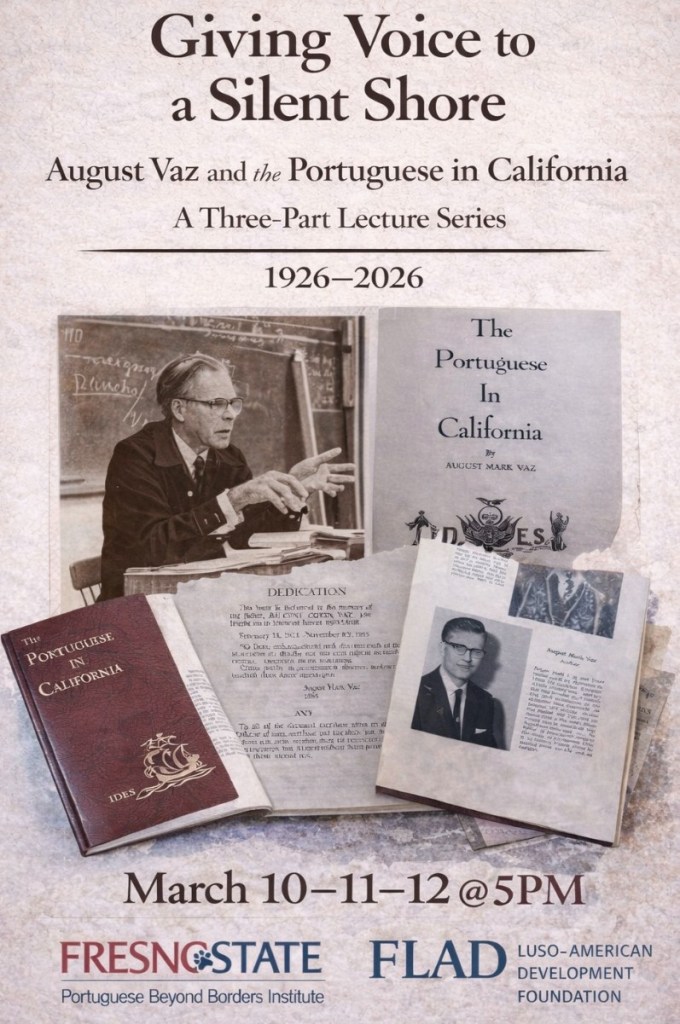
The story of these institutions might have faded into obscurity were it not for the careful work of historians who recognized their significance. Among those scholars, Augusto Vaz occupies a special place. His research into the Portuguese presence in California offers more than a simple chronicle of organizations and dates. It reconstructs the social architecture of an immigrant community—the networks of solidarity, faith, and leadership that sustained Portuguese life across generations.
Vaz’s work reminds us that the history of immigration is not only the story of individuals seeking opportunity but also the story of communities building institutions. His book allows us to see how ordinary people—farm workers, fishermen, laborers, mothers, and daughters—created structures of mutual care that shaped the Portuguese-American experience. In recovering this history, he restores visibility to a network of organizations that quietly sustained thousands of lives.
What emerges from his research is a portrait of a community that understood the power of collective responsibility. Portuguese immigrants did not wait for external institutions to solve their problems. Instead, they built their own. They organized funds, drafted constitutions, elected leaders, and created traditions that would bind generations together. Through these acts of organization and care, they constructed a cultural and social infrastructure that endured long after the first immigrants had passed on.
Today, when we look back at the history of Portuguese fraternal societies in California, we see more than a collection of organizations. We see an expression of an immigrant philosophy: the belief that community is built through shared responsibility, that culture survives through collective memory, and that solidarity can transform vulnerability into strength.
In the end, the story of these societies is not merely about the past. It is about the enduring human capacity to create belonging in unfamiliar landscapes. Across the Pacific Ocean and the American continent, Portuguese immigrants carried with them a simple but profound conviction: that a community survives when its members care for one another.
And in the quiet architecture of those fraternal halls—in the ledgers, the rituals, the meetings, and the celebrations—we glimpse the living proof of that conviction
Diniz Borges, PBBI, Fresno State.
 Filamentos (artes e letras)