
Giving Voice to a Silent Shore
August Mark Vaz and the Portuguese Story of California
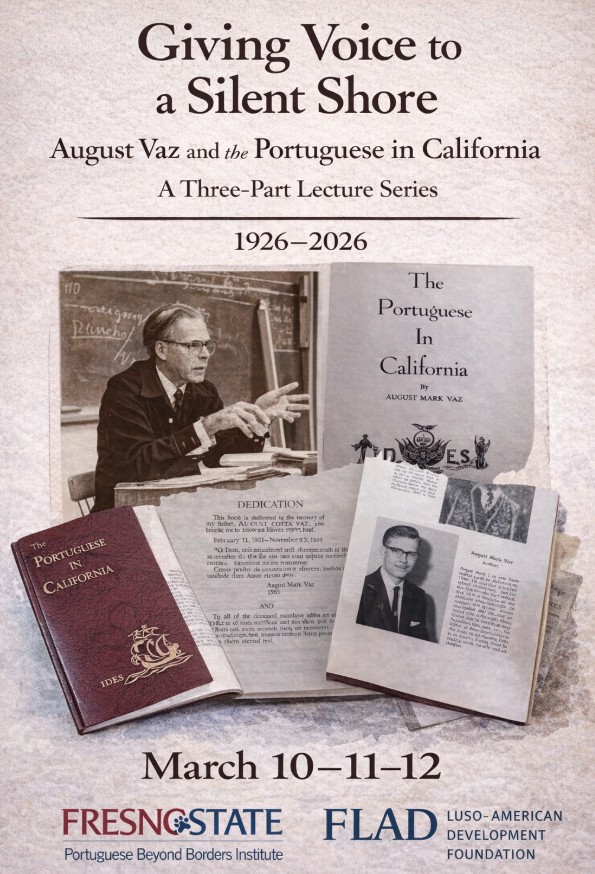
History is often written as the story of nations—of governments rising and falling, of wars fought across continents, of the loud punctuation marks that signal the turning of an era. Yet beneath these events runs another history, quieter but no less decisive: the history of migrations. It is the story of people who move across oceans and frontiers not as conquerors but as laborers, sailors, and farmers; people whose lives rarely appear in official chronicles but whose work slowly alters the landscapes they inhabit. These histories unfold without spectacle. They accumulate through persistence, through the daily negotiations of survival and adaptation, until the marks they leave behind become indistinguishable from the very fabric of the place.
It was this quieter history that historian August Mark Vaz sought to recover in his pioneering work The Portuguese in California. Published at a time when immigrant histories were still largely absent from mainstream narratives of the American West, Vaz’s study stands as one of the earliest sustained efforts to document the presence of Portuguese migrants along the Pacific coast. His book does more than catalogue settlement patterns; it reconstructs a story of movement and transformation, revealing how immigrants from the Azores, Madeira, and mainland Portugal became part of California’s evolving society. By tracing their journey from maritime labor to agricultural settlement, Vaz illuminated a dimension of California’s past that had long remained obscured.
Among the most evocative sections of his work is the chapter titled “Whaling, Gold and Homesteading.” In these pages Vaz follows the gradual emergence of Portuguese communities across the nineteenth century, showing how their migration unfolded across three distinct worlds: first the maritime economy of whaling, then the restless frontier of the Gold Rush, and finally the agricultural landscape that would anchor their permanent settlement. The trajectory he describes is not simply economic but cultural—a passage from mobility to rootedness, from temporary labor to enduring community.
The story begins not with a planned migration but with an almost accidental arrival. In 1792, when the British explorer Captain George Vancouver anchored at Monterey during his exploration of the Pacific coast, several sailors deserted their ships. Among them were Portuguese seamen who chose to remain in California rather than return to the rigid discipline of maritime life. From this moment emerges the figure of Antonio Rocha, perhaps the earliest documented Portuguese settler in the region. As Vaz records, “One of these men may have been the first documented Portuguese settler in California, Antonio Rocha.” By 1815, Rocha appears in records in Los Angeles, and within little more than a decade he had acquired the La Brea Rancho, a vast tract of land measuring over four thousand acres. His story illustrates the fluid social landscape of early California, where individuals from distant lands could reimagine their futures.
Yet Rocha’s experience remained exceptional. The true engine of Portuguese migration to the Pacific emerged from the maritime economy of the nineteenth century. American whaling ships sailing from ports such as New Bedford and Nantucket regularly stopped in the Azores to recruit sailors. The Azorean islands, isolated in the Atlantic yet deeply tied to maritime traditions, provided a steady supply of experienced seamen. Portuguese sailors quickly gained a reputation for endurance and skill. As Vaz notes, “the Portuguese were noted for their seamanship, hard work and ability to spot the whales.”
Through these voyages the Azores became connected to a vast oceanic network that stretched from New England to Hawaii and the Pacific coast of North America. For many Azorean sailors, California was initially no more than a distant port of call. Yet for some, it became the beginning of a new life.
Portuguese whalers established some of the earliest sustained settlements along the California coast. Whaling stations appeared in places such as Monterey, Pescadero, Point Lobos, and Half Moon Bay, where crews processed whale oil and other products that fueled nineteenth-century industry. These operations were often modest in scale but economically significant. At Monterey, for example, a Portuguese group processed more than 24,000 barrels of whale oil within three years, an indication of both the productivity of the industry and the central role played by Portuguese labor.
These coastal communities represented the first recognizable Portuguese enclaves in California. Their existence reflected the broader maritime networks that connected the Azores to the Pacific world. What emerges from Vaz’s narrative is a portrait of migration shaped less by dramatic upheaval than by gradual adaptation. Portuguese immigrants did not arrive in California as a single wave nor with a unified plan of settlement. Instead, their presence grew through overlapping networks of maritime travel, labor migration, and family connections that slowly expanded across the Pacific world.
History, however, rarely remains tied to a single economic system. By the mid-nineteenth century the whaling industry began to decline, while a discovery in the Sierra Nevada mountains would transform California forever.
The Gold Rush of 1849 brought an extraordinary influx of migrants to the region. News of gold spread rapidly across continents, drawing adventurers and laborers from Europe, Latin America, Asia, and the Pacific islands. California was transformed almost overnight into a cosmopolitan frontier society. As Vaz writes, the discovery of gold “turned California almost overnight into a great cosmopolitan center.”
Portuguese migrants were part of this great movement. Some arrived directly from the Azores, while others came from Hawaii or from American whaling ports where they had previously worked. A number of them sought their fortunes in the goldfields themselves. Yet, as Vaz carefully demonstrates, gold was rarely the final destination for Portuguese immigrants. The instability of mining and the uncertainty of fortune led many to seek more sustainable livelihoods.
Gradually, Portuguese immigrants began to move into agriculture, fishing, and small-scale commerce. In this transition we see one of the defining characteristics of Portuguese migration: adaptability. As Vaz observed, immigrants from the Azores often arrived as laborers but eventually “went on to buy the land and work the soil as his own.”
Communities began to form across California. Portuguese settlers established themselves in San Jose, San Leandro, Stockton, and the Sacramento Valley, forming tightly knit neighborhoods known as colonias. These communities provided social and cultural support for immigrants navigating unfamiliar surroundings.
Within these settlements, traditions brought from the Azores continued to shape community life. Language, religion, and shared customs helped maintain cultural continuity across generations. Among the most visible expressions of this continuity were the Holy Ghost festivals, celebrations rooted in Azorean religious tradition that soon became defining features of Portuguese-American culture in California.
By the late nineteenth century, Portuguese immigrants had increasingly established themselves as farmers and ranchers. Their reputation for diligence and careful cultivation soon became widely recognized. Vaz describes Portuguese farmers as “exceedingly industrious and careful farmers,” a phrase that reflects both their agricultural success and the respect they earned in local communities.
In regions such as Alameda County and the San Joaquin Valley, Portuguese farmers helped develop thriving agricultural enterprises, particularly in dairy farming and vegetable cultivation. The transformation from sailor to farmer thus became the defining trajectory of Portuguese migration in California.
By the early twentieth century Portuguese immigrants and their descendants had become firmly embedded within California society. Churches, mutual aid societies, newspapers, and cultural organizations emerged to sustain community life. Cities such as Oakland, San Jose, and Stockton became important centers of Portuguese-American culture, while later generations extended this presence throughout the Central Valley, including communities in Turlock, Tulare, and Fresno.
Yet what makes Vaz’s narrative particularly compelling is his recognition that the Portuguese story in California unfolded quietly. Unlike the dramatic legends that dominate popular histories of the American West, the Portuguese experience was marked by steady perseverance rather than dramatic conquest.
“In a quiet, unobtrusive way,” Vaz wrote, the Portuguese established themselves in California.
Looking back across more than a century, the arc traced by August Vaz reveals a migration defined less by spectacle than by patient endurance. Portuguese immigrants did not arrive with proclamations of destiny nor did they leave behind monuments celebrating conquest. Instead, they entered the state’s history gradually—first as sailors scanning the horizon from the mastheads of whaling ships, then as laborers navigating the uncertain economy of the Gold Rush, and finally as farmers cultivating the fertile valleys that would sustain their communities for generations.
Through work rather than spectacle, through community rather than conquest, immigrants from the Azores and other Portuguese regions gradually became part of California’s social and economic fabric. Churches, festivals, and mutual aid societies helped preserve cultural traditions while new generations adapted to the rhythms of American life.
August Vaz understood that such histories are easily overlooked precisely because they unfold quietly. By gathering fragments of memory—ship records, land deeds, and community histories—he transformed scattered traces into a coherent narrative of migration and belonging. His work reminds us that the history of California is not only the story of gold mines and railroads but also the story of countless migrants whose labor reshaped the land.
In preserving these stories, Vaz ensured that the voices of those early immigrants would not disappear into silence. Their journey—from the decks of whaling ships to the farms of California’s valleys—became part of a larger American narrative, one in which distant islands and western frontiers were joined by the enduring human impulse to seek opportunity beyond the horizon.
Through his scholarship, what might once have remained a silent shore now speaks with clarity across generations.
Diniz Borges- PBBI, Fresno State.
 Filamentos (artes e letras)