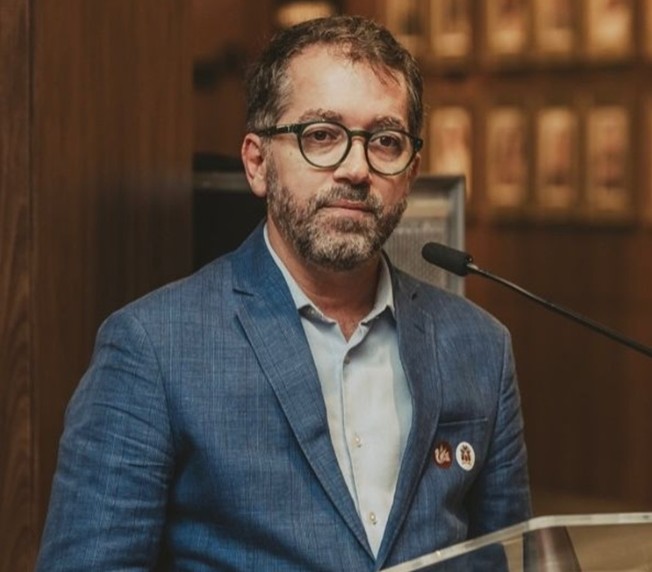
In this conversation, anthropologist and historian Luiz Nilton Corrêa, president of the Historical and Geographical Institute of Santa Catarina (IHGSC), reflects on the Institute’s mission at a pivotal moment in its 130-year history. He highlights the importance of the Biblioteca Açoriana Machado Pires as the leading reference center for Azorean culture in southern Brazil and outlines new initiatives to digitize and democratize access to Santa Catarina’s historical memory.
Luiz Nilton Corrêa currently leads the Instituto Histórico e Geográfico de Santa Catarina, guiding the institution into a new phase defined by digital access and global engagement. An anthropologist and historian whose academic path spans the Azores and Salamanca, Corrêa assumed the presidency with the goal of consolidating the Institute’s presence in the digital and international arena. Founded more than a century ago, the IHGSC remains a cornerstone in shaping the cultural and historical identity of Santa Catarina, a Brazilian state forged by successive waves of migration and complex processes of territorial and cultural affirmation.
Under the new leadership, the Institute has made the digitalization and democratization of its archival holdings a central priority. Its collections include thousands of historic photographs, maps, manuscripts, and periodicals—materials that document the political, cultural, and geographic evolution of the region. By bringing these materials online, the Institute hopes to expand access not only for scholars but also for the broader public interested in the documentary memory of the state.
Institutionally, Corrêa has also emphasized the Institute’s international dimension. Among its most meaningful partnerships is its longstanding relationship with the Autonomous Region of the Azores, a connection he describes as marked by a “singular closeness.” This relationship has been expressed through joint research projects, academic exchanges, and—most visibly—the establishment of the Biblioteca Açoriana Machado Pires, a specialized collection that has become the most important center for Azorean cultural studies in southern Brazil.
To mark its 130th anniversary, the Institute is preparing its first International Congress, dedicated to the theme Identity in Construction. The event aims to project Santa Catarina into the global academic conversation while reaffirming the Institute’s historic role as a bridge between memory, scholarship, and the future.
In an interview with our reporter, Luiz Nilton Corrêa, 48, anthropologist, historian, and president of the Institute, discussed the institution’s new initiatives, its digital ambitions, and its enduring ties to the Azores.
DL: When you assumed the presidency of the Historical and Geographical Institute of Santa Catarina, what management priorities did you establish, and what structural changes did you seek to implement?
Taking the presidency of an institution like the Historical and Geographical Institute of Santa Catarina—an institution with 130 years of leadership in shaping the identity of our state—is to accept a responsibility of singular magnitude. Santa Catarina, by definition, is a cultural mosaic.
With a population approaching eight million people, the state carries a deeply plural heritage. It is estimated that Santa Catarina is home to roughly three million descendants of Italians, two million of Germans, and one and a half million of Azoreans. This demographic foundation is interwoven with African influences and with additional migratory currents from Austrians, Poles, Ukrainians, Dutch, Hungarians, and Japanese communities. Together they form a diversity that is rare in the Brazilian landscape.
Building a cohesive identity within such a diverse context required the sustained effort of identifying shared heroes and symbols—figures capable of uniting us. Among them are the poet Cruz e Sousa, the revolutionary heroine Anita Garibaldi, and the painter Victor Meirelles. The IHGSC played a central role in this process. One of its historic milestones was the International Congress of History in 1948, which marked a turning point in recognizing the Azorean roots of Santa Catarina’s coastal culture.
Our mission reaches back to the very origins of the state itself. One of the Institute’s earliest tasks was to help consolidate Santa Catarina’s territorial boundaries during the Contestado dispute, when our researchers traveled to Lisbon to consult archival documents that ultimately helped establish the legal foundations of the state’s borders.
In this sense, the Institute did more than help draw the map of Santa Catarina—it helped shape the soul of its people.
DL: The Institute has long played a central role in preserving the historical memory of Santa Catarina. How do you evaluate its impact today on the production and dissemination of knowledge about the state?
Over its 130-year history, the Institute has served—often alone—as the principal guardian of Santa Catarina’s historical memory. It is important to remember that the state’s first universities were founded decades after the Institute itself. The Federal University of Santa Catarina (UFSC) was established only in 1960, and the State University of Santa Catarina (UDESC) followed in 1965.
For seventy years before those institutions existed, the IHGSC was not only preserving memory but actively shaping it. It helped construct and interpret the narrative of regional identity. Even today, that role continues through rigorous scholarly production and academic events that influence the historiography of the state.
A contemporary example occurred in 2015, when the Institute published research that redefined the founding date of Florianópolis. The city had long been believed to date from 1723. Our study demonstrated that settlement began in 1673, with the arrival of Francisco Dias Velho. This discovery effectively changed the age of the capital and reaffirmed the Institute’s role as an active and technically rigorous participant in the revision and strengthening of our historical knowledge.
DL: The recently announced project to digitize Santa Catarina’s historical images and collections represents an important step in democratizing access to memory. What stage is the initiative currently in, and what challenges have you faced?
This project embodies the central commitment of my administration: the digitalization and democratization of access to more than eight thousand historic photographs. These images document conflicts, decisive political moments, landscapes, and the many milestones that shaped Santa Catarina’s territory over the last two centuries.
This is only the first step. The photographs will soon be available on the Institute’s website in high resolution, under open-use licensing that requires only proper attribution to the IHGSC.
Our ambitions, however, extend far beyond photographs. We hold more than 350 historical maps, thousands of manuscripts, and a library containing rare and centuries-old works. We also maintain a remarkable collection of periodicals, including the Revista do IHGSC, whose earliest issues date back to 1902. All of this documentary treasure will gradually be digitized.
It is important to emphasize that none of these achievements comes from guaranteed funding. Every initiative requires submitting projects to competitive grants and knocking on doors in search of support. Often success does not come on the first attempt. Writing the project is sometimes the easiest part—the real challenge is securing the financial means to make it possible.
DL: How can the digitalization of the Institute’s holdings benefit researchers, schools, and universities, and contribute to the broader recognition of Santa Catarina’s identity?
The democratization of this archive is not merely an administrative action. It opens a portal to new forms of research and to a deeper understanding of Santa Catarina’s identity—and by extension, Brazil’s.
Each Brazilian state contains its own unique historical reality. The images we are making available possess the extraordinary power to transform imagination into something concrete. Landscapes, human types, decisive events—photography materializes what texts describe. It elevates the photograph from mere illustration to a primary source of historical analysis.
Once integrated into digital networks, these materials will become accessible to researchers anywhere in the world, fulfilling the original promise of the internet: universal access to quality information supported by the scholarly authority of a centennial institution.
DL: The Azorean presence played a decisive role in the formation of Santa Catarina. How do you interpret this historical influence today?
Like much of the Americas, the territory that is now Santa Catarina was already inhabited when Europeans arrived. But in the eighteenth century, the Portuguese Crown faced the urgent need to consolidate its control over this region.
Beginning in 1748, settlers from the Azores arrived in successive waves. Their arrival marked the beginning of a distinctive urbanization process. Communities were organized around small central squares anchored by chapels and churches—nuclei that eventually became many of the coastal cities of Santa Catarina and Rio Grande do Sul.
The Azoreans therefore preceded German and Italian immigration by nearly a century, playing a decisive role in establishing the earliest urban networks of the region. Beyond the physical landscape, they left a profound cultural imprint. Azorean traditions blended with indigenous knowledge, producing a unique cultural synthesis that can still be seen today in the toponyms of cities such as Itajaí, Camboriú, and Garopaba—names of indigenous origin embedded within a historical landscape shaped by Azorean settlement.
DL: What projects currently exist to study this shared history between Santa Catarina and the Azores?
The Institute maintains long-standing partnerships with the University of the Azores and with the Regional Government of the Azores. The landmark congress of 1948 awakened an Azorean identity that had long remained unspoken, and it laid the groundwork for decades of scientific cooperation.
More recently, in 2018, the Institute organized a major conference commemorating 270 years of Azorean presence in Santa Catarina, bringing together scholars and authorities from both sides of the Atlantic.
Looking ahead, we aim to strengthen this transatlantic cooperation by increasing joint publications and developing academic programs that support Brazilian students studying in the Azores. These initiatives reaffirm the Institute’s role as a bridge between a shared past and a shared future.
DL: How would you describe the relationship between the Institute and the Azorean government?
The relationship between the IHGSC and the Autonomous Region of the Azores is marked by a truly singular closeness. Among the many migratory roots that shaped Santa Catarina, the Azorean connection stands apart.
One of the clearest expressions of this bond is the Biblioteca Açoriana Machado Pires, housed within the Institute. Created through the initiative of Professor Vilca Merízio, the library grew from a donation by the Regional Directorate for the Communities of the Azores. It now houses an important collection of works by Azorean authors.
More than a library, the Machado Pires collection stands as a living symbol of the scientific, cultural, and diplomatic cooperation linking our Institute with the Government of the Azores. It confirms the IHGSC as the principal guardian of Azorean memory in southern Brazil.
DL: Finally, who is Luiz Nilton Corrêa?
Luiz Nilton Corrêa is a scholar whose personal and academic journey mirrors the transatlantic movements he studies. Born in Santa Catarina, he first became immersed in Azorean identity in 2001 through the cultural group Arcos.
That awakening led him to spend nearly two decades in Europe, balancing work with academic life and participating in the folklore traditions of Relva, in the Azores. He holds a degree in History and a master’s degree in Insular and Atlantic History from the University of the Azores, where he studied the migration of Azoreans from São Miguel to the Dominican Republic in 1940—a study later published in Portugal and by the Dominican Academy of History.
He later earned a PhD in Anthropology from the University of Salamanca, focusing on the Festivals of the Holy Spirit. Today, as president of the IHGSC, he also coordinates the Institute’s postdoctoral program and serves as a visiting professor at institutions in Spain and Portugal—bringing together the lived experience of an emigrant with the analytical vision of a social scientist.
Interview by Ígor Lopes
Journalist
In Diário da Lagoa, Clife Botelho, director.
 Filamentos (artes e letras)