
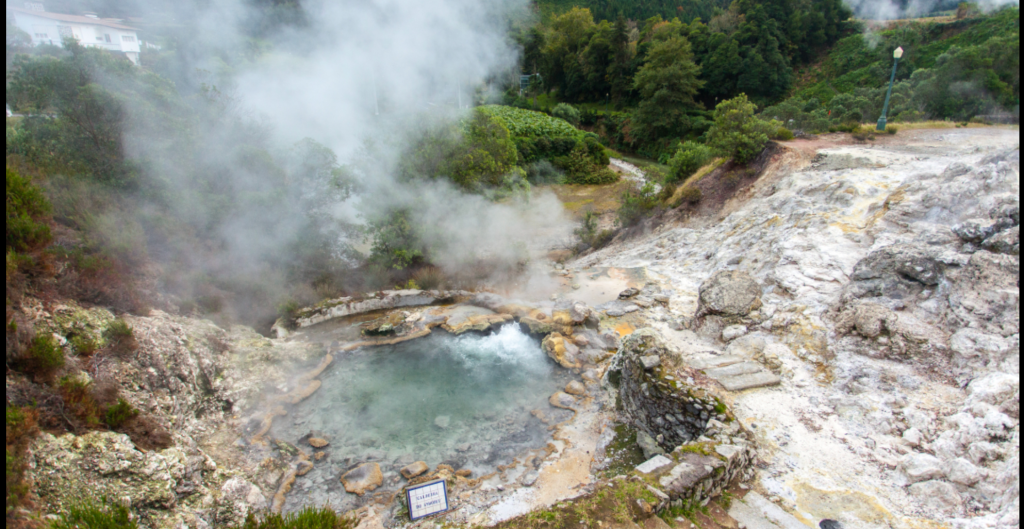
Last Sunday I returned, once more, to the Valley of Furnas. Each visit reveals some subtle alteration—changes easily verified in the private archive of photographs I have gathered over the years. This time the transformation lay along the shore of the lake, near the steaming caldeiras where the famed cozido is buried in volcanic earth. The space has been thoughtfully reorganized: more pits opened for cooking, safer walkways laid down, even modest kiosks offering refreshment. Nothing jars the spirit of the place. Nothing disturbs the vast basin’s silence, broken only by the murmur of hot bubbles striking pumice stone.
Not long ago, in winter’s gray season, this lakeside stood abandoned and windswept. People feared the rising waters and the havoc they might bring upon the Valley. Today, though surrounding areas remain flooded, the leafless trees endure, patient in their austerity, awaiting spring’s return to restore them to their green dominion—when they will once again cast shade over summer visitors.
Furnas is a valley of retreat, of silence, of catharsis. Here the entrails of the earth speak without stirring terror in those who dwell nearby. In the early seventeenth century, a small family of hermits settled here and endured a violent volcanic eruption. When the ash settled, Jesuit fathers established a house, and a settlement gradually formed with families arriving from Ponta Garça, Povoação, and Vila Franca, as chronicled by Gaspar Frutuoso. Since then, Furnas has imposed itself upon memory and imagination through its environmental diversity—its forests, its volcanic and hydrothermal phenomena, its landscape of rare beauty—and through a mysticism that evokes both death and rebirth.
When Raúl Brandão visited the archipelago in 1924 and later wrote The Unknown Islands, he captured that paradox with trembling intensity: “Beneath the crust we tread—perhaps only meters thick—hell naturally continues. It is enough to prod the earth with the tip of a cane to open a chimney.” Professor Machado Pires, in his preface to Brandão’s work, reminds us that the writer was a creature of emotion, capable of extracting tenderness from a stone or a tree. It is no wonder, then, that Brandão described the Valley as a place where “trees grow before our eyes,” where “every cutting takes root,” where the soil—warmed by the sun, sheltered by mountains, and irrigated by subterranean hot veins flowing toward the lake—produces taro leaves of nearly black green and corn as tall as two men. The boxwoods swell to arboreal proportions; water falls and turns mill wheels, irrigates fields, and intoxicates the roots of araucarias, banana trees, and bamboo thick as trunks. “A small garden,” he called it. “A luxury of greenery.” “Parks of wonder.” Even the shapes the plants assume “are not of this world.”
Half a century later, the ethnologist F. Carreiro da Costa confirmed that the parks of Furnas are veritable forest museums. By then, the Valley’s thermal wealth had also drawn scientific attention. At the First Azorean Congress, held in Lisbon in May 1938, Professor Armando Narciso—one of the leading hydrologists of his time—estimated that more than ten million liters of medicinal water flow daily from the Valley’s springs, perhaps as much as fifteen million in total. Such abundance inspired awe among European physicians. The Society Terra Nostra preserved in its book of honor tributes from eminent scientists: Dr. Justin Besançon of the Paris Faculty of Medicine declared Furnas worthy of being “the vanguard of European hydropolises.” Dr. Jacques Forestier foresaw it becoming an arthropolis of the first rank. Others praised it as a unique thermal world where thermotherapy might be joined to crenotherapy and even thalassotherapy. “Blessed are the patients who come to be treated in this crater,” wrote Dr. Mougeot. Another called it destined to be “the great world station of combined cures.”
And yet, despite such prophetic endorsements, the Valley’s thermal promise has never been fully realized. A thermal station was built—recently transformed into a spa hotel—along with bathhouses meant to harness the waters’ healing force. But these facilities have not benefited from the technical, scientific, and therapeutic development that thermalism enjoys in other centers with far fewer resources. Today, as the University of the Azores begins offering pre-medical studies, it seems urgent that health authorities undertake a serious evaluation of Furnas’ potential. How can we allow fifteen million liters of medicinal water to run unused into the Atlantic when they might serve domestic and industrial purposes in ways that are clean, sustainable, and environmentally sound?
Walking in silence through the streets of Furnas, one is startled by the persistent sound of curative waters coursing beneath the earth, feeding a spectacular forest sanctuary before flowing down to Ribeira Quente and out to sea. In these days when Lisbon gathers tourism investors and public officials to discuss the future of development, may no one forget that in the Valley of Furnas, landscape beauty and natural force wait in patient union. They await those capable of drawing from them the fullest benefit—for the health of what some once dreamed might become the greatest hydropolis in the world, and for the well-being of this fertile earth where, to borrow the biblical phrase, milk and honey also flow.
José Gabriel Ávila, journalist (in Diário dos Açores)
Tranaslated by Diniz Borges
References:
1Brandão, Raúl, As Ilhas Dsconhecidas, Editorial Comunicação, 1988
2Carreiro da Costa, Esboço Histórico dos Açores, Instituto Universitário dos Açores, Livraria Editora PAX,L.da, março de 1978
3Livro do “Primeiro Congresso Açoriano”, 2ª edição Jornal da Cultura, 1995
 Filamentos (artes e letras)