
The Letters of Our Diaspora
(January 29, 2016)
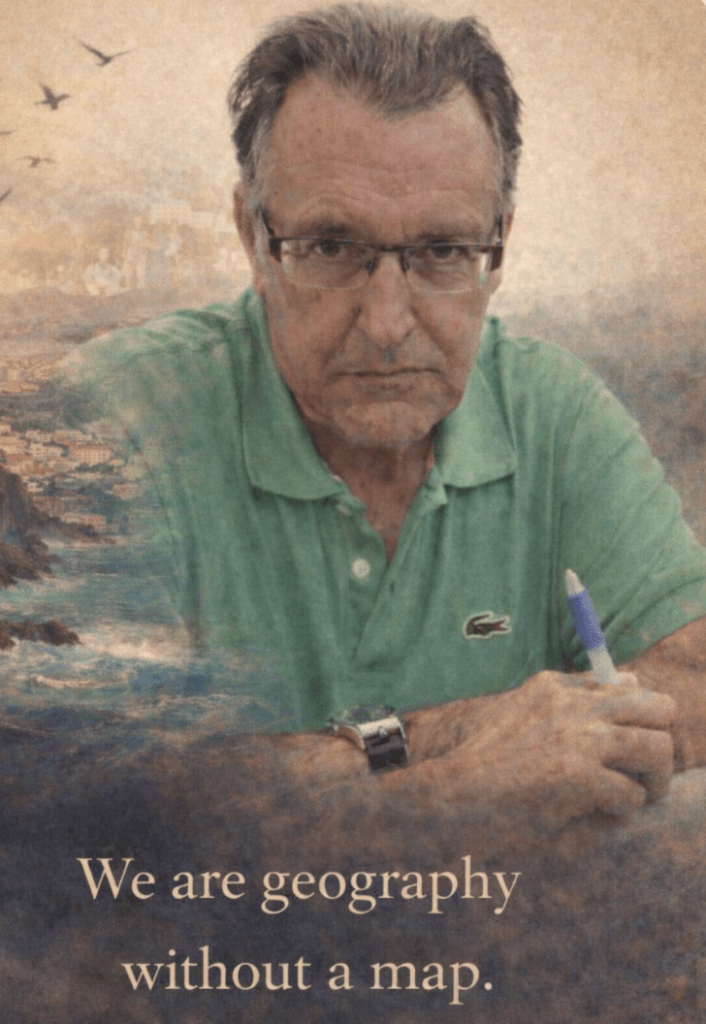
Vamberto Freitas
That there is a place within the literary traditions of the New World for the letters of Portuguese-language immigrants and their Luso-American and Canadian descendants becomes the most important message anthologies like this one send to the world.
— George Monteiro, Writers of the Portuguese Diaspora in the United States and Canada
It has become difficult for me to write about these matters of our diasporic literature without repeating myself in various ways. So be it. Repetition of words and phrases belongs to poetry itself, to the poetic insistence on a decisive image, metaphor, idea, or feeling. In the end, this textual repetition may be noticed only by a small group of readers here and elsewhere—those who read and value the writing of a Lusophone nation in motion. More than that, those same readers know that beyond the aesthetic pleasure of a literary text lies a permanent record of how a people who has lived—and lives—consciously within its own history understands itself; our history has always been intertwined with others, across the most dispersed geographies and traditions.
I write on International Thank-You Day, 2016. At first I laughed at the idea; then I accepted it in good spirit. So, thank you to Professor and writer Luís Gonçalves, of Princeton University, and to poet Carlo Matos, of the City Colleges of Chicago, for this new anthology of Luso-American and Canadian literature, Writers of the Portuguese Diaspora in the United States and Canada.
Portugal may forget, with some frequency—except when it needs emigrant remittances, still necessary for the balance of our finances—that beyond continental Europe and the Atlantic islands the Nation is present and increasingly active in all four corners of the world. And what corners they are on the other side of the Atlantic, when they include the United States, Canada, and Brazil. We carry centuries of ironic prejudice when we think about our own peregrination: we speak of an adventurous people who gave worlds to the world, and then we treat that same movement as a procession of wretches incapable of surviving in the homeland—people with fractured tongues turned into others on this and that side of the sea, judged by a provincial elite almost always ill-informed about what happens just beyond its own door and street.
The endlessly repeated story goes like this: Portuguese around the world first died working brutally hard; now they give us one of the most dynamic diasporas of Luso-descendants, proving that their stature is no smaller than that of other peoples. Since the middle of the last century, when subsequent generations began to enter institutions of higher education, the other side of the coin became plain to see—individuals across every sphere of human activity demonstrated their capacity for integration, in industry, politics, and the arts, with literary works at the center of these expressions. They inherited from us a great literary tradition, but at their own cost. From their grandmothers’ kitchens—whether in the urbanity of the American East Coast or the fields of California—they received love and the mythic pull of ancestral origins. Portugal—continent and islands—became a distant, unfamiliar, yet desired place.
I believe the writers and poets gathered in this anthology (some of them first-generation immigrants) know our country up close; others have already taken part in major cultural and literary events among us. If none of this can be tallied in the values and markets that dominate our societies today, the truth is that their writing constitutes an immeasurable wealth—the identity of an entire people, the essential self-esteem of those who will perpetuate not only our name but also affirm, without equivocation, the dignity of their countries of birth and of their ancestry.
George Monteiro, who not long ago anthologized Luso-American poetry with Alice R. Clemente, thereby defining a substantial part of a developing canon, notes in the preface that this collection follows earlier ones—of prose and poetry in both languages—and that contributions were solicited from the writers and poets included here. Monteiro, together with the late Professor Nancy T. Baden and Onésimo Teotónio Almeida, were pioneers in the effort to secure institutional legitimacy for immigrant and Luso-descendant literatures in North America through their own scholarship and publications, especially the now historic Gávea-Brown: A Bilingual Journal of Portuguese-American Letters and Studies.
The two editors of Writers of the Portuguese Diaspora in the United States and Canada belong to a new generation of scholars and authors who enjoy a crucial advantage for the continuity of this writing: they know better than anyone their colleagues spread across both countries on that continent—many still unknown to general readers, and even to those, like myself, who devote much of their lives to studying this field.
Among names secure on any reading list, in Portuguese or English—Katherine Vaz, George Monteiro, Anthony Barcellos, Lara Gularte, Millicent Borges Accardi, Nancy Vieira Couto, Rose Silva King, Sam Pereira, Darrell Kastin, Diniz Borges, and Frank X. Gaspar—we also encounter others now beginning to circulate their work among us across genres that include poetry, fiction, biography, and autobiography, on both sides of the border: Amy Sayre Baptista, Alyse Knorr, Richard Simas, Diana Ramos Firestone, Brian Sousa, Ian E. Watts, Jennifer Jean, Joe Amaral, Linette Escobar, Marina Carreira, Sarah Chaves, Emanuel Melo, Paula Neves, Jozhe, and Catarina Costa Laranjeira. I also note others—known to varying degrees on both sides of the Atlantic—such as António Ladeira, Eduardo Bettencourt Pinto, Esmeralda Cabral, João S. Martins, Augusto Mark Vaz, Paulo da Costa, Miguel Moniz, and Manuel Carvalho.
No hierarchy of names or works is implied here; this is simply my own response and reading over recent years. Some of these authors may not yet have published books, their work remaining dispersed across varied publications. It was gratifying to encounter several of them for the first time, and from whom we can expect—indeed, hope for—much more in the future. Set aside judgment for now: what I read, I read with pleasure and surprise.
It so happens that the publication of this volume coincided in the Azores with the appearance of O Conto Literário de Temática Açoriana, selected and accompanied by an extended study by Mónica Serpa Cabral. This is another collection of our fiction of that kind from the nineteenth century to the present, confirming certain canonical authors while introducing others. For years I have argued for a place within our literary corpus for diaspora writers and poets, regardless of the language in which they write, provided their thematic references and certain linguistic textures belong to our Tradition—recreating images and metaphors that represent our ancestral and historical past.
That happens for the first time in Mónica Serpa’s work, with the inclusion of a short story by Katherine Vaz (“My Hunt for King Sebastião,” from Fado & Other Stories). Not all readers on both sides of the sea will agree with this proposal, but no one can deny that in the era of globalization communities redefine identity—or identities; the geographies of affection become irreversibly mixed; the languages of expression belong to a shared cultural and literary patrimony.
Immigrant literatures everywhere resemble one another closely, and may even be considered within what has come to be called “postcolonial” literatures. While histories do not coincide in specific details, they converge in shared themes: the voice of the Other emerging—or reemerging—from societal margins; responses to power and to the languages of dominant classes within national spaces; responses to canonical literatures once defined and imposed by institutional systems that never accounted for those forgotten and marginalized voices, as reaffirmed years ago in The Empire Writes Back by Bill Ashcroft, Gareth Griffiths, and Helen Tiffin.
Against the old defamatory term portugee found in some famous authors and reference works, there now stands—decisively—the word Portuguese. When a Luso-descendant writer appropriates the former, it is with irony, stripping it of racist or chauvinist charge. This, too, is what the emerging Luso-descendant literature will do: create a new creative archive of our people everywhere; provide a sophisticated artistic mirror of who we were and are in lands that once belonged only to others. The natural osmosis among these literatures allows—beyond all the pleasure and civilizational signal that art represents—a fuller understanding of our History, and it cements the identity of a people that is always more complex and diverse than earlier studies and discourses allowed.
Reference
Writers of the Portuguese Diaspora in the United States and Canada, selected and edited by Luís Gonçalves and Carlo Matos. Charleston, SC: Boavista Press, 2015.
The translation of the epigraph is my own. Originally published in “BorderCrossings,” Açoriano Oriental, January 29, 2016
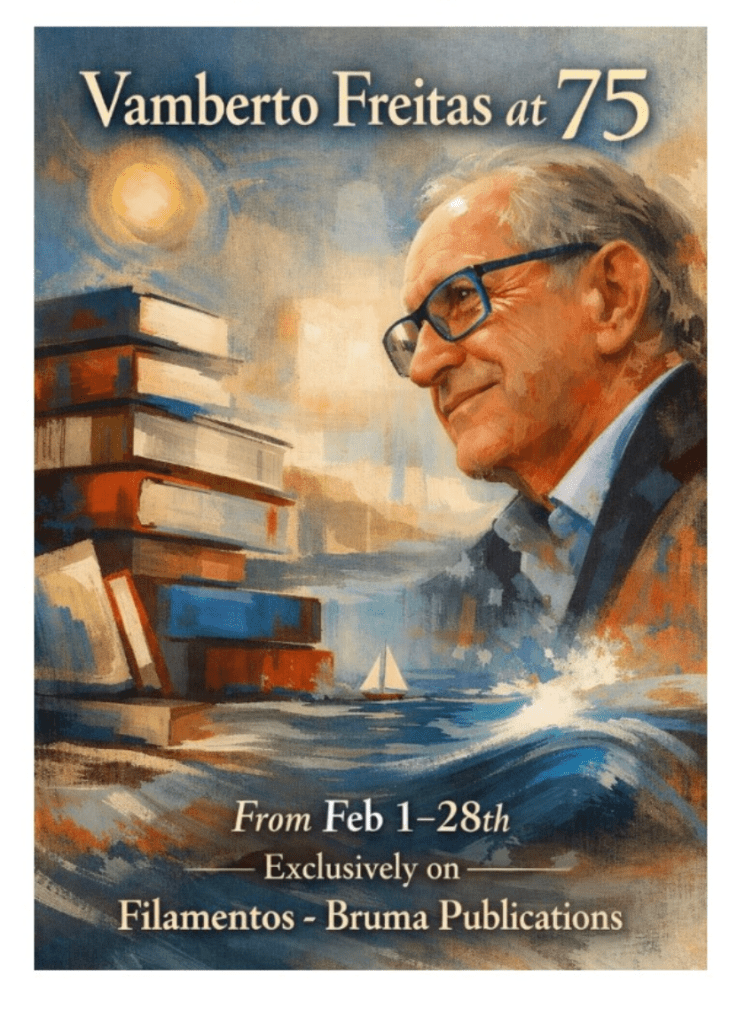
Vamberto Freitas at Seventy-Five
The Long Work of Critically Listening to and writing about Dispersed Voices
Filamentos – arts and letters
Bruma Publications | Portuguese Beyond Borders Institute (PBBI),
California State University, Fresno
Introduction
For more than three decades, Vamberto Freitas has practiced literary criticism as a form of sustained attention—patient, rigorous, and ethically alert. His work has traced the quiet, often overlooked trajectories of writers shaped by migration, insularity, and memory, especially those of American and Canadian authors with roots in the Azores. At seventy-five, his critical legacy stands not as a monument but as an ongoing conversation: a life of letters placed in the service of literature itself, where reading becomes an act of responsibility and criticism as a way of listening deeply to voices dispersed across geographies, languages, and generations.
Throughout the month of February, Filamentos – arts and letters, an initiative of Bruma Publications at the Portuguese Beyond Borders Institute (PBBI), California State University, Fresno, will honor this legacy with daily segments published from February 1 through February 28. Each entry will revisit, reflect upon, and extend the critical pathways opened by Vamberto Freitas, reaffirming the enduring relevance of his work within Atlantic, diasporic, and transnational literary studies.
Vision
To honor literary criticism as a form of cultural stewardship—one that listens across distance, preserves intellectual memory, and affirms the centrality of diasporic voices within the broader landscape of contemporary literature.
Mission
Through this February series, Filamentos – arts and letters seeks to celebrate the life and work of Vamberto Freitas by foregrounding criticism as a practice of care, rigor, and continuity. By publishing daily reflections, excerpts, and critical engagements, this initiative reaffirms Filamentos’ commitment to literature that crosses borders, sustains dialogue between islands and continents, and recognizes reading as an ethical act—one capable of holding dispersed voices in thoughtful, enduring relations.
 Filamentos (artes e letras)