

In the voice of Arnaldo Ourique, autonomy is no longer the shared architecture of nine islands bound by regional solidarity. It has become, he argues, a system tilted toward a single center of gravity — where one island concentrates political force, economic leverage, and strategic decision-making power, while the remaining eight orbit in diminishing influence.
For Ourique, this is not merely a political imbalance; it is a constitutional distortion. The promise of Azorean Autonomy, born in the aftermath of 1976, was plural — rooted in geographic dispersion, historical tripolarity, and the idea of regional unity. What emerged instead, in his reading, is a model where autonomy consolidates rather than distributes, centralizes rather than harmonizes.
“Eight islands subjected to one” is less a slogan than a diagnosis: a warning that the spirit of insular equilibrium has given way to an extractive hierarchy — where cohesion replaces equality, and unity becomes rhetorical rather than structural.
In the constitutional imagination he defends, autonomy was meant to shield difference, not subordinate it.
We are marking 50 years of Azorean Autonomy. What kind of balance sheet can be drawn?
In this first half-century, two unavoidable conclusions emerge: that the Autonomous Region of the Azores has settled into mediocrity; and that this political construct, as it has evolved, is not the answer to the aspirations of the Portuguese of the Azores. Fifty years on, the warning issued in 1975 by the Eighth Committee of the Constituent Assembly has, in my view, come to pass: that insular autonomy could decay into a monopoly of elites—just as five centuries of Azorean political history had so often demonstrated.
The concern was so real that the Constitution itself, beyond defining the powers of the State and of the Autonomous Region, included a specific safeguard prohibiting the Region from legislating in ways that undermined workers’ rights. That clause remained until the 1997 constitutional revision. And yet, the fear it reflected has materialized.
First, in 1998, the Political-Administrative Statute eliminated a centuries-old autonomist principle: the existence of three historic urban centers serving as poles of development, each radiating economic and social dynamism across its respective island. Since the earliest settlement, Azorean society had grown—however imperfectly—around those centers. That tripolar structure shaped everything from the three district boards established in 1832 to the governance model that lasted until 1976, and even the tripartite structure of the University of the Azores. Today, that political tripolarity has nearly vanished.
Second, in 2009, the Statute replaced the long-standing political ideal of “harmonious development” with the economic concept of “balanced development.” That may sound benign, but it marked a philosophical shift. “Harmonious development” spoke to political cohesion and shared destiny; “balanced development” reduced autonomy to metrics and distribution formulas, embedding what I would call an extractive model of democracy.
Third, the concept of “regional unity,” foundational to the autonomy system, was never fully developed—and has, in fact, been steadily eroded. Even more troubling, the political imagination of “regional identity” has been neglected, if not altogether forgotten. In its first phase, the Autonomous Region was conceived as a union of islands bound by regional unity. In a second phase, it became a Region of islands defined by cohesion policy. Then came a model of one island driving internal development while eight others were relegated to cohesion status. We are now in a third phase: one dominant island and eight others subordinated within an extractive economic autonomy.
Because we lack what I consider a fully constitutional system of governance—and what exists, I believe, strays from constitutional principles—the government has allowed itself actions without transparent legal grounding. One example: by its own admission, it quietly redirected the anchoring of a major Google submarine cable from Terceira, where technical assessments reportedly favored its placement, to São Miguel. Such decisions, taken in secrecy, reflect deeper structural flaws.
What has emerged over time is a system of governance built on weak checks and balances. For years, we attributed that to novelty or inexperience. Today, I am convinced it was intentional. When we eventually learn why the first president of the regional government abruptly left office, we may better understand this chapter of Azorean political history. My belief is that he withstood elite pressure for two decades, but ultimately grew weary of defending popular freedom without institutional backing. After his departure, the Autonomous Region first celebrated—and then consolidated control over the totality of Azorean insular identity. Since then, the situation has only deteriorated.
That, in part, explains the fragility of today’s political class. Many settle into a prestige that is, frankly, illusory—sustained by salaries that, while modest by mainland standards, surpass those of most islanders. Some even abandon established professions entirely to pursue political office. The incentives are clear.

You have been working, as a scholar of constitutional autonomy, on a multi-year commemoration of these 50 years. What does that entail?
Yes, that is correct. We launched a three-year commemorative initiative marking both the 50th anniversary of the Autonomous Region and 444 years of Azorean political history, invoking the regional motto: “Rather die free than live in peace subjected.”
In 2024, we published Poems of Azorean Autonomy. In 2025, alongside several reprints, we released a second edition of Fundamental Laws of Portugal, which organizes and simplifies the three governing legal frameworks of the country, the Azores, and Madeira. We also published a collection of poetic tales, Treatise of the Island, tracing the political history of the Azores through the cultural lens of the traditional bullfights by rope.
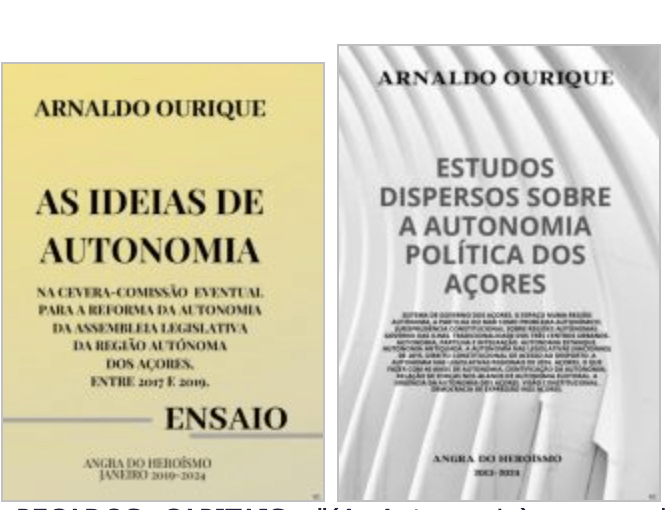
In January 2026, we will publish Autonomic Garajau, a volume of essays. At the same time, we are organizing small civic forums in several parishes on Terceira Island, focused on autonomy, constitutional literacy, and citizenship, using Fundamental Laws of Portugal as an accessible educational tool.
But let me be clear: this is not an opportunistic undertaking. We have marked autonomy consistently over the decades. In 1996, on the 20th anniversary, we hosted commemorative programming at Rádio Clube d’Angra. In 2001, for the 25th anniversary, we did so again. Between 2017 and 2019, we published several works marking 40 years of autonomy. In 2022, we commemorated the 45th anniversary.
This 50-year milestone is not a one-off reflection. It is part of a sustained intellectual and civic commitment to examining what autonomy was meant to be—and what it has become.
In Diário Insular
 Filamentos (artes e letras)