
On the Work of Aníbal C. Pires
The poet always departs from the island toward the world,
and from the world always returns
to the geography of memory and affection.
— Aníbal C. Pires
There would be much to say about the poetic structure of Aníbal C. Pires—even more about his imagery, his metaphors, and, above all, the ideas that unfold from verse to verse, from poem to poem. Yet in a moment and a space such as this, I choose not to theorize about literature, nor about the complexity of a singular voice among us, such as that of Aníbal C. Pires, nor even about the poetic act in general.
So-called literary canons are little more than personal opinions—those of anthologists, admirers, and, yes, adversaries of certain texts and authors. In the Azores, provincial as we have been and often still are, alterity and marginality are frequently no more than literary constructions, shaped by aesthetics and thematic preferences—once again, constructions: personal, group-based, arising from closed circles formed informally, loosened tongues, and the isolation that so often elevates ignorance, weekend writers, and literary dilettantes.
Great writing has always suffered from rushed and superficial reception—sometimes degrading, and rightly forgotten. This happens in the name of supposed ideology, of literary cliques reinvented as castes, of interests more commercial than artistic. Ignorance and arrogance combine easily, armed with a handful of half-digested notions formed in the darkness of saying without reading, of talking about knowledge rather than entering the text itself. I have never aligned myself with such spaces of pretended knowing and guesswork. In the Azores—and far beyond—this is a literary disease, cheerful perhaps, but chronic, and best ignored.
Poetry as Ethical Combat
The integrity of the struggle for the word—for poetry and for meaningful writing—is fully present in the work of Aníbal C. Pires. Were it not so, not a single word of mine—or of anyone else—would be worth writing. Nor would criticism itself have meaning in our turbulent, confused days, when even our existence feels under threat.
I am weary of writers sealed inside their own ego chambers, pretending to stand above what happens around them, locally and especially in the world. Writing may indeed be an individual act—an act of creation, of forging verse or narrative out of circumstance or obsession—but for me, poetry and all creative writing must combine two imperatives: self-recognition and collective vision. We must see one another, recognize other ways of being, perceive the collective to which we belong, our past and our memories, our joys and happiness, our pain and our absences.
All of this is present in the poetry and prose of Aníbal C. Pires. The poetic “I” exists only through communion with community and with the world. His deepest humanity emerges in poems such as Devaneio, then expands outward to confront the criminality unfolding across much of the planet. His verse structure is free, indebted to Walt Whitman, and in Portuguese to our first literary modernism—Fernando Pessoa and his peers—those who challenged tradition at its core.
Poetry without ideas is mere imagery and metaphor, often signifying nothing at all—recalling here William Shakespeare and William Faulkner, the latter in his revolt against empty academic language, against games of words devoid of meaning.
Aníbal C. Pires writes in the lineage of words that mean. His verses and stanzas combine rhythmic beauty with the musicality of lived experience, setting the kindness of life beside humanity’s suffering, and insisting on persistence and resistance against every form of Power that preys upon the defenseless—near and far, if “far” still exists in a world we now witness daily, nightly, from our living rooms, through voices that have become intimate through constant proximity.
His poems arrive as live testimony. Each word awakens thought, sometimes ambiguity, always demanding contextual reflection—especially in relation to what we see and hear daily across multiple media. They reveal what we had not noticed, lead us to the other side of reality and of lyric art.
In Destroços à Deriva, false poetic language is expelled. No ornamental landscapes of falling leaves or seasonal reveries. Yes, the geographical nature of the Azores is present—but only as the stage for human existence and the violence that touches us all: here and everywhere, the cries of men and women under lethal fire, the scream of senseless despair. This poetry does not indulge in so-called strategic or military reasoning. It denounces such logic clearly and loudly. And then it affirms the beauty of standing together in the struggle for another reality altogether. This is a supreme poetic act. Great poets tell us—sing to us—what could be, even when it is not.
Poetry as Memory and Resistance
All of Aníbal C. Pires’s work, in prose and poetry, is a language of meaning that permanently archives who we were and who we are. I often call him a continental-islander, just as I call myself an island-continental. His poetry in Destroços à Deriva continues this trajectory with remarkable coherence—always himself, as poet, writer, and political activist.
Reading him is dazzling: for the beauty of his language, yes, but equally for his unwavering loyalty to his ideals and worldview. Writing about him is an enormous challenge—for the radiance of his words, for the absolute authenticity of his ideas about a world in constant upheaval. To write about him is one of my greatest privileges: as literary critic, as citizen, as colleague, as friend.
When the poet steps momentarily away from civic urgency and contemporary history—from the daily deaths of innocents—and enters into praise of the human being, as in poems like “mothers of Gaza,” I know I am in the presence of someone I fully recognize, someone I admire without reservation.
Destroços à Deriva evolves verse by verse in clarity of vision, and in the quiet of homes here and overseas, treading Azorean stones—not slippery, but firm in the belief that life, his and ours, will continue to seek a world both triumphant and just, alongside the necessary struggle against those who would turn everything into hell.
These pages hold the green and blue of our days, alongside unspeakable catastrophe elsewhere—symbols of humanity at its worst: oppressed, abused, exploited by minorities whose terrorism is as real as it is diabolical, extending far beyond weapons. For them, much of the world is merely a resource to be looted, dignity a nuisance to be crushed.
Each reader will bring their own interpretation, memory, and ideology. Aníbal C. Pires never conceals his. His words shine with clarity, generosity, and solidarity with all who have always resisted those who would crush them for profit and power. His poetry refuses complacency, rejects indifference toward forces that deny us peaceful days and shared equality—the “ninety-nine percent,” as one North American democratic movement has named it.
Destroços à Deriva may well be Aníbal C. Pires’s most politically committed book. Yet it does not pursue ideology—it seeks the deepest core of our being. The present is a false mosaic, allowing only its own limited colors. What this poetry teaches us is refusal: refusal to surrender to despair. Struggle is part of life. And above all, we must remain alert to fissures of light and happiness.
And finally—so necessary in our time—this work offers a luminous tribute to suffering women, to their sacredness and beauty in the face of demons that fall from the “sky,” and to the fragile beauty of lives lived in cities without bombs, where normalcy still resists murderous rage.
Reference
Aníbal C. Pires, on his complete body of work.
Originally published in BorderCrossings, Açoriano Oriental, June 28, 2024.
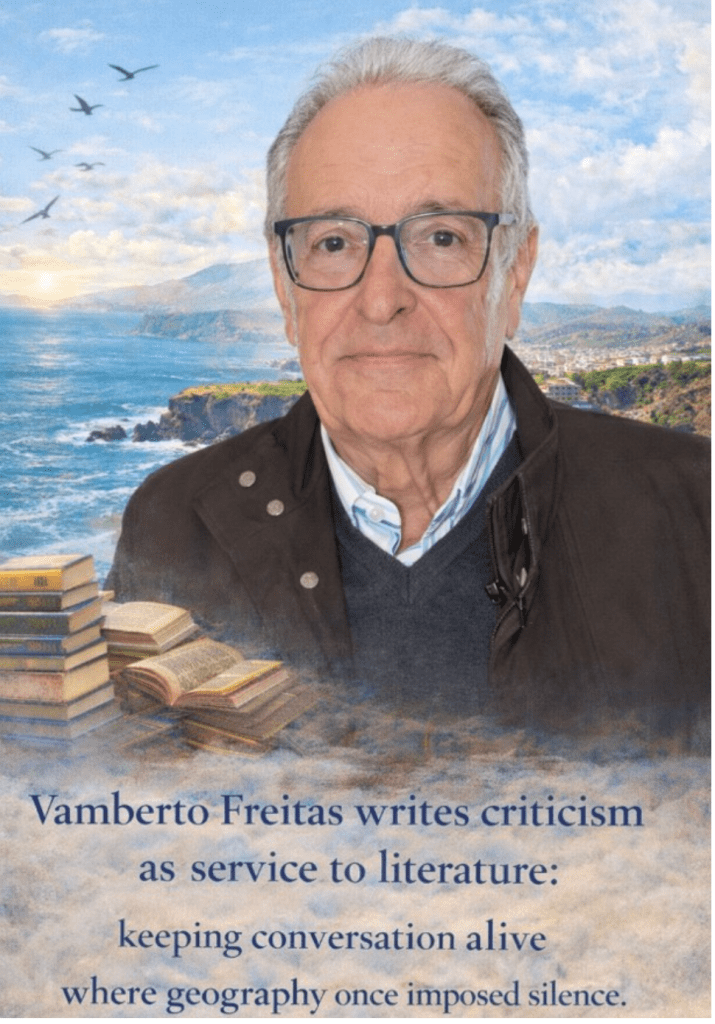
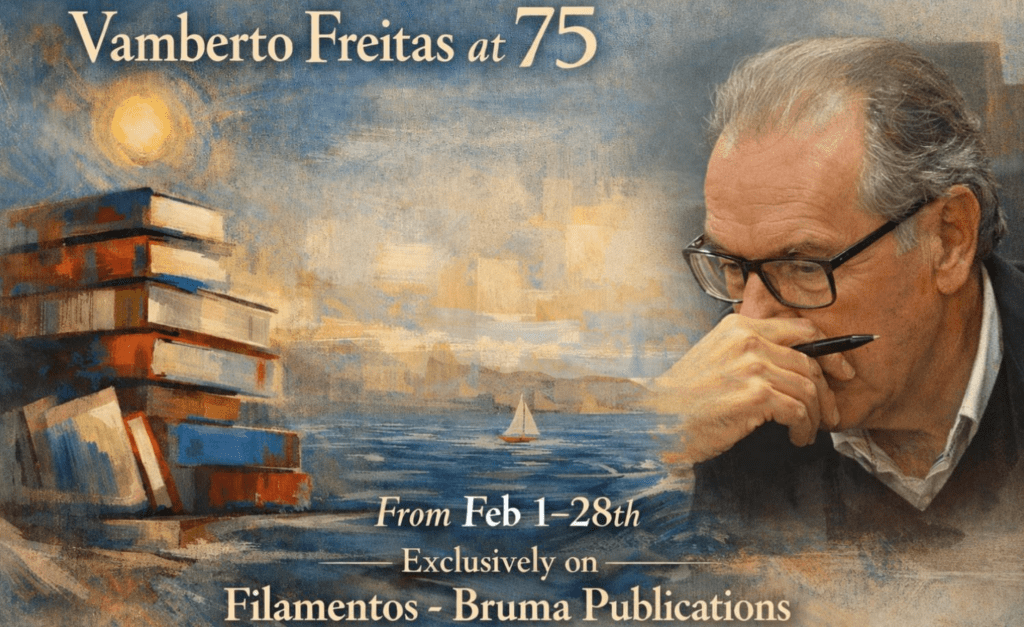
Vamberto Freitas at Seventy-Five
The Long Work of Critically Listening to and writing about Dispersed Voices
Filamentos – arts and letters
Bruma Publications | Portuguese Beyond Borders Institute (PBBI),
California State University, Fresno
Introduction
For more than three decades, Vamberto Freitas has practiced literary criticism as a form of sustained attention—patient, rigorous, and ethically alert. His work has traced the quiet, often overlooked trajectories of writers shaped by migration, insularity, and memory, especially those of American and Canadian authors with roots in the Azores. At seventy-five, his critical legacy stands not as a monument but as an ongoing conversation: a life of letters placed in the service of literature itself, where reading becomes an act of responsibility and criticism as a way of listening deeply to voices dispersed across geographies, languages, and generations.
Throughout the month of February, Filamentos – arts and letters, an initiative of Bruma Publications at the Portuguese Beyond Borders Institute (PBBI), California State University, Fresno, will honor this legacy with daily segments published from February 1 through February 28. Each entry will revisit, reflect upon, and extend the critical pathways opened by Vamberto Freitas, reaffirming the enduring relevance of his work within Atlantic, diasporic, and transnational literary studies.
Vision
To honor literary criticism as a form of cultural stewardship—one that listens across distance, preserves intellectual memory, and affirms the centrality of diasporic voices within the broader landscape of contemporary literature.
Mission
Through this February series, Filamentos – arts and letters seeks to celebrate the life and work of Vamberto Freitas by foregrounding criticism as a practice of care, rigor, and continuity. By publishing daily reflections, excerpts, and critical engagements, this initiative reaffirms Filamentos’ commitment to literature that crosses borders, sustains dialogue between islands and continents, and recognizes reading as an ethical act—one capable of holding dispersed voices in thoughtful, enduring relation.
 Filamentos (artes e letras)