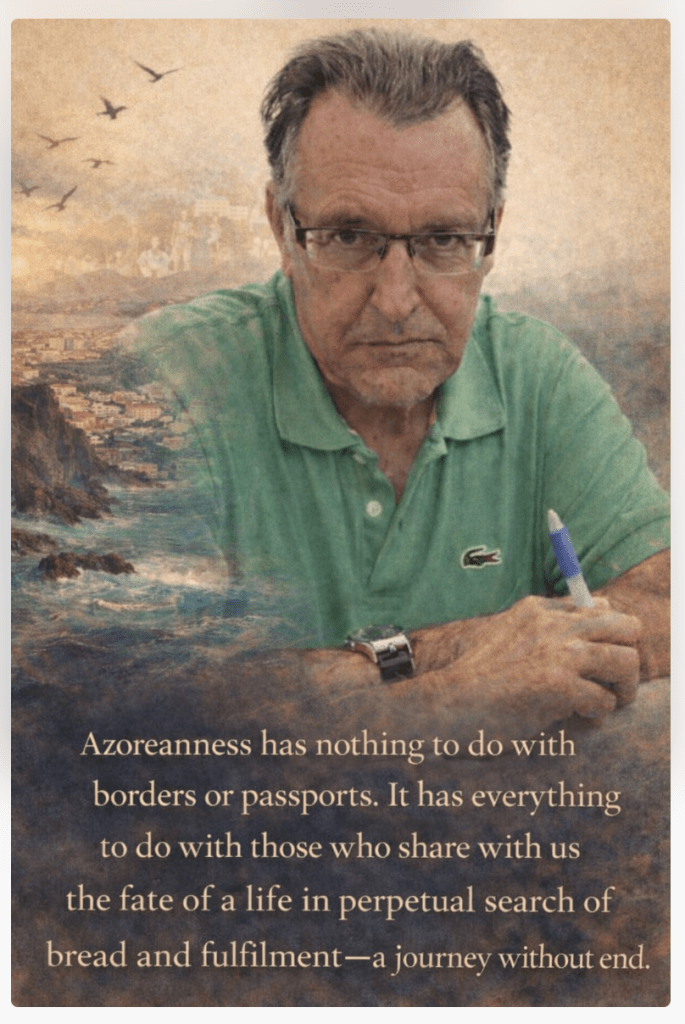
On the Pain and the Joy of Crossing Borders
Vamberto and Anthony were often seen walking the halls of Pleasant View School with their heads close together, talking about whatever was happening at the moment, their faces lit up with smiles and laughter.
— Mary Barcellos Chancellor, from a recent letter sent to me
Mary Barcellos Chancellor is speaking here of my friendship with her brother Anthony Barcellos, who passed away recently—he was exactly my age—but I will get there in due time. Today I can hardly imagine what we were talking about back then, still children, though apparently already full of “ideas.”
First things first. You leave a small Azorean island—Terceira—in 1964. You have completed one full year at the National Lyceum of Angra do Heroísmo. You are thirteen years old. You leave your rural parish in the municipality of Praia da Vitória—in tears, in absolute insecurity, and yes, in fear. You are leaving your birthplace and the geography of a happy childhood, the only world you know. It is June. Neighbors and family gather to say goodbye. You head toward rough seas—at least they seemed rough those days—and toward the dock at Angra.
Men help you into an open boat, because the ship Funchal is anchored offshore. Then you climb a long rope ladder, always with crew members lending a hand. The journey takes you to Ponta Delgada, where decades later my destiny—both tragic and happy—would await me. The next morning you see another city, one that seems large and naturally strange, yet welcoming. You run about in amazement while waiting for medical exams and the American consulate paperwork. Another voyage follows, now to Santa Maria aboard the ship Ponta Delgada: the beauty of our sea again, and yet another unknown island as a stopover and continuation.
I remember my father offering us a tour of the island that would send us on our way to America. I do not remember whether the plane was Pan American or TWA, but that hardly matters. What I know is that, once again, the fear was real—yet a child is never quite so afraid; trust in those who accompany and protect us is never questioned. The third destination was Boston. I know I kept a “diary” on board, but I never found it again, lost in the strangeness of the journey and in the fascination of flying for hours without any idea of what awaited me.
The first cultural shock was delicious: escalators, for someone who had never seen—or ridden—an elevator, and the smells of food and soft drinks. America! Little did I know that another plane awaited us, and then more than five hours to Los Angeles, where a few family members were waiting. From there, by car, another three-plus hours on Highway 99, which runs through much of California. We were headed to the San Joaquin Valley—more precisely, to the city of my longing, Porterville—though our new home would be in the rural world of farms and dairies where my father would work for a year or so milking cows, as members of our family had done decades earlier. Back on Terceira, he had rejected that life of land and labor. Very young, he had entered the American base at Lajes, spoke fluent English after many years working at the American Officers’ Club.
These are very old stories, but they are part of who I am—part of my lived experience.
In that Californian rural world, full of beauty and kindness, I met Anthony Barcellos, the first and most significant friend of my life. Despite my year at the lyceum on Terceira, my age did not yet qualify me for American high school. Anthony had grown up on his parents’ and grandparents’ dairy farm not far from mine, and we rode one of those yellow school buses—icons of schooling in a country as vast as my new one. He became my salvation. I spoke a single word of English. Okay doesn’t count.
From the beginning, Anthony insisted on being my friend and my occasional “teacher” in this other, unknown language. In the classroom he sat beside me at the teacher’s request—Mr. Snow—so that he could translate all instructions, readings, and the rest of what happens among newly arrived children and adolescents. There was no so-called “bilingual education”; everything demanded a greater, more attentive effort.
We passed through a small town called Poplar and arrived at Pleasant View School, surrounded by vast lands that seemed to belong to no one—far more expansive than my entire island of birth. It was a radical restart: challenging, happy. When I recall those tender school years, Anthony always returns to me with saudade and affection.
Not long after, my father—a man of few words but decisive actions—resolved to leave the family’s work and go farther afield, to greater Los Angeles and the Imperial Valley, to a town called Chino, where he worked the rest of his life, with periodic returns to his home in Fontinhas. In the end, his true “America” had been Terceira, not the promised land across the Atlantic. Another destiny of mine had been set.
I attended two colleges, then spent fourteen years as a secondary-school teacher. I lost all contact with Anthony Barcellos until, decades later, he published his masterful novel Land of Milk and Money, a prose devastating in its irony and reckoning with his own past. We resumed our relationship at a distance, and once again I feel the absence he leaves behind. Shortly before his death, he asked Mary to tell me what was happening to him. It was painful—both his fate and the knowledge that he never forgot me in a final farewell.
That America cannot—and must not—ever leave me. When people ask today what I think of that other country of mine, “of the Americans,” I always answer with another question: which “America,” which “Americans”? Those of kindness and decency, or those of irrational rage and violence? At last, the Portuguese are beginning to understand that our country, like all others, is made up of many people. Living memory wards off judgment and prejudice of every kind.
Anthony Barcellos remains within me as the example of a great human being, a great university professor, a great writer, and a great advisor to the California State Assembly. He was and will always be the defining friend of my civic consciousness and my intellectual life.
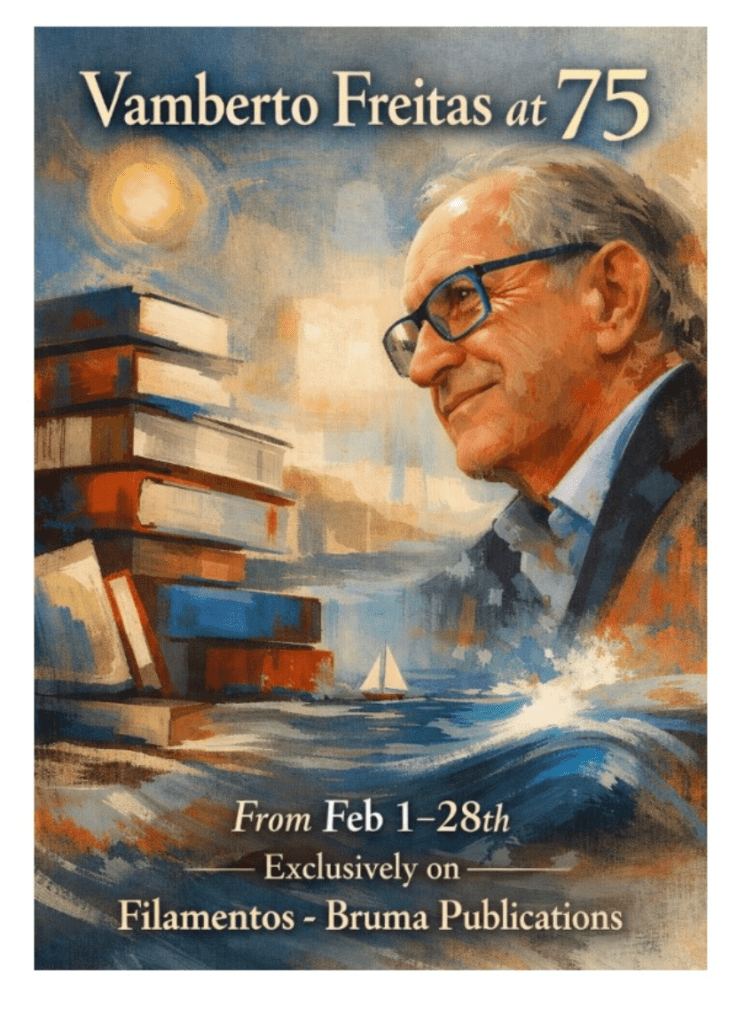
Vamberto Freitas at Seventy-Five
The Long Work of Critically Listening to and writing about Dispersed Voices
Filamentos – arts and letters
Bruma Publications | Portuguese Beyond Borders Institute (PBBI),
California State University, Fresno
Introduction
For more than three decades, Vamberto Freitas has practiced literary criticism as a form of sustained attention—patient, rigorous, and ethically alert. His work has traced the quiet, often overlooked trajectories of writers shaped by migration, insularity, and memory, especially those of American and Canadian authors with roots in the Azores. At seventy-five, his critical legacy stands not as a monument but as an ongoing conversation: a life of letters placed in the service of literature itself, where reading becomes an act of responsibility and criticism as a way of listening deeply to voices dispersed across geographies, languages, and generations.
Throughout the month of February, Filamentos – arts and letters, an initiative of Bruma Publications at the Portuguese Beyond Borders Institute (PBBI), California State University, Fresno, will honor this legacy with daily segments published from February 1 through February 28. Each entry will revisit, reflect upon, and extend the critical pathways opened by Vamberto Freitas, reaffirming the enduring relevance of his work within Atlantic, diasporic, and transnational literary studies.
Vision
To honor literary criticism as a form of cultural stewardship—one that listens across distance, preserves intellectual memory, and affirms the centrality of diasporic voices within the broader landscape of contemporary literature.
Mission
Through this February series, Filamentos – arts and letters seeks to celebrate the life and work of Vamberto Freitas by foregrounding criticism as a practice of care, rigor, and continuity. By publishing daily reflections, excerpts, and critical engagements, this initiative reaffirms Filamentos’ commitment to literature that crosses borders, sustains dialogue between islands and continents, and recognizes reading as an ethical act—one capable of holding dispersed voices in thoughtful, enduring relation.
 Filamentos (artes e letras)