
Sea and Sea and America and America on Every Side
Vamberto Freitas
My country was a land planted in no one’s homeland, with water in the sea and high tide in the eyes.
— José Francisco Costa, Mar e Tudo e Outros Casos
I reread Mar e Tudo e Outros Casos by José Francisco Costa and find myself—this has been a perpetual state in my Azorean and diasporic readings—returned, sometimes against the will of the moment, to my own past. This does not mean that our personal stories or life destinies have been or are always identical, or even aligned in lived experience, from our births and childhoods here on the islands, nor in the course each of us took—or takes—on the inevitable real or imagined vessel that has been the fate of the vast majority born in these islands.
For us, children of the sea, looking eastward with a patriotic sense is sometimes an ambiguous act. That imagined national community—lived by some—was for centuries a redoubt of wealthy minorities and the very rich, the supposedly aristocratic memory of a few who, as others have written, belonged to the tiny apex of the pyramid (first described by Onésimo Teotónio Almeida) that has always depicted the social condition of our archipelago. And yet it must be reaffirmed that there are no geographies more universalized than small islands scattered across the planet—a point insisted upon throughout the work of Édouard Glissant in his theorization of insular literatures, even from Paris, with his native Martinique in the Caribbean as another example of being at home in the world.
José Francisco Costa’s writing is precisely this exercise in hybrid prose: it exemplary combines biography and memory of time and people from São Miguel with his wanderings between Capelas, where he was born, the seminary in Angra do Heroísmo, subsequent higher studies in Lisbon, and a teaching career on the outskirts of the capital—everything followed, I would say inevitably, by his departure for the United States of America (Providence, Rhode Island, in his case) with his wife in the late 1970s. There he completed a doctorate on the work of Jorge de Sena and began a long university career, a detail of clear importance for some of the narratives in this volume.
What appears to us as literary realism subtly contains, within it, passages of a gentle surrealism—perfectly legible within the larger context of these stories—when they move from island mysteries to a Portuguese identity that is at once clear and ambiguous within the eventual shelter of the vast and complex North American society. This takes place necessarily from an intellectualized position, with factories next door where, historically, most of our compatriots paid for all their sins.
How does good—or great—fiction necessarily become a collective portrait, reenter the spirit of a time and a place, and summon the shared history of a community? By creating protagonists and other characters who recount their lives—directly or indirectly—their passions, happiness or unhappiness, their acceptance or rejection of destiny, above all those states of being under the most familiar or unexpected conditions of life. For an Azorean islander, the smallness of land and mentality rarely aligns with the vastness of the sea-as-carpet. Daniel de Sá once wrote that “to emigrate is the worst way of staying on the island,” to which Onésimo Teotónio Almeida replied, “Perhaps it is the best.”
And then one reimagines the island through the pain of saudade—which persists yet gives way to its imagined splendor beyond exuberant Nature—while keeping in memory everything that constitutes its sacred and profane rites: the smells of land and sea, the colors of flowers, the beauty of the brush; a humanity once enclosed in bygone times, made free by departure. The immigrant never returns—cannot return—to what he never left, as another writer already mentioned here once put it.
All the texts in Mar e Tudo e Outros Casos become, as it were, a single transnational narrative. Not a single description or transfiguration of the other life in America is free from the past, from origins; the force of roots never yields to the alienation that those who never left imagine distance produces in those who left only physically. These literatures—Lusophone or otherwise—within a diversified society like the American should never be called “minority” literatures. On the contrary, American literary art would be incomplete without this other definition of “America,” even if many readers there scarcely notice.
From the 1990s onward, the Lusophone literary act in immigration began to be accompanied by substantial works in English by Luso-descendants. They continually “return” to what they scarcely know directly, reconstructing instead the indelible memories of grandparents and parents, and even of more distant ancestors.
José Francisco Costa’s prose adds to its beauty and thematic force—through its reinterpreted past and its colorful illumination of how one can be far away without leaving the homeland—some of the languages brought back by temporary returnees, languages that cause such confusion among those whose horizons were always closed and skies perpetually overcast. The occasional Portuguese term, now Americanized, attests to a richness of things and worldview that never existed here: a living language reinvented by a life courageously reinvented. Without works like this, Azorean literature would be truncated, more limited, and—yes, to the dismay of some—less universalized.
This is a literature that rarely addresses Anglo-American readers; it addresses us here and us there. It reminds us of what we look at but do not see; it presents us, instead, with the island extended across all seas that lead westward, the elongated homeland that has been almost our only historical salvation.
“Still in the parking lot,” the narrator writes of one of his characters in the opening story of the section titled In each islander / a boat / on the line of the eyes, “Duarte came face to face with the manager who, in a Portuguese-flavored harangue, didn’t miss the chance to ask him, for the thousandth time, when he would drop the serious face he always wore upon arriving at the factory. Duarte replied with a ‘next time’ so dry with bitterness that the other merely shook his head in disarray. The foreman didn’t even have the chance to ask how Duarte’s second year of engineering classes at the university were going. It was another factory night, the kind in which hours tangle like a wave that swells and dies upon itself without breaking on the rock. Time here was always the same. For Duarte, the only difference at this threshold of spring was a detail that always felt like a discovery, wrenching him from monotony: the days were growing longer, shortening the night. All that remained was the timid hope of the end of the long shift and the much-desired day off.”
If I have spoken of the clarity and irony of other passages, I must also note the humor—sometimes tragically tinged—with which each being here understands or expresses a world made of a past that never fully becomes past and a present that, for almost all, moves toward the comfort and challenge of a new world, toward personal and familial fulfillment once dreamed of on the other, harsh shore of the Atlantic.
We are here another Pessoa-like people, seeking balance among the many selves that inhabit us, within the multiplicity of our experience and the languages of our fluid identity—what the most relevant and reflective literature of our own or any other history transmits. American literature, Portuguese literature, Azorean-American literature, Luso-descendant literature.
At an opportune moment, Onésimo Teotónio Almeida and Augusto Santos Silva founded or expanded the Portuguese Communities Collection of the Imprensa Nacional–Casa da Moeda, of which Mar e Tudo e Outros Casos is the second volume. José Francisco Costa, for his part, has an extensive body of work in fiction, essay, and poetry, and has devoted himself to lettering for artists on both sides of the Atlantic, as well as to various contributions to the theater produced within our Diaspora.
Reference
José Francisco Costa, Mar e Tudo e Outros Casos (Foreword by António Rego). Lisbon: Portuguese Communities Collection, Imprensa Nacional–Casa da Moeda, 2022.
Originally published in BorderCrossings, Açoriano Oriental, October 6, 2023.
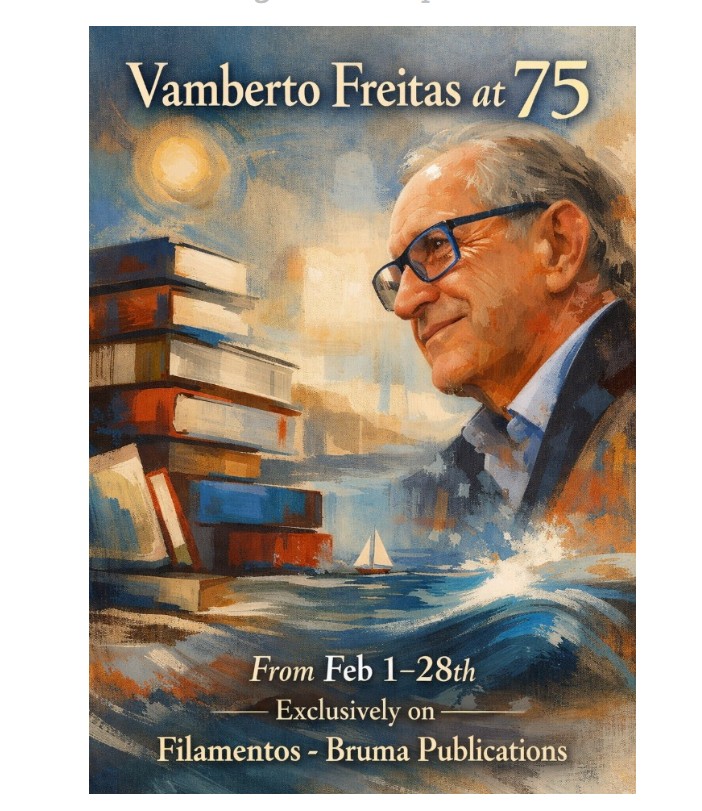
Vamberto Freitas at Seventy-Five
The Long Work of Critically Listening to and writing about Dispersed Voices
Filamentos – arts and letters
Bruma Publications | Portuguese Beyond Borders Institute (PBBI),
California State University, Fresno
Introduction
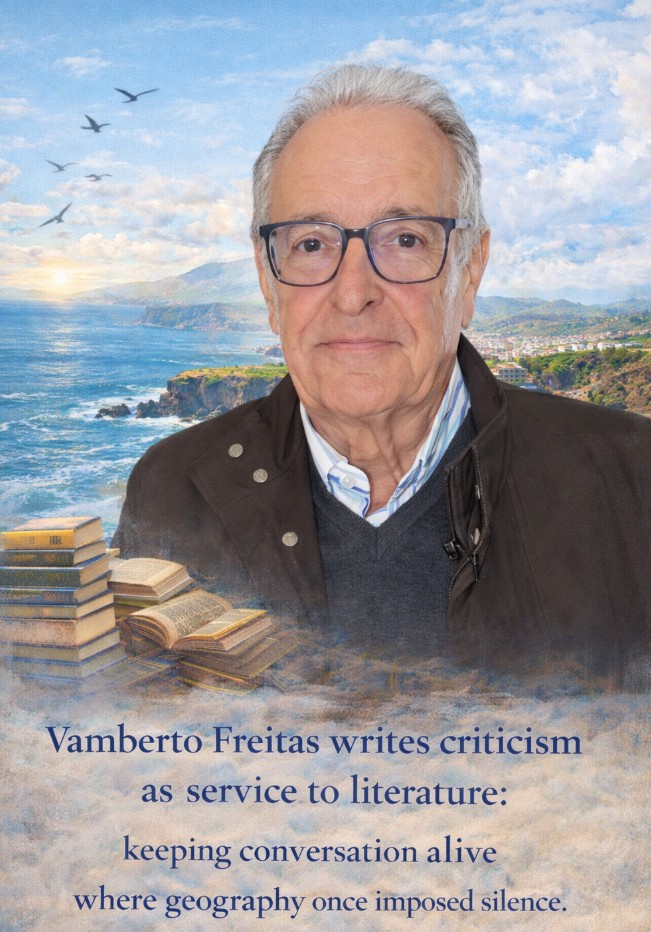
For more than three decades, Vamberto Freitas has practiced literary criticism as a form of sustained attention—patient, rigorous, and ethically alert. His work has traced the quiet, often overlooked trajectories of writers shaped by migration, insularity, and memory, especially those of American and Canadian authors with roots in the Azores. At seventy-five, his critical legacy stands not as a monument but as an ongoing conversation: a life of letters placed in the service of literature itself, where reading becomes an act of responsibility and criticism as a way of listening deeply to voices dispersed across geographies, languages, and generations.
Throughout the month of February, Filamentos – arts and letters, an initiative of Bruma Publications at the Portuguese Beyond Borders Institute (PBBI), California State University, Fresno, will honor this legacy with daily segments published from February 1 through February 28. Each entry will revisit, reflect upon, and extend the critical pathways opened by Vamberto Freitas, reaffirming the enduring relevance of his work within Atlantic, diasporic, and transnational literary studies.
Vision
To honor literary criticism as a form of cultural stewardship—one that listens across distance, preserves intellectual memory, and affirms the centrality of diasporic voices within the broader landscape of contemporary literature.
Mission
Through this February series, Filamentos – arts and letters seeks to celebrate the life and work of Vamberto Freitas by foregrounding criticism as a practice of care, rigor, and continuity. By publishing daily reflections, excerpts, and critical engagements, this initiative reaffirms Filamentos’ commitment to literature that crosses borders, sustains dialogue between islands and continents, and recognizes reading as an ethical act—one capable of holding dispersed voices in thoughtful, enduring relation.
 Filamentos (artes e letras)