
A Utopia Without Illusion: Onésimo T. Almeida and the Quiet Revolution of Clarity
January 21, 2013 — Vamberto Freitas
“In Portugal, there is a light that shines brightly and points toward modernity in one of its earliest manifestations: the empirical mindset of a small group.”
— Onésimo Teotónio Almeida, Utopias in a Minor Key
Let us begin with the book’s full title, newly published and already widely reviewed across Portugal: Utopias in a Minor Key: Transatlantic Conversations with Onésimo. It is, in essence, a long interview with Onésimo T. Almeida. The co-author and interlocutor, João Maurício Brás, holds a doctorate in philosophy from the Universidade Nova de Lisboa and is currently a researcher at the University of Lisbon. Having immersed himself in Almeida’s philosophical essays—along with his creative and journalistic writing—Brás issued the challenge that became this volume: an extended conversation, at times in person and at times at a distance, focusing on the less familiar dimension of Almeida’s work in Portugal—his philosophical labor.
That philosophical dimension, still insufficiently gathered into book form, lies in germinal fashion in his unpublished doctoral dissertation on the concept of “ideology,” in the essays collected in From Marx to Darwin: The Suspicion of Ideologies (2009), and in numerous specialized academic publications awaiting consolidation. Brás himself, alongside Cristina Ovídio and Ana Bernardo, also collaborated in selecting and publishing Almeida’s creative texts in Onésimo: Portuguese Without Filter, An Anthology (2011).
This body of work has long deserved closer attention, particularly for its sustained engagement with “modernity” and “national identity.” It demands to be read today within the dense political and economic fabric of Europe—and, indeed, of the world. One hesitates to list credentials, yet context becomes necessary for those who have not followed Almeida’s academic trajectory. A decisive public recognition of his philosophical stature came with Miguel Real’s Contemporary Portuguese Thought (1890–2010), which situates Almeida alongside Teófilo Braga, Antero de Quental, and José Enes—devoting more than thirty pages to his thought, including his theoretical contributions to Azorean literature and culture.
The moment was ripe. For too long, Almeida had been confined in Portugal to the image of the witty chronicler and fiction writer—transfiguring the life of the diaspora and navigating the frictions between American and Lusophone realities. The preface to Utopias in a Minor Key, written by physicist Carlos Fiolhais of the University of Coimbra, underscores the thematic terrain: aesthetics, ethics, justice, freedom—matters no serious intellectual today can afford to ignore.
The subtitle—Transatlantic Conversations with Onésimo—suggests a duality both of personality and intellectual practice: the formal gravity imposed by the themes under discussion and the intimacy of addressing the philosopher by his first name. It is hard to imagine another Portuguese thinker of similar stature inviting such proximity. Yet this informality speaks well of us. Perhaps it is itself a sign of that possible—“minor”?—modernity among us.
To call someone by name is an act of affection, but also of respect. Almeida writes in Portuguese yet thinks with the lucidity of someone steeped in American analytic philosophy and Anglo-Saxon empiricism. His prose follows the unwritten rule of English clarity: say it clearly, say it directly. He illustrates, exemplifies, draws on overlooked aspects of our realities to situate his arguments. He suggests; he does not impose. Facts—reality itself—serve as the point of departure for broader theoretical reflection.
Threaded through the dialogue is what Brás aptly calls a “walking university”—an erudition both vast and disciplined. At its center lies Almeida’s understanding of “modernity,” followed by an unending disagreement over Portuguese “national identity,” especially in light of our history since the Discoveries. He reclaims emphatically our scientific aptitude and investigative spirit—qualities that once propelled us into new worlds and into an open mode of thinking we now seem to lack.
The volume closes with the syllabi of Almeida’s courses at Brown University—“On the Dawn of Modernity,” “The Shaping of World Views,” “The Lusophone World and the Challenge of Modernity,” “National Identity”—and a lucid postface by José Eduardo Franco, “Onésimo or Our Critical Conscience.”
At one point in the conversation, reflecting on baroque excess and the obfuscation that has marked Portuguese discourse, Almeida observes:
“It was that inherited environment that made our Portuguese writing profoundly verbose, hiding thoughts behind complex expressions and always avoiding clarity because clarity was dangerous. That situation helped propagate the myth that difficult writing is profound writing. A gross error in our culture, one that still persists and hampers the establishment of an intellectual dialogue that is dust-free, uninhibited, open, and informed. I generalize, because much has changed in the last decade, and the internet has helped immensely. Fortunately.”
In a single stroke, Almeida justifies his own academic and creative clarity while exposing a cultural tendency to manufacture complexity as a shield against ideas—or worse, as a mask for their absence. The fear of clarity has political and institutional roots; it thrives in environments where hyper-protected authority cannot be challenged. In Portugal, as Eça de Queirós once suggested, the “word” has too often reigned over the “idea.” When one dislikes a writer’s proposal, one hunts for a misplaced comma—a revenge of the impotent.
Modernity, then? Almeida offers a succinct beginning: from modernity arise democracy, justice, human rights, civic equality—the conditions that allow each citizen to shape a life according to personal desire, or, in the American idiom that also inflects this dialogue, to pursue happiness and prosperity as each defines them.
That is the utopia still possible—the one that, among all others, “hurts” less.
Finally, it must be said that João Maurício Brás proves himself an interlocutor equal to the task. No dimension of Almeida’s work is neglected. From the philosophical (Antero de Quental’s The Causes of the Decadence of the Peninsular Peoples figures prominently) to the public and Azorean phases of his career, essay, fiction, and chronicle converge. What emerges is the portrait of one of the most significant and encompassing literary and essayistic productions of our time.
Onésimo Teotónio Almeida e João Maurício Brás, Utopias in a Minor Key: Transatlantic Conversations with Onésimo, Gradiva, Lisboa, 2012.
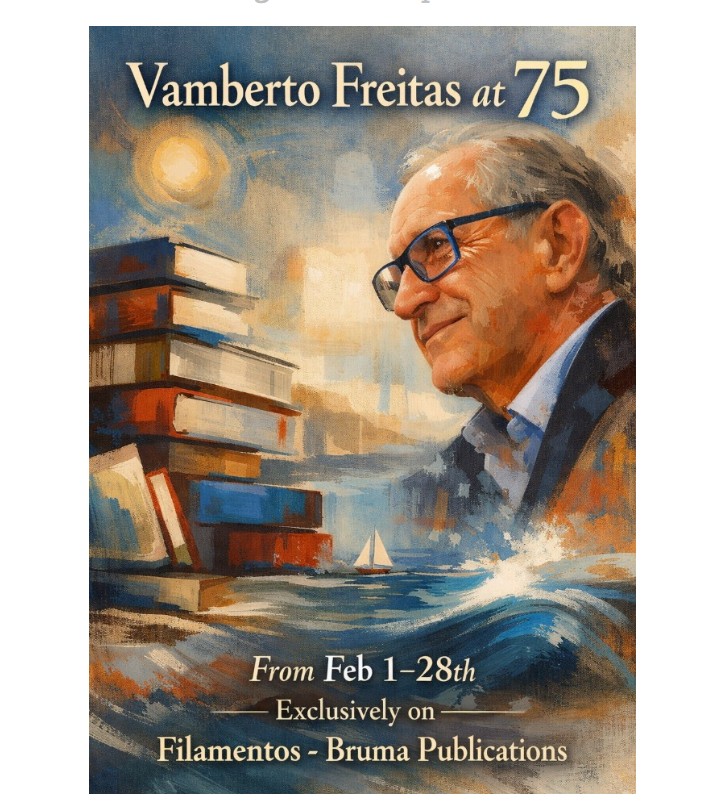
Vamberto Freitas at Seventy-Five
The Long Work of Critically Listening to and writing about Dispersed Voices
Filamentos – arts and letters
Bruma Publications | Portuguese Beyond Borders Institute (PBBI),
California State University, Fresno
Introduction
For more than three decades, Vamberto Freitas has practiced literary criticism as a form of sustained attention—patient, rigorous, and ethically alert. His work has traced the quiet, often overlooked trajectories of writers shaped by migration, insularity, and memory, especially those of American and Canadian authors with roots in the Azores. At seventy-five, his critical legacy stands not as a monument but as an ongoing conversation: a life of letters placed in the service of literature itself, where reading becomes an act of responsibility and criticism as a way of listening deeply to voices dispersed across geographies, languages, and generations.
Throughout the month of February, Filamentos – arts and letters, an initiative of Bruma Publications at the Portuguese Beyond Borders Institute (PBBI), California State University, Fresno, will honor this legacy with daily segments published from February 1 through February 28. Each entry will revisit, reflect upon, and extend the critical pathways opened by Vamberto Freitas, reaffirming the enduring relevance of his work within Atlantic, diasporic, and transnational literary studies.
Vision
To honor literary criticism as a form of cultural stewardship—one that listens across distance, preserves intellectual memory, and affirms the centrality of diasporic voices within the broader landscape of contemporary literature.
Mission
Through this February series, Filamentos – arts and letters seeks to celebrate the life and work of Vamberto Freitas by foregrounding criticism as a practice of care, rigor, and continuity. By publishing daily reflections, excerpts, and critical engagements, this initiative reaffirms Filamentos’ commitment to literature that crosses borders, sustains dialogue between islands and continents, and recognizes reading as an ethical act—one capable of holding dispersed voices in thoughtful, enduring relation.
 Filamentos (artes e letras)