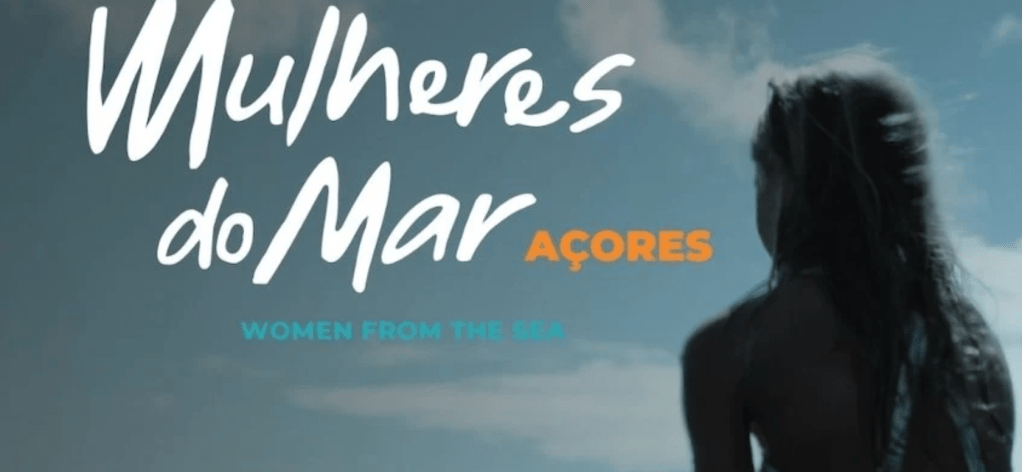
There are islands where the ocean is not a horizon but a presence — a breathing, tidal companion that shapes language, labor, longing. In the Azores, the sea is not merely scenery. It is inheritance. And now, through the documentary Mulheres do Mar – Açores (“Women of the Sea – Azores”), it is also testimony.
The initiative Mulheres do Mar was born from a simple yet radical conviction: to promote the role of women in preserving and valuing the oceans by amplifying their voices — voices too often unheard, memories too often undervalued, contributions too often rendered invisible in a maritime world historically narrated by men.
The documentary premiered on July 7, 2025, on the island of Faial. Now it arrives in Terceira and Graciosa, carrying with it the salt of shared memory and the cadence of lived experience. Produced by the NGO Help Images, the 77-minute film brings together the voices of 49 women interviewed across the archipelago, with a total of 71 women participating — representing every island of the Azores.
They are fishermen and marine biologists, sailors and architects, teachers and lawyers, nurses and guardians of tradition. Some work professionally in maritime fields; others carry the ocean in more intimate ways — through ancestry, childhood, ritual, and daily contemplation. What unites them is not merely occupation, but devotion. A passionate, emotional bond with the sea — a bond that has not always translated into recognition or authority.
The result is a deeply moving portrait of women whose lives unfold in dialogue with the Atlantic.
Director Raquel Clemente Martins describes the film as an act of listening and care:
“I believe that when people hear these women’s voices and feel their dedication and love for the sea that embraces these islands, they will recognize the power of their words and messages for ocean protection. We were all united by the project’s central motto — those who love, care; those who care, love. The interviews became intimate moments of sharing memories, emotions, and concerns. This documentary acts as a portal into their world, recovering the essence of what it means to exist, work, and coexist with the sea.”
Her words echo the larger truth the film reveals: to be a woman in an oceanic world — especially one historically dominated by men — is to navigate both tides and thresholds. The dialogues captured in the film illuminate the paths these women have traveled and the barriers they continue to confront. Their stories are not ornamental; they are structural. They are foundational to any meaningful conversation about marine conservation, sustainability, and social equity.
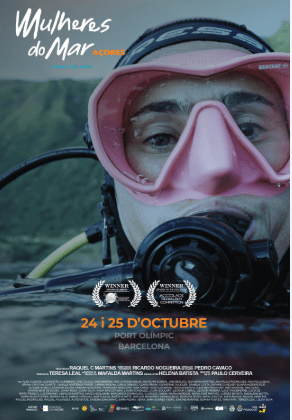
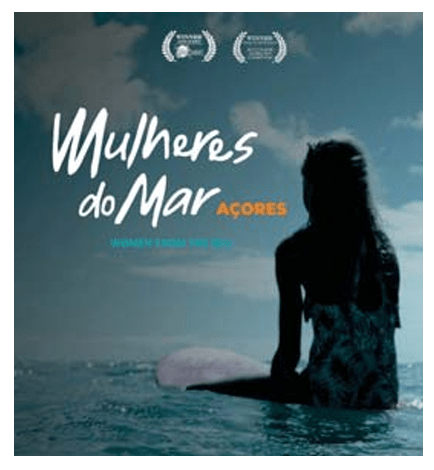
The project has already traveled beyond the Azores, screening in Spain, Ireland, Germany, France, Belgium (including at the European Parliament), and Hong Kong. It has received two international honors at the Accolade Global Film Competition: an Award of Excellence in Nature/Environment/Wildlife and an Award of Merit for Women Filmmakers. UNESCO has recognized the initiative, which is now part of the global actions for the United Nations Decade of Ocean Science.
Help Images, the NGO behind the project, has since 2021 been developing Mulheres do Mar as an international platform. With a list of more than 1,000 women from 30 countries, the Azorean documentary represents one luminous chapter in a much larger maritime archive of female voices. The organization believes in storytelling as an instrument of social justice, equity, and environmental conservation — and has committed to expanding the project through a collection of documentaries, a digital hub, and sustained communication campaigns through 2030.
The Azorean documentary was made possible with financial support from the Regional Government of the Azores and through collaboration with a wide network of regional partners — among them SATA Azores Airlines, the National Maritime Authority, the Municipality of Angra do Heroísmo, Atlântico Line, and many others whose support underscores the communal nature of this endeavor.
Screenings in Terceira and Graciosa are supported by Save the Waves, the Municipality of Santa Cruz da Graciosa, the Municipality of Praia da Vitória, Surfing Graciosa, and GDMP. The film was shown yesterday at the Ramo Grande Auditorium in Praia da Vitória and screens today at the Cultural Center of Santa Cruz da Graciosa.
But beyond venues and awards, beyond institutions and itineraries, what remains is the sound of women speaking into the wind — their words crossing water the way seabirds do, with instinct and endurance.
In the Azores, the ocean has always been a teacher. Through Mulheres do Mar, it is also revealed as a chorus — and in that chorus, the women of these islands are no longer background tide, but voice, current, and compass.
This chronicle is an adaptation from an article published in Diário dos Açores-Paulo Viveiros-director
 Filamentos (artes e letras)