
The American Origins of the Life and Work of Dias de Melo*
(February 12, 2016)
Vamberto Freitas
Arriving without history. Only the presence of my Father, now at peace, within me…
— Dias de Melo, Das Velas de Lona às Asas de Alumínio
I
I first met Dias de Melo in person in the mid-1980s in San Diego, at the southern edge of California, home to a Portuguese community from the Azores traditionally devoted—at least until then—to deep-sea fishing. There were times when a great deal of money circulated there—and in Portuguese communities across America, wealth is a world unto itself. Never fully penetrating the country’s “native” social and political circles, display takes on curious forms, a spectacle meant for insiders only. Intellectuals were (and are) always warmly received simply because they have a “name,” and nothing in American society is more delicious than the leveling power of money: If you come to my world, I am king; and because I am king, your ideas don’t bother me.
That was how I understood the cultural and literary receptions that took place outside academic settings among our immigrants and a handful of Luso-descendants—very few at the time. I don’t know what Dias de Melo thought when I approached and extended my hand. He looked at me slowly; a mutual friend had told him I would be his guide for a few hours. Then he embraced me. He had never been to the United States; I had been there since 1964. For a moment—such was his ease—I felt I had never left the Azores, or that he had always been an immigrant like me in California.
Around us swirled the bustle of another community celebration, vividly colorful—in this specific case, and without parallel in America, a feast of the Holy Spirit, now surrounded by young women in striking capes, the queen and her attendants, accompanied by marching bands, politicians, and civic figures. Dias de Melo witnessed all this that day, but he never said a word to me about what he saw or heard.
At one point I asked what he most wanted to see in California. He replied that what he really wished—really wished—was to go to the city cemetery to visit the grave of a dear friend from island days and from whaling—and then to cross the land of John Steinbeck and his characters. Right then and there I resolved to read all his books.
Many before me had already formed judgments about his work, and not only in the Azores. Though often associated with Portuguese neo-realism, his endurance owes to far more than that: his writing is an original repository of language, history, daily life, and the total way of being of Azorean people—especially those of Pico. He spoke to me of all this, and more, in a long interview I would include in the first edition (1992) of O Imaginário dos Escritores Açorianos. What remains here, in part, is a sincere record of his education, his—borrowing Máximo Gorki’s phrase—“universities,” and of how another island writer came into being and endured in a milieu and among people that periodically forced him to confront situations he held dear.
What follows, then, are some observations on North American immigration at a particular historical moment, offered by a major Azorean writer. We would have our differences in his later years, but I remember with affection evenings spent with friends at my house in Pópulo, or the occasional visit I paid him at his home in São Gonçalo, here in Ponta Delgada. What Dias de Melo leaves us in Das Velas de Lona às Asas de Alumínio—his book about this American passage—stands among the finest things written about this country in our language.
II
— Your visit to America in 1988 was, as you later wrote, deeply moving. That strikes me as a very interesting reaction for a European “of the Left.” Almost all Europeans with similar political commitments tend to look at the United States with reserve, if not disdain. Would you speak about that experience? What impression did the country leave on you?
Dias de Melo: I confirm it: I am a man of the Left and I say so plainly, without quotation marks or hesitation. What you may not know is that I settled decisively into that position when, already a grown man, my father spoke to me of the great labor struggles launched by unions—the unions, as they are called in America—precisely in California. Struggles for various demands, among them two main ones: the working day—whether eight or still ten hours, I no longer recall—and wages. In those struggles he played a responsible role. He even became a strike picket leader. And he lived alongside foreign revolutionaries of great renown, among them Leon Trotsky.
At a certain point, for family reasons, one of the brothers who were in California—besides my father—had to return to Pico. Being the eldest and the first to have gone to California, my father returned. Not intending to stay. But… marriage… my mother, who did not want to leave the island…
Before my father, my paternal grandfather had worked in California. In California my uncles remained and are buried. My cousins—their children—live there as American citizens; my second cousins as well, children of my father’s cousins; and other cousins, daughters of one of my mother’s brothers who emigrated in the 1920s, are also American citizens, along with cousins who emigrated in my own lifetime.
To retrace approximately the same route they had taken and to compare it—they on whaling sailboats, months at sea, if not years; later crammed like slaves into the hold of some steamer, weeks on end to disembark on the American East Coast; then the crossing of the continent in fire-cars without comfort, from the Atlantic to the Pacific (from farther back I knew no one, but it would have been worse still)—I, today, cutting through the sky comfortably settled into an airplane seat, four hours from Terceira to Boston, six from Providence to San José… It is enough to provoke in me a powerful emotion and a lasting experience that continues when, upon landing, I travel California’s roads with the clear sensation that I know this land, that it is as if it were mine, that I had long lived there…
America has its rights—but it also has its reverse. Like everything in this world. Discrimination persists there—not only between social classes, between poor and rich, but worse still among ethnicities and races. Our immigrants are discriminated against by Americans and also discriminate among themselves, generally clustering in areas where few Americans live. Some of those areas (I saw one) are quite poor, scarcely different from the shantytowns we have here. They are inhabited by elderly immigrants, retirees, or newly arrived youths waiting for a chance to get ahead. Yet even while discriminated against by Americans, they align themselves to discriminate against African Americans, descendants of slaves freed by the Civil War.
The exploitation of man by man is a fact—even among our immigrants. I knew one—of my father’s age—a large “rancher” who, lamenting today’s workers’ demands (mindful of hours and unwilling to forgo overtime when work exceeds eight hours), let slip this outburst: “If only a man could grab one of those boys who arrive without papers… but as soon as they become legal—and there are always fools who help them…”
Still, aside from those who huddle in poor neighborhoods, many achieve in California a level of comfort they could never have dreamed of on the island or the mainland. With that standard of living they go to work by car, leave work, stop at the Portuguese mini-market—where prices are higher than the American supermarket but there’s a tavern disguised behind the door at the back of the counter—down a glass, exchange a few words with a friend, pass by the bank when necessary, and go home. And at home, from the door inward, they live on the Island. In the parish. In the mainland village. Talking, playing cards, turning glasses with friends, beside the cask, in the cellar-adega set up in the basement.
What happens outside—even work problems—does not interest them; it’s not their concern. That is the case with immigrants who left at a certain age. Those who departed young—between thirteen and twenty—still sway, one foot there, one here. The others—those who left as children or were born in America—generally want nothing to do with it. They refuse to speak Portuguese. They are even ashamed of being Portuguese. They are the Adrians of Onésimo Teotónio Almeida’s story in Sapa(teia) Americana, sometimes sliding into drug addiction and crime.
As for America itself: Europeans should shed the megalomaniac prejudice that Europe is still everything and America has taken only its first steps toward Culture. The good American universities—I visited several—are true worlds of exemplary organization where, with the best and most modern tools available, work is done with commitment and seriousness—and with the pleasure that comes from work carried out in freedom—for the conquest of the Future. And without complexes: so free of complexes that no pedagogical or scientific council hesitates, out of moth-eaten nationalist vanity, to recruit—wherever he or she may be—the master who can best serve.
* Drawn from a long interview in my O Imaginário dos Escritores Açorianos (1992; 2013). For a fuller understanding of Dias de Melo’s American experience, I recommend reading (or rereading) Das Velas de Lona às Asas de Alumínio (Lisbon: Edições Salamandra, 1990). Originally published in “BorderCrossings,” Açoriano Oriental, February 12, 2016.
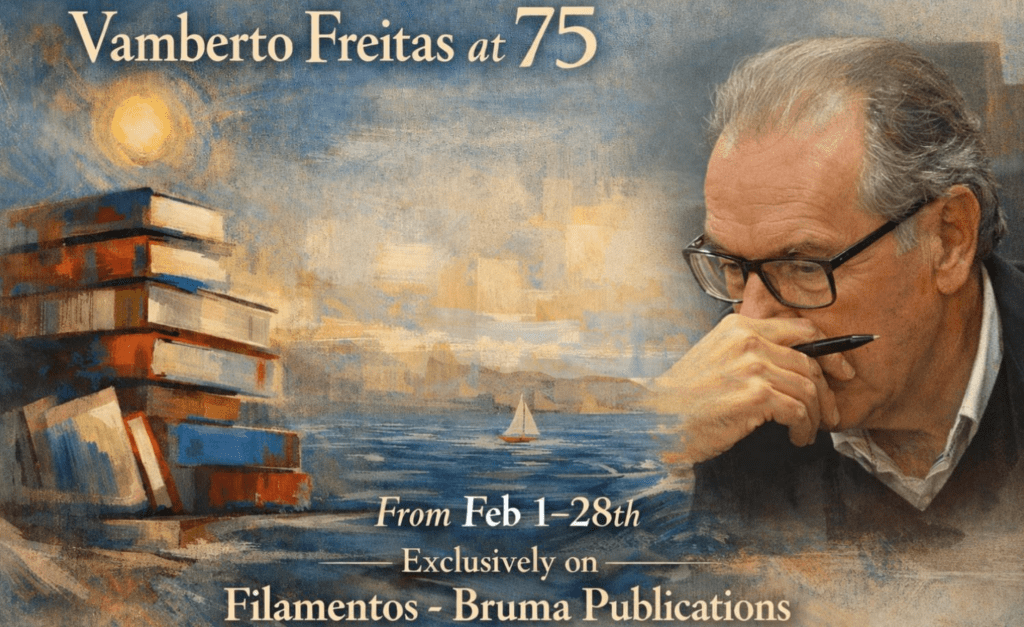
Vamberto Freitas at Seventy-Five
The Long Work of Critically Listening to and writing about Dispersed Voices
Filamentos – arts and letters
Bruma Publications | Portuguese Beyond Borders Institute (PBBI),
California State University, Fresno
Introduction
For more than three decades, Vamberto Freitas has practiced literary criticism as a form of sustained attention—patient, rigorous, and ethically alert. His work has traced the quiet, often overlooked trajectories of writers shaped by migration, insularity, and memory, especially those of American and Canadian authors with roots in the Azores. At seventy-five, his critical legacy stands not as a monument but as an ongoing conversation: a life of letters placed in the service of literature itself, where reading becomes an act of responsibility and criticism as a way of listening deeply to voices dispersed across geographies, languages, and generations.
Throughout the month of February, Filamentos – arts and letters, an initiative of Bruma Publications at the Portuguese Beyond Borders Institute (PBBI), California State University, Fresno, will honor this legacy with daily segments published from February 1 through February 28. Each entry will revisit, reflect upon, and extend the critical pathways opened by Vamberto Freitas, reaffirming the enduring relevance of his work within Atlantic, diasporic, and transnational literary studies.
Vision
To honor literary criticism as a form of cultural stewardship—one that listens across distance, preserves intellectual memory, and affirms the centrality of diasporic voices within the broader landscape of contemporary literature.
Mission
Through this February series, Filamentos – arts and letters seeks to celebrate the life and work of Vamberto Freitas by foregrounding criticism as a practice of care, rigor, and continuity. By publishing daily reflections, excerpts, and critical engagements, this initiative reaffirms Filamentos’ commitment to literature that crosses borders, sustains dialogue between islands and continents, and recognizes reading as an ethical act—one capable of holding dispersed voices in thoughtful, enduring relation.
 Filamentos (artes e letras)