
Other American Narratives
(February 28, 2012)
Vamberto Freitas
The vanity of the dollar is a feeling as intense as the vanity of genius. To conquer the dollar in order to squander the dollar and create a name, secure fame, assert individuality.
— Alfredo de Mesquita, North America
Let us begin with an essential claim: North America, the narrative simply titled by the Terceiran journalist and diplomat Alfredo de Mesquita (1871–1931), is among the finest—if not the finest—books about the United States written in Portuguese by a non-immigrant and non-resident. Taste and sensibility are, of course, not up for adjudication, but this judgment is grounded in years of reading the many volumes our writers have produced about that vast country over the decades—from Mundo Novo, Novo Mundo by the distinguished modernist and Salazar collaborator António Ferro, to Cavalgada Cinzenta by Fernando Namora, alongside others in between, such as Descobri Que Era Europeia by Natália Correia, América em Carne Viva by João Alves da Costa, and Ida e Volta: À Procura de Babbitt by Ilse Losa. One should add the notable Azorean narratives about our other chosen homeland to the west, including Das Velas de Lona às Asas de Alumínio by Dias de Melo, especially in its treatment of California.
Any work must be read in perspective against those that preceded or followed it thematically. America—now more than ever—continues to exert its fascination over certain intellectuals among us, many of whom seem to glimpse only New York—because it feels chic, because Wall Street moves them to love or fury. Yet neither domesticated CNN, nor the occasional brief visit, nor the cursory reading of a newspaper or magazine can offer even the faintest sense of the plurality and complexity of that immense society. Conversely, to read only the pages of visitors—without also reading what has been and is written in Portuguese or English by our immigrant and Luso-descendant authors—is to settle for a severely limited vision of a world profoundly significant to us. As Alfredo de Mesquita wrote in his own time: “Paris is France. Portugal is Lisbon; but New York, by itself, tells us very little about what America as a whole is.”
Born in Angra do Heroísmo, where he completed his secondary education and began his journalistic career, Mesquita later moved to Lisbon and became a contributor to major newspapers such as Diário de Notícias, as well as periodicals like Ocidente. His bibliography includes several titles, from Portugal Moribundo to Memórias de um Fura-Vidas. It was his final work, North America, originally published in 1928 (two years before the aforementioned diary-like book by António Ferro), that brought him the greatest recognition and was, by all accounts available to us, warmly received by the reading public.
Dates matter here. A diplomat who served Portugal in several European consulates, Mesquita was appointed consul in New York in 1918–1919. He used nearly all his time to travel extensively across the country—driven by innate and professional curiosity, but also because, after meeting railroad magnates, he was offered journeys, routes, and accommodations that carried him as far as San Francisco, on the opposite edge of the continent.
Mesquita witnessed in full one of the great historical moments of radical socio-economic transformation, when America emerged from near-total rurality into an industrial civilization, an immediate result of its triumph in the First World War and, consequently, of a devastated Europe. He does not dwell on that factor. Instead, he focuses on what he sees as the primary root of the new society: an open political culture and the determination of elites—and, by osmotic example, of the population at large, beyond hierarchical distinctions—to dominate without restraint their share of the continent, from the Atlantic to the Pacific. America’s business was, as one of the great automotive executives would later say, business—period.
From the pioneering gigantism of skyscraper architecture to the art of advertising every new product; from the blaze of continual inventions that increasingly mechanized daily life to unapologetic enrichment and display—everything contributed to defining a national culture unparalleled in the world or in history. Unlike many later visitors who would “philosophize” at speed about what they glimpsed from afar—Jean Baudrillard among them, who “saw” and “understood” all that immensity from a highway in America, prejudices intact—Mesquita confines himself to observing and reporting a daily life almost devoid of memory of each group’s origins, yet wholly devoted to domesticating a vast space: the sole way of being for pioneers and their descendants.
Like any narrative, his is partial. It leaves aside much of the intellectual and labor opposition that consistently challenged the ruling class and its ideology in the name of alternative social equilibria. Mesquita may have grasped immediately the minority status of those forces, foreseeing no political conjuncture capable of altering an America already consolidated and resolute about its future. In retrospect, he was largely correct—and little would surprise him if he returned today to a Europe still Europe and an America still America.
North America describes with meticulous care nearly everything: nature, cities, private and public buildings, feats of engineering and engines, rivers and mountains, men, women, and animals. The relationship between whites and African Americans is not omitted. Mesquita enumerates several European immigrant groups, yet—curiously—even after reaching California, he leaves out the Azoreans settled there. In matters of culture, he focuses almost exclusively on mass entertainment, describing in detail New York theaters and their astonishing acrobatics and expansive stagecraft. But this is a European long accustomed to the elitist nausea of his continent, now fascinated by a creative equality previously unseen. He was right again: it was precisely this entertainment—and more—that the United States would export overwhelmingly to the rest of the world.
Without the explanatory burden or analytical pretension of many other narratives, Mesquita sharpens his descriptive and opinionated prose in clear, flowing language, constantly comparing what he sees with what he inherited and lived in the Old World.
“The neurosis of haste,” he writes in a passage that crystallizes his view of America and Americans, “and the concern with finding and using the definitive practical form of all things—ideas, movement, and acts—characterize the American genius, and they converge in everything the American does. Every gesture he makes, every tool he uses, condenses as much as can be condensed of expressive and active expenditure. Unlike us, who squander energy, the American economizes it even when it appears in infinitesimally small units.”
North America was republished a few years ago in a deluxe edition, with black-and-white illustrations on nearly every page, depicting people and things as the narrative unfolds. For those interested in the United States at large and in our centuries-long presence at the most nerve-centers of a society then under construction, Alfredo de Mesquita’s book is a treasure—even if, ideologically, we can and should interrogate it at every step. Great writing always contains its own contradiction. Hunger for—and obsession with—the dollar ultimately serve to erase memory of origins, and above all to perpetuate a longing for a future forever under construction.
Reference
Alfredo de Mesquita, North America. Lisbon: Parceria A. M. Pereira (with support from FLAD), 2001.

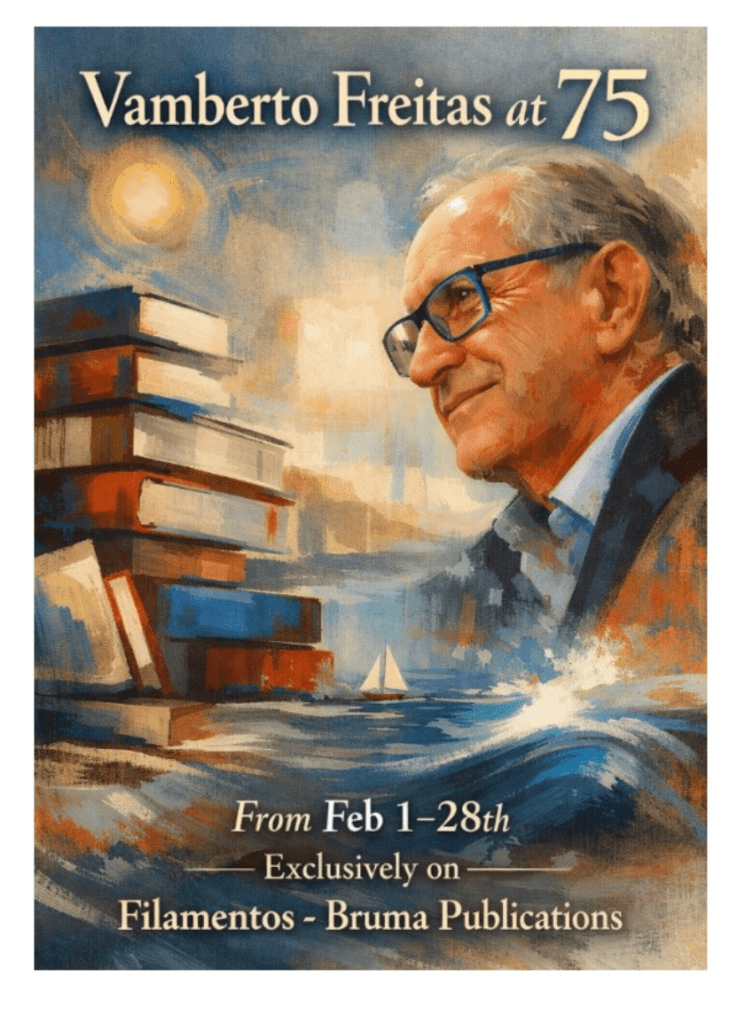
Vamberto Freitas at Seventy-Five
The Long Work of Critically Listening to and writing about Dispersed Voices
Filamentos – arts and letters
Bruma Publications | Portuguese Beyond Borders Institute (PBBI),
California State University, Fresno
Introduction
For more than three decades, Vamberto Freitas has practiced literary criticism as a form of sustained attention—patient, rigorous, and ethically alert. His work has traced the quiet, often overlooked trajectories of writers shaped by migration, insularity, and memory, especially those of American and Canadian authors with roots in the Azores. At seventy-five, his critical legacy stands not as a monument but as an ongoing conversation: a life of letters placed in the service of literature itself, where reading becomes an act of responsibility and criticism as a way of listening deeply to voices dispersed across geographies, languages, and generations.
Throughout the month of February, Filamentos – arts and letters, an initiative of Bruma Publications at the Portuguese Beyond Borders Institute (PBBI), California State University, Fresno, will honor this legacy with daily segments published from February 1 through February 28. Each entry will revisit, reflect upon, and extend the critical pathways opened by Vamberto Freitas, reaffirming the enduring relevance of his work within Atlantic, diasporic, and transnational literary studies.
Vision
To honor literary criticism as a form of cultural stewardship—one that listens across distance, preserves intellectual memory, and affirms the centrality of diasporic voices within the broader landscape of contemporary literature.
Mission
Through this February series, Filamentos – arts and letters seeks to celebrate the life and work of Vamberto Freitas by foregrounding criticism as a practice of care, rigor, and continuity. By publishing daily reflections, excerpts, and critical engagements, this initiative reaffirms Filamentos’ commitment to literature that crosses borders, sustains dialogue between islands and continents, and recognizes reading as an ethical act—one capable of holding dispersed voices in thoughtful, enduring relation.
 Filamentos (artes e letras)