

Kicking the Sky, Without a Net
(December 13, 2013)
Vamberto Freitas
It was the summer when no one slept. During the last sticky week of July, the air abandoned us, with no passing breeze in our streets and crooked alleys.
— Anthony De Sa, Kicking the Sky
Anthony De Sa’s first novel, Barnacle Love—published in Portugal under the title Terra Nova (Dom Quixote, 2009)—was intimately bound to Azorean immigration in the author’s Canada. It was his transfiguration of how parents from São Miguel (Lomba da Maia) left the island in the middle of the last century to rebuild their lives, along with thousands of compatriots from all the islands, in what would become one of the great Portuguese diaspora communities in North America. The narrator was precisely one of their children, a second-generation son struggling to survive between two languages and two cultures, often antagonistic despite the preaching of a supposed Lusitanian universalism capable of absorbing everything and everyone into a new being, a new citizen.
Barnacle love: the ancestral land continuously calling, conditioning a daily life that now related to the islands only through memory and saudade—alleviated by a glass of vinho de cheiro or homemade wine (grapes secretly crushed in a garage where a pig might also be hanging in secret), a sausage, intensely Azorean religious festivals, and the smell of kitchens in the basements of more or less humble houses belonging to those condemned to live by the strength of their arms and by the contingencies that now, truly universally, mark the experience of all “exiles.”
This generation of Luso-descendant writers has no parallel in our history or literary culture, here or abroad. Through art, they account for themselves, redefining— in English, in Canada and even more so in the United States—our fate in distant lands, eliminating geography by insisting on the past of those who gave them life, embracing without complexes their condition as hyphenated citizens. Canadian or North American literature? Yes—canonically integrated into their own tradition. And once translated into our language, with their images, metaphors, historical references, and Portuguese terms italicized in the English original? The deterritorialization, even the denationalization, of literature has been underway for decades. Languages no longer have homelands; they have speakers—and in our case those speakers are literally scattered across the globe.
These reflections arise naturally from Anthony De Sa’s second novel, recently published in Canada, Kicking the Sky—which both continues his earlier prose and themes and departs toward other, far more dramatic (and comic) territories of mind and heart. Based on a true event that occurred in Toronto in 1977, it begins with the murder of an Azorean-Canadian teenage shoeshine boy—“the Shoeshine Boy”—named Emanuel Jacques, whose involvement with a certain homosexuality in a neighborhood of the city becomes the point of departure (the novel is not homophobic—quite the opposite). From there, the narrative takes us through the most isolated and depressed alleys of a largely Portuguese district, seen through the voice of another adolescent, Anthony/António Rebelo, who re-examines the destiny of first-generation immigrant parents, of fractured languages, of neighbors and friends wedged between two Luso-Canadian worlds—of dimmed ambition giving way to the despair of their children.
Nothing like this had ever been written by a Luso-descendant: the myth of our supposed triumph (always the triumph of a few, never of the majority) placed side by side with the tragedy and solitude of those who belong nowhere entirely; the essential rebellion of the next generation searching for a place and for the promised happiness. The first communal condition revealed in Kicking the Sky is an acute sense of claustrophobia in a marginal neighborhood, where disillusionment in love—at home and in the communal street—coexists with the dreamed-of professional success that seems barred to these people, a life entirely dominated either by insane labor or by the acceptance of camouflaged poverty.
The only “Canadian” we see and hear for most of the narrative—James—is another marginal figure living in a neighborhood garage among the Portuguese, exploiting the adolescents around him. Emanuel’s violent death, which gives the novel its firm unity, occurs right at the beginning—before we know it was, in fact, almost inevitable. What we gradually understand is that death hovered constantly over the surviving friends, most of them devoted to petty theft and drug dealing, or drifting through the neighborhoods of commercial sex, selling without pleasure a body in search of some monetary reward. Throughout, we glimpse the daily danger these youths inhabit, never forgetting the solitude of adult men and women who ritually pursue the happiness of a stable life in the city of their dreams.
The lapa returns here—now constantly named in Portuguese; in English, barnacle gives way to the more popular limpet. Its symbolism of attachment to the ancestral past is even stronger. António/Anthony, here twelve years old, eats them raw as if he had been born and raised in Lomba da Maia. One day, holding a shell, a play of reflected light convinces him he has clearly seen a figure of Christ—resembling, of course, the Holy Christ. When the father discovers the “miracle” and the “revelation,” he has no half measures: he announces it throughout the neighborhood and opens the same garage where he presses grapes for his wine, immediately receiving neighbors and others seeking the son’s blessing, cures and peace—and, he believes, improving the family’s finances through the gifts of the faithful.
António sits in the garage like a kind of Buddha of Christendom, facing everyone, draped in a red cape over his shoulders and adorned in gold colors (memory speaks…), until the local Portuguese priest puts an end to it—as the Holy Church always does, admitting no competition or preaching beyond its reach. What happens in Kicking the Sky is something that rarely works in a novel—and here it does: drama and comedy inhabiting the same characters, the same incidents, the same atmosphere, invented within a precise geography.
Let us recall that our community in Toronto is one of the very few embedded in a vast, wealthy, hyper-modern metropolitan area, yet insisting on a life of its own—pre-defined over many centuries on small, isolated islands in the ghostly Atlantic. The city lights on the great hot-and-cold continent shine brightly, but at a distance, and seemingly for others. This entire world—vast and at the same time small—is seen through three Azorean-Canadian adolescents: the narrator; Manny (a bicycle thief who sells to order for others, pocketing a few bills); and Ricky, the most tragic of them all, living alone with an alcoholic father abandoned by his wife, who long ago returned to São Miguel.
Here is one of our first repatriates—finding peace and well-being on the island of his ancestors. Irony, yes—brilliant and redemptive. He left hell behind to “kick the sky” on the island, in the company of the only person who could love and protect him. In a letter to António, he writes that he now wakes up with breakfast waiting for him.
Kicking the Sky can at times feel like a more or less depressing literary journey, but its author has not only found a voice distinctly his own; he handles his languages with wise dexterity. The internal tension of the narrative is balanced by humor and, often, by the innocence and wisdom of adolescents already old in life, shaped by the fortune and experience dealt to them. The novel dismantles the idea of absolute happiness imposed on us by traditional narratives of immigration to North America—almost always falsely. Transgressive and condemned sexuality, family conflict, disbelief in the benevolence of Terra Nova. Anthony De Sa’s novel belongs to the great New World artistic tradition: the loss of innocence, the confrontation with “reality,” the realization that little of what adults say makes sense or is true.
Between fantasy and reality lies what matters most: life in its full ugliness and beauty—love and tragedy, tears and laughter.
Reference
Anthony De Sa, Kicking the Sky. Canada: Doubleday Canada, 2013.
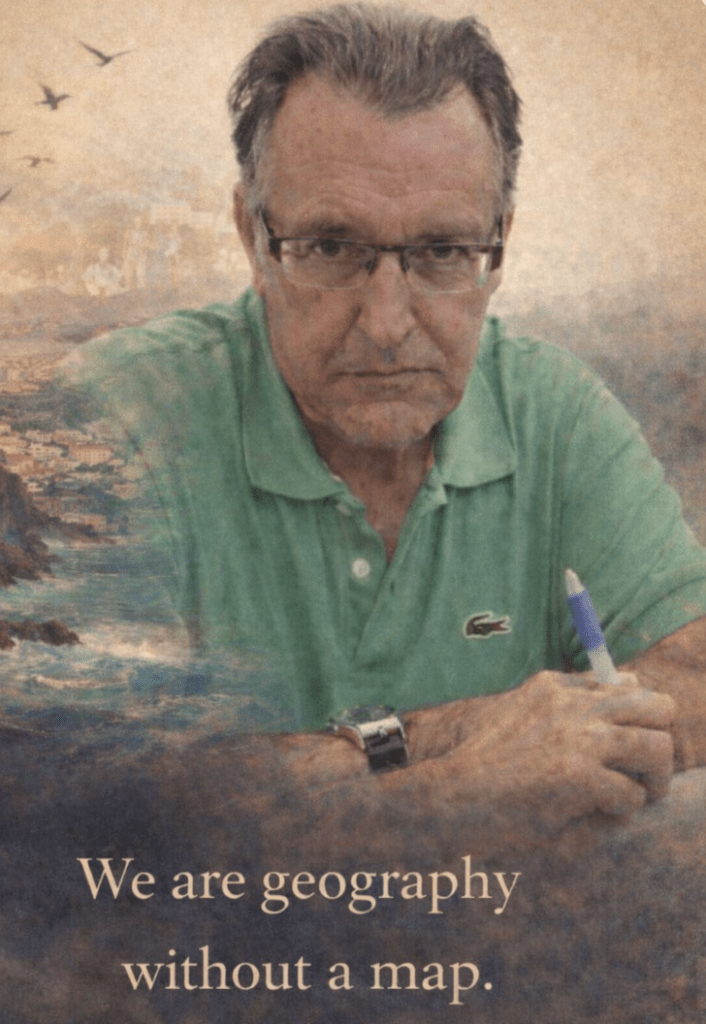
Vamberto Freitas at Seventy-Five
The Long Work of Critically Listening to and writing about Dispersed Voices
Filamentos – arts and letters
Bruma Publications | Portuguese Beyond Borders Institute (PBBI),
California State University, Fresno
Introduction
For more than three decades, Vamberto Freitas has practiced literary criticism as a form of sustained attention—patient, rigorous, and ethically alert. His work has traced the quiet, often overlooked trajectories of writers shaped by migration, insularity, and memory, especially those of American and Canadian authors with roots in the Azores. At seventy-five, his critical legacy stands not as a monument but as an ongoing conversation: a life of letters placed in the service of literature itself, where reading becomes an act of responsibility and criticism as a way of listening deeply to voices dispersed across geographies, languages, and generations.
Throughout the month of February, Filamentos – arts and letters, an initiative of Bruma Publications at the Portuguese Beyond Borders Institute (PBBI), California State University, Fresno, will honor this legacy with daily segments published from February 1 through February 28. Each entry will revisit, reflect upon, and extend the critical pathways opened by Vamberto Freitas, reaffirming the enduring relevance of his work within Atlantic, diasporic, and transnational literary studies.
Vision
To honor literary criticism as a form of cultural stewardship—one that listens across distance, preserves intellectual memory, and affirms the centrality of diasporic voices within the broader landscape of contemporary literature.
Mission
Through this February series, Filamentos – arts and letters seeks to celebrate the life and work of Vamberto Freitas by foregrounding criticism as a practice of care, rigor, and continuity. By publishing daily reflections, excerpts, and critical engagements, this initiative reaffirms Filamentos’ commitment to literature that crosses borders, sustains dialogue between islands and continents, and recognizes reading as an ethical act—one capable of holding dispersed voices in thoughtful, enduring relation.
 Filamentos (artes e letras)