
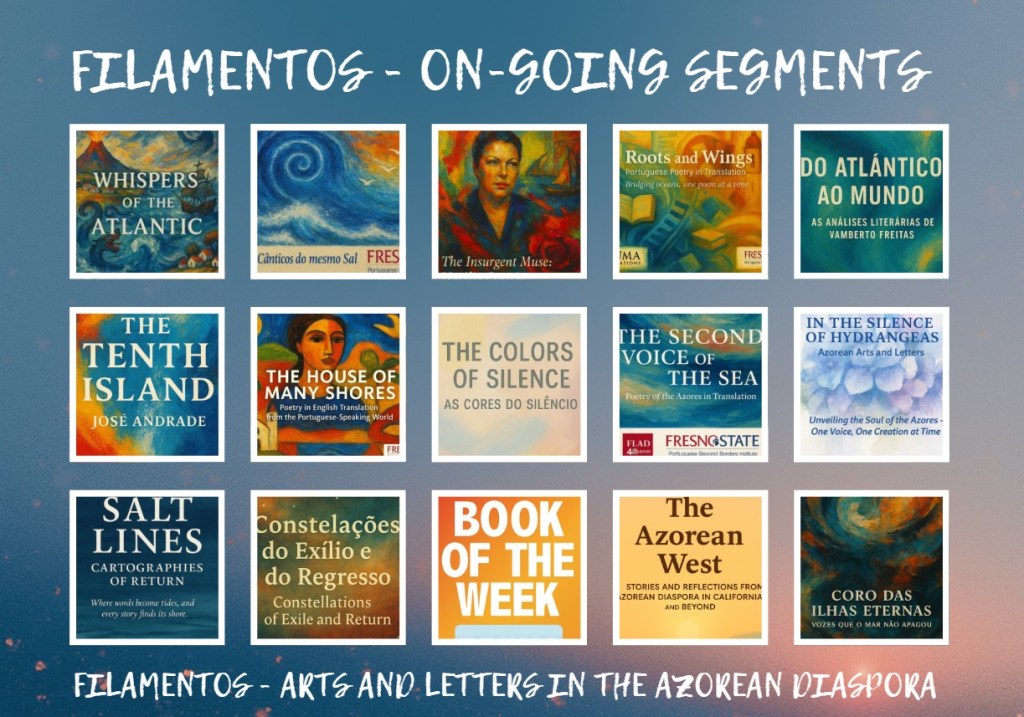
Filamentos was never conceived as a mere digital space for texts and images. It was imagined — and slowly built — as a weaving. A loom stretched between islands and continents, between the Azores and California, between Lisbon and Toronto, between Praia and Providence. Each segment is a thread. Each thread holds memory. Each memory becomes dialogue.
When one opens Whispers of the Atlantic, one does not simply read poetry — one hears the sea speaking in multiple registers. It is the murmur of departure and the cadence of return. It is the Atlantic, not as a barrier but as a bloodstream. The segment gathers voices shaped by salt and wind, reminding us that geography is not destiny; it is an invitation.
Cânticos do Mesmo Sal deepens that idea. We may speak different dialects, inhabit different passports, carry different histories — but we are seasoned by the same salt. This segment insists on the shared sensibility of the Lusophone world, from the volcanic soil of Pico to the urban rhythm of São Paulo. It is a hymn to continuity within diversity.
Then comes The Insurgent Muse, which honors the restless spirit of creation. The Azores, Portugal, and their diasporas have never been culturally passive. Their writers have questioned authority, confronted silence, and transformed marginality into vision. This segment recognizes that literature is not decorative; it is insurgent. It unsettles, critiques, and liberates.
In Roots and Wings, the metaphor becomes explicit. We carry origins — language, ritual, story — but we also carry flight. Translation plays a central role here. Portuguese poetry in English, English voices conversing with Portuguese tradition. It is where the rooted becomes airborne, and the airborne remembers where it began.
Do Atlântico ao Mundo extends the horizon. It situates Azorean and Portuguese literary analysis within global conversations. It affirms that insular writing is not provincial writing. The Atlantic is not a margin; it is a crossroads. Criticism becomes cartography.
With The Tenth Island, the diaspora is named as territory. Not metaphorically — but existentially. California, New England, Bermuda, Canada: these are extensions of the archipelago. This segment acknowledges that migration did not dilute identity; it reconfigured it.
The House of Many Shores reminds us that translation and bilingualism are not compromises — they are expansions. The Lusophone world is plural. This house has many entrances, many rooms, and many accents. It is an architecture of hospitality.
In The Colors of Silence / As Cores do Silêncio, we encounter what has often gone unspoken — women’s voices, interior landscapes, emotional geographies. Silence here is not absence. It is density. It is what literature dares to translate into light.
The Second Voice of the Sea continues the maritime metaphor but insists on depth. The first voice is obvious — departure, longing. The second voice is subtler — resilience, reinvention, creative survival. It is the poetry born not only of leaving, but of staying.
In the Silence of Hydrangeas evokes the emblematic flower of the islands — abundant, quiet, persistent. Arts and letters flourish in that silence. This segment honors painters, musicians, essayists, chroniclers — the cultural gardeners of the Lusophone imagination.
With Salt Lines: Cartographies of Return, we begin mapping trajectories. Return is not always physical. Sometimes it is literary. Sometimes it is intergenerational. The lines are drawn not on maps, but in memory.
Constelações do Exílio e do Regresso expands that mapping into the sky. Exile is not solitary; it is a constellation. Every migrant star glows in relation to others. The diaspora becomes celestial geography.
Book of the Week grounds the project in immediacy. Literature is not museum artifact; it is living conversation. Every week, a new text enters the dialogue, reminding readers that culture is continuous labor.
The Azorean West situates the archipelago in the American narrative. Stories from California and beyond affirm that Azorean identity has shaped — and been shaped by — the American West. The Atlantic meets the Pacific.
And finally, Coro das Ilhas Eternas gathers all voices into polyphony. No single island sings alone. No single language carries the whole story. The chorus insists on multiplicity — Terceira and São Miguel, Madeira and mainland Portugal, Brazil, and the diaspora communities across North America.
Together, these segments embody Filamentos’ mission: to sustain a constant dialogue among the Azores, Portugal, the Lusophone world, and the global diaspora. Not nostalgia — dialogue. Not preservation alone — creation. Not fragmentation — weaving.
Filamentos is not simply a publishing culture. It is practicing cultural continuity.
Each segment is a filament. Each filament carries light. And when woven together, they illuminate an Atlantic world that is no longer distant — but profoundly, continuously connected.
Thanks to all who are taking this collective journey. Transforming the Azorean and Portuguese Diaspora, one thread at a time.
Abraços
Diniz Borges
 Filamentos (artes e letras)