

When the Island Is Both Mother and Stepmother
Vamberto Freitas
Home is an island. Time to be poor. Time to go barefoot, hungry and cold. Time to be born and to die in dark cottages. One must make a journey to change things. One must make it, then.
— Alfred Lewis, Home Is an Island
There are books that belong to a people before that people knows how to claim them. Home Is an Island, by the Florentine writer Alfred Lewis (1902–1977), is such a book: the first true classic of Azorean-American immigrant literature, and still, one suspects, insufficiently read by those who ought to cherish it as part of their inheritance. Its neglect is not merely unfortunate; it is symptomatic of a culture divided against itself—linguistically, historically, imaginatively.
America has always been present in the Azorean imagination. But it has meant more than the runway lights of the Lajes Air Base or the cultivated glamour of a tourist’s New York. In Lewis’s novel, America is neither spectacle nor abstraction; it is hunger’s answer, and hope’s wager. The book’s achievement is double: it captures with historical precision the island life that shaped generations of emigrants, and it accomplishes an editorial feat unprecedented among our writers in the United States.
Written in English by a young man who left Flores in 1922 at the age of twenty—without a word of the language and without entrée into the American academy or literary establishment—Home Is an Island was sent, audaciously, to Random House. In 1951, it appeared in the publisher’s customary hardbound format, reviewed favorably in publications of national stature, including The New York Times and the San Francisco Chronicle. Lewis had already placed short stories in Prairie Schooner and was selected for The Best American Short Stories (1949–1950). For an immigrant from a remote Atlantic island, this was not merely success; it was a kind of literary transubstantiation.
And yet, for more than sixty years the novel drifted in a kind of cultural limbo—out of print, scarcely distributed, its Portuguese translation (Minha Ilha, Minha Casa) appearing only in 2010. It is an injustice compounded by irony: a culture that prides itself on being one of poets has failed to honor one of its foundational novelists.
I first read Home Is an Island as a university student in California in the 1970s. A photocopy of the original edition—rescued from the stacks at UCLA—was pressed into my hands by my late friend and professor, Nancy T. Baden. Youth, as ever, is confident in its dismissals. In the midst of an intellectual hunger for Lusophone references in a vast and indifferent American landscape, I judged the novel “too” sentimental, even naïve. My professor warned me gently that I was mistaken. Time, as it does, has rendered its verdict.
What I once mistook for sentimentality reveals itself now as a sustained prose poem: the first great Lusophone-American novel to claim, in English, its dual inheritance—Portuguese and Anglo-Saxon. Its emotional register recalls, at moments, the humane pathos of John Steinbeck, writing a little to the north in Salinas, and—unexpectedly—the moral village world of Fiddler on the Roof, itself drawn from the tales of Sholem Aleichem. In each case, a small, threatened community stands at the edge of modernity: the Russian shtetl, the Azorean parish, the Californian valley. Tradition trembles; youth looks outward; the house threatens to collapse.
Beira—the fictional name for Fajãzinha, near Santa Cruz das Flores—is a village pressed between mountain and Atlantic abyss. Its second homeland is America. In the scented sacks of clothing sent by relatives abroad, in the embellished memories of those who returned at the century’s end, America is myth and materiality at once. No one forgets the crossing; no one ceases to dream it. From Lisbon, as Natália Correia once wrote in another context, came the books and the edicts; from America came bread and hope.
It is no accident that a novel which begins and ends on the island, whose protagonist never yet sets foot on American soil within its pages, should be claimed as American literature. José de Castro, only son of a modest rural family, stands between a devout mother who would keep him near as a priest and a father—former whaler and former Californian emigrant—who urges him toward departure. The novel opens with José’s childhood at the turn of the century and concludes with his embarkation on the steamship that will carry him west.
He leaves with Os Lusíadas in his luggage, already marked as a poet in embryo. The hyper-patriotic literature of his youth does not restrain him. The imagination—fed by legends and by the lessons of Professor Silva—demands to know what lies beyond the closed horizon. The Great Azorean Voyage, begun with the Corte-Reals, continues in José. America exists between him and every other villager as idea and dream.
Professor Silva, offering the immigrant’s other truth at the hour of departure, foretells saudade in terms that might serve as an epitaph for the entire diaspora:
“Of course you will return. However hard you try, the new land will not be your land. As you live—and perhaps love—far from your country and your village, you will always see them. Gradually they will gain a new light; they will become a beautiful mirage. You will return, if not physically, then in imagination, again and again. Saudade will begin to be part of you; it will always be your companion. And in your lonely days and nights, though the streets may burst with people, though there is laughter and talk… you will still be alone in the midst of it all.”
Home Is an Island is the imaginative return of José de Castro; it is equally the return of Alfred Lewis. In this long, unbroken poem of exile, author and protagonist converge. The island is both mother and stepmother: the site of hunger and the source of identity; the place one must leave and the place to which one inevitably returns—if only in language.
A great novel is always a universal mirror. Each reader sees himself alone within it, seldom aware that the crowd around him stands in the same solitude—dreaming the same departure, enduring the same mirage of home.
Alfred Lewis, Home Is An Island, Tagus Press at UMass Dartmouth, Dartmouth, Massachusetts, 2012.
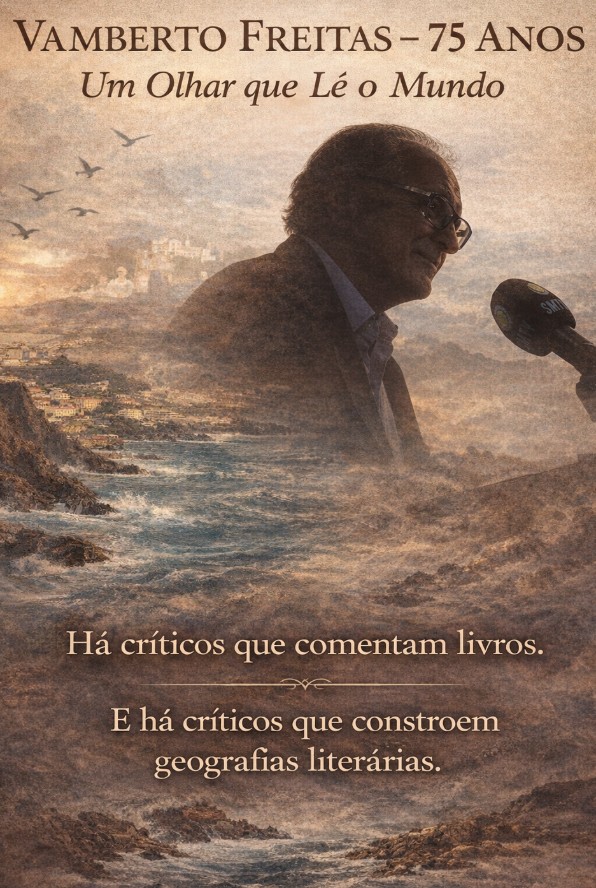
Vamberto Freitas at Seventy-Five
The Long Work of Critically Listening to and writing about Dispersed Voices
Filamentos – arts and letters
Bruma Publications | Portuguese Beyond Borders Institute (PBBI),
California State University, Fresno
Introduction
For more than three decades, Vamberto Freitas has practiced literary criticism as a form of sustained attention—patient, rigorous, and ethically alert. His work has traced the quiet, often overlooked trajectories of writers shaped by migration, insularity, and memory, especially those of American and Canadian authors with roots in the Azores. At seventy-five, his critical legacy stands not as a monument but as an ongoing conversation: a life of letters placed in the service of literature itself, where reading becomes an act of responsibility and criticism as a way of listening deeply to voices dispersed across geographies, languages, and generations.
Throughout the month of February, Filamentos – arts and letters, an initiative of Bruma Publications at the Portuguese Beyond Borders Institute (PBBI), California State University, Fresno, will honor this legacy with daily segments published from February 1 through February 28. Each entry will revisit, reflect upon, and extend the critical pathways opened by Vamberto Freitas, reaffirming the enduring relevance of his work within Atlantic, diasporic, and transnational literary studies.
Vision
To honor literary criticism as a form of cultural stewardship—one that listens across distance, preserves intellectual memory, and affirms the centrality of diasporic voices within the broader landscape of contemporary literature.
Mission
Through this February series, Filamentos – arts and letters seeks to celebrate the life and work of Vamberto Freitas by foregrounding criticism as a practice of care, rigor, and continuity. By publishing daily reflections, excerpts, and critical engagements, this initiative reaffirms Filamentos’ commitment to literature that crosses borders, sustains dialogue between islands and continents, and recognizes reading as an ethical act—one capable of holding dispersed voices in thoughtful, enduring relation.
 Filamentos (artes e letras)